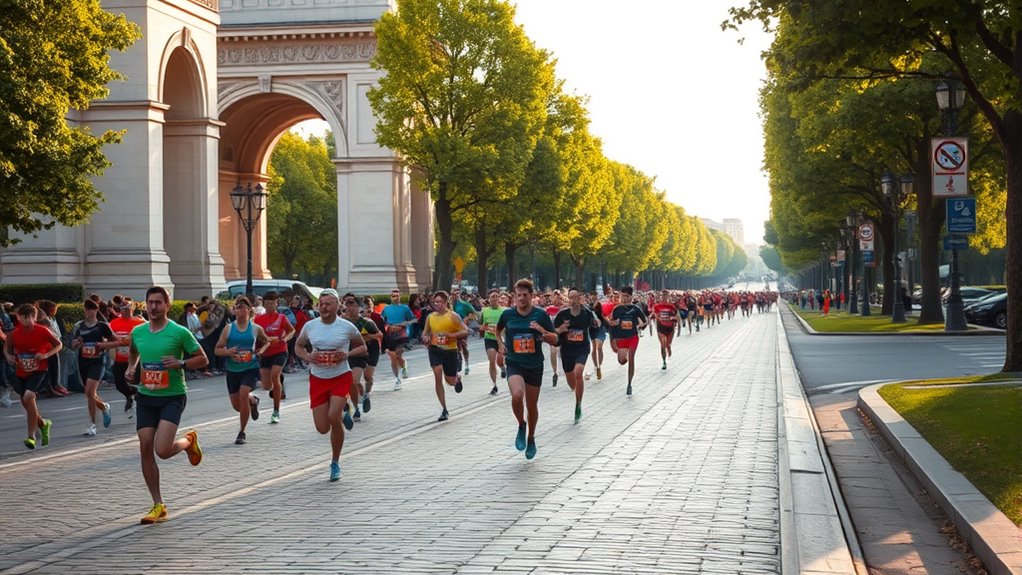

Starting your Paris Marathon on the lively Champs-Élysées, you’ll pass famous landmarks like the Arc de Triomphe before heading through the city center past Notre Dame and the Louvre. As you approach the scenic shift, you’ll enter the peaceful Bois de Boulogne, offering a revitalizing green escape and a mental boost. To discover more about this iconic route and tips for your run, keep exploring what lies ahead.
Key Takeaways
- The marathon starts on the iconic Champs-Élysées, energizing runners with views of shops, cafes, and the Arc de Triomphe.
- Participants pass through central Paris landmarks like Notre Dame and the Louvre, boosting morale along the route.
- The course transitions from urban streets to the peaceful green scenery of Bois de Boulogne.
- Supporters are encouraged to gather at key points like Champs-Élysées and the entrance to Bois de Boulogne.
- The route concludes at the Eiffel Tower, symbolizing achievement and providing a memorable finish.
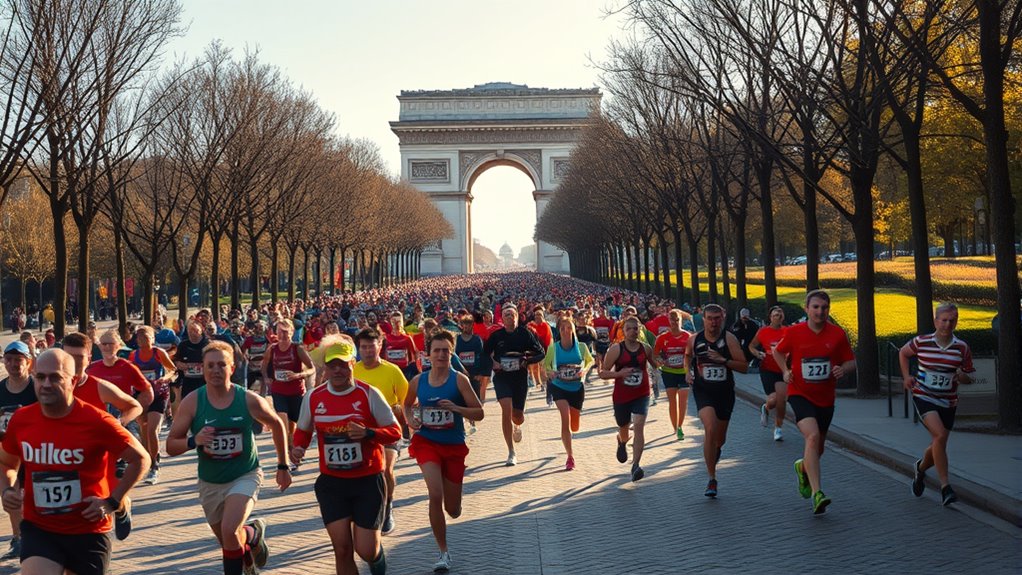
The Paris Marathon route takes you through some of the city’s most iconic landmarks, offering runners a scenic and historic course. As you prepare for race day, focusing on marathon training is essential to guarantee you’re ready for the demands of this challenging route. Your training should include long runs that mimic race pace, hill workouts, and recovery days to build endurance and avoid injury. Remember, consistent preparation pays off when faced with the varied terrain and scenic sections of this course. Knowing the route well during your training helps you mentally prepare for the sections where you’ll encounter crowds or need extra motivation, especially near the bustling city center. Incorporating system performance evaluation into your training routine can help you identify areas for improvement and optimize your endurance for race day.
Spectator tips are equally important if you plan to have friends or family cheering you on. The Paris Marathon attracts large crowds, so planning where to meet loved ones after crossing key landmarks can ease your race day stress. Encourage your supporters to stay at designated spots along the route, like around the Champs-Élysées or near the Eiffel Tower, where crowds are lively and supportive. Wearing a brightly colored or distinctive outfit can help your supporters spot you easily in the sea of runners. Communicate your route and meeting points beforehand to avoid confusion and make the most of their cheers and encouragement.
Plan meeting points at key landmarks like Champs-Élysées and Eiffel Tower for easy supporter spotting and stress-free race day.
Starting on the Champs-Élysées, you’ll feel a surge of excitement as you begin your journey amid the historic avenue lined with shops, cafes, and the Arc de Triomphe. The energy from spectators here is contagious, boosting your motivation during the early kilometers. As you head through the city’s heart, you’ll pass Notre Dame, the Louvre, and other renowned sites, each offering a stunning backdrop that keeps your spirits high. During your marathon training, simulate these sections by running through urban environments to get used to the sights, sounds, and the need for strategic hydration and fueling.
As you approach the Bois de Boulogne, the course shifts to a more peaceful, green setting. This part of the race can be a mental and physical challenge, so rely on your training to push through fatigue. Spectators often gather here, creating a lively atmosphere that can help you maintain your pace. Take advantage of this energy, and remember to stay hydrated and listen to your body. Crossing the finish line near the Eiffel Tower is a moment of triumph, made all the sweeter by the effort you put into your marathon training and the support you’ve received along the way.

AI TIDE Carbon Plate Marathon Running Racing Shoes Men Stable Support Shock-Relief Ultra-Light TPU Outsole Rebound Sneakers Size 10
【Breathable upper】The upper of the sneakers is spliced with multi-color flying-woven tatting materials to enhance air permeability and…
As an affiliate, we earn on qualifying purchases.
As an affiliate, we earn on qualifying purchases.
Frequently Asked Questions
What Is the History Behind the Paris Marathon?
You might find it fascinating that the Paris Marathon’s historical origins date back to 1976, inspired by the Boston and New York marathons. Over the years, it’s evolved from a small event into one of the world’s most popular marathons, attracting thousands of runners annually. The race’s route has also changed, showcasing Paris’s iconic sites, and it continues to grow, reflecting the city’s rich history and vibrant running community.
How Many Participants Typically Run the Paris Marathon?
You’ll find around 50,000 runners lining up for the Paris Marathon each year, a vibrant mosaic of ages, backgrounds, and motivations. The registration process feels like a bustling marketplace, where enthusiastic runners secure their spot amidst a sea of hopefuls. As you join this diverse crowd, you become part of a dynamic tapestry, united by your shared passion for crossing the iconic Parisian finish line.
Are There Any Notable Landmarks Along the Route?
You’ll pass many notable landmarks along the route, making your run truly scenic. Expect to see historic sites like the Arc de Triomphe, the Eiffel Tower, and Notre-Dame, giving you a glimpse of Paris’s rich history. The scenic views of the Seine River and the lush Bois de Boulogne add to the experience. These highlights keep you motivated, blending Paris’s beauty with your marathon challenge.
What Are the Race Day Weather Conditions Usually Like?
On race day, you’ll likely find the weather as unpredictable as a Parisian sky—sometimes bright and clear, other times drizzling like a gentle rain. Typically, temperatures hover around 10-15°C (50-59°F), making it ideal for running. Expect mild breezes and occasional clouds, but rare extremes. You’ll want to prepare for these typical weather patterns, so you can focus on your stride without weather worries.
How Does the Paris Marathon Support Local Charities?
You can support local charities through the Paris Marathon by participating in charity partnerships that raise funds for various causes. The race actively promotes community involvement, encouraging runners to run for charity and bring awareness to important issues. By doing so, you help foster a sense of solidarity and social impact, making your participation more meaningful beyond just the race itself. Your efforts directly contribute to positive change in the local community.

AiRunTech Hydration Running Belt with Water Bottle,Running Fanny Pack for Phone and Wallet Holder,Running Bag Runners Essentials Accessories Marathon Triathlon Walking Jogging Gear Gift
ANTI-SLIP TECHNOLOGY FOR ULTIMATE FIT AND FRICTION-FREE COMFORT : AiRunTech Upgraded run belt hook&loop tape's in place nicely…
As an affiliate, we earn on qualifying purchases.
As an affiliate, we earn on qualifying purchases.
Conclusion
So, as you sprint from the stunning Champs-Élysées to the serene Bois de Boulogne, savor every step of this spectacular stretch. Feel the fervor, embrace the energy, and relish the rich scenery that surrounds you. With every mile, you master the marathon’s magic, making memories that last. Keep moving, stay motivated, and marvel at the magnificent journey that takes you from fame to forest—your unforgettable Paris marathon adventure awaits!

Kivosliviz Running Gift Runner Gift Fitness Athlete Encouragement For Marathon Runner
💗Running Gift Runner Fitness Athleteencouragement Gift for Marathon Runner💗—-Whenever you find yourself doubting how far you can go…
As an affiliate, we earn on qualifying purchases.
As an affiliate, we earn on qualifying purchases.

The RunnerBox® by Fuel Goods – Best Running Gift Box for Women and Men, 10-12 Runner Essentials for Training, Recovery, and Race Day; Marathon Gifts
Thoughtfully curated runner gift box with 10–12 training, recovery, and race-day essentials
As an affiliate, we earn on qualifying purchases.
As an affiliate, we earn on qualifying purchases.