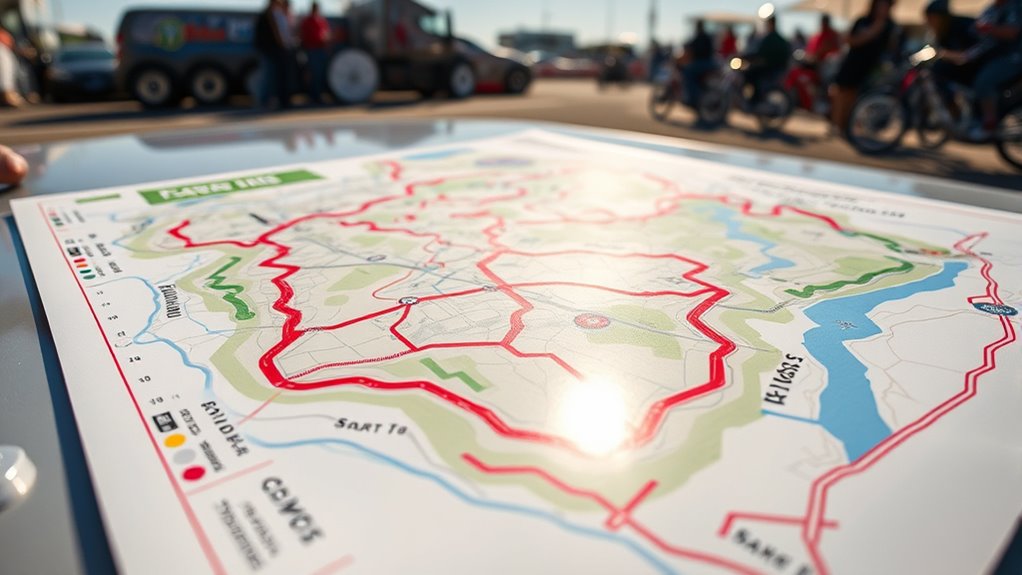

To interpret a race course map, start by identifying key features such as turns, straightaways, and elevation changes that influence your pace. Use the legend to understand symbols for zones like aid stations and hazards. Pay attention to contrast and color codes for clarity. Check the scale to estimate distances and the orientation to relate the map to actual terrain. Mastering these steps will help you plan effectively—keep exploring to learn even more about steering your course.
Key Takeaways
- Study the map legend to understand symbols, icons, and zone indicators for course features.
- Identify turns, straightaways, and elevation changes to plan pacing and strategy.
- Use contrast and visual cues to differentiate key features from background details clearly.
- Note the scale and orientation to estimate distances and relate them to race time.
- Visualize the entire course layout, including key zones, to prepare effectively for race day.
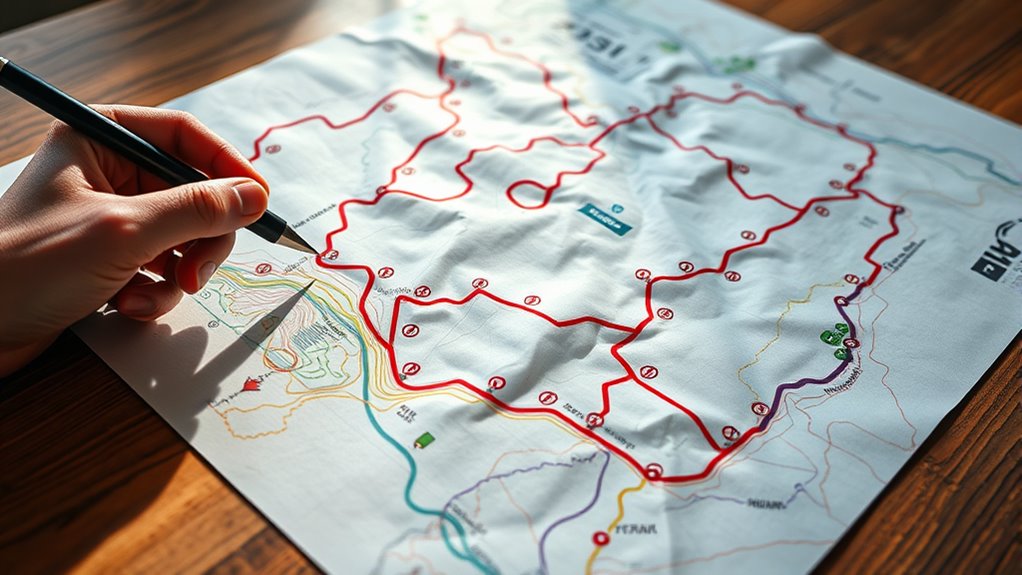
Understanding a race course map is essential for anyone looking to navigate or enjoy a race confidently. When you first look at the map, you’ll notice various symbols, lines, and colors designed to give you quick information about the course. To make sense of these, you need to focus on understanding race track features and mastering map legend interpretation. The race track features include turns, straightaways, elevation changes, and specific zones like pit stops or spectator areas. Recognizing these elements helps you plan your pacing and know what to expect at different points along the course. For example, sharp curves or steep inclines can slow you down, so spotting them early on allows you to prepare mentally and physically. Additionally, understanding the contrast ratio of the map’s visual elements can help differentiate between important features and background details, ensuring you interpret the map accurately. Map legend interpretation is key to decoding all the symbols and icons on the map. Legends are usually positioned at the side or bottom of the map and act as a key to understanding what each symbol represents. Common symbols might include arrows for direction, flags for start and finish lines, or icons indicating hydration stations and medical tents. When you interpret the legend correctly, you’ll quickly understand the layout of the racecourse, including aid stations, spectator zones, and any restricted areas. This knowledge can help you strategize your race plan and avoid surprises during the event. As you study the map, pay attention to the scale and orientation. The scale tells you how distances on the map relate to real-world distances, so you can estimate how long each segment of the course is. Orientation indicates which direction is north, helping you align your understanding with actual landmarks or terrain features. Combining this information with your knowledge of race track features allows you to visualize the entire course better, reducing potential confusion on race day. Furthermore, understanding the map’s symbols for elevation changes can be particularly helpful if you’re running a hilly course. Elevation icons often resemble contour lines or small mountain symbols, indicating climbs or descents. Knowing where these are located allows you to conserve energy or adjust your effort accordingly. When you take the time to interpret the map legend and identify key race track features, you gain a clearer picture of the racecourse. This preparation boosts your confidence, helps you pace yourself effectively, and ensures a smoother race experience from start to finish.
Frequently Asked Questions
What Symbols Are Used to Indicate Hazards on the Map?
You’ll notice hazard symbols or danger icons on the map that clearly mark potential risks. These symbols often include warning triangles, exclamation points, or specific icons like falling rocks or slippery surfaces. When you see these hazard symbols, stay alert and plan your route accordingly to avoid dangers. Recognizing these danger icons ensures you navigate safely, helping you stay aware of hazards and prevent accidents during your race.
How Do Elevation Changes Affect Race Strategy?
Elevation changes influence your race strategy by encouraging you to adjust your race pace on climbs and descents. You should conserve energy before steep sections, then push harder afterward. Keep an eye on hydration points near challenging hills, so you stay fueled and avoid fatigue. Proper planning helps you maintain a steady pace throughout the course, ensuring you stay strong and finish well, regardless of elevation shifts.
Are There Different Map Types for Various Race Disciplines?
Yes, different race disciplines use various map types to highlight race surface types and weather impact considerations. For example, trail maps emphasize terrain and elevation, while road race maps focus on surface quality and traffic zones. You should always check the map details for surface types like gravel, asphalt, or dirt, and consider weather impact considerations like potential flooding or slipperiness. This helps you plan your strategy effectively and stay safe during your race.
How Can I Identify the Start and Finish Lines?
Think of the start and finish lines as the heartbeat of race course navigation—they’re your guiding stars. To identify them, look for bold symbols, color-coded markers, or flagged areas on the map. The start line usually appears at the beginning of the course, while the finish line marks the end. Understanding race markers helps you stay on course, ensuring you hit every essential point without losing your way.
What Should I Look for Regarding Spectator Areas?
You should look for designated spectator zones and viewing points marked on the course map. These areas are usually near key turns, start/finish lines, or scenic spots. Keep an eye out for signs or symbols indicating accessible viewing points, seating, or standing zones. Choosing spots with good sightlines guarantees you get the best experience. Arrive early to secure a prime spot, and respect barriers and staff instructions to stay safe and enjoy the race.
Conclusion
By understanding how to read a race course map, you gain the confidence to navigate any course with ease. Remember, “a journey of a thousand miles begins with a single step.” With practice, you’ll spot key landmarks and plan your route like a pro. So, keep exploring maps and sharpening your skills—you’ll be race-ready in no time. Trust the process, and enjoy every stride toward your goal.