TL;DR

Get workout gear delivered free with Prime
- Fast, free delivery on millions of items
- Prime Video, Amazon Music and more included
- Member-only deals all year
Fit&Well published a three-exercise kettlebell routine designed to take about 10 minutes and challenge core stability at home. Certified kettlebell specialist Faith Ellis recommends starting with manageable weights, prioritizing form and increasing the load gradually; the source does not report trial results or measured strength gains.
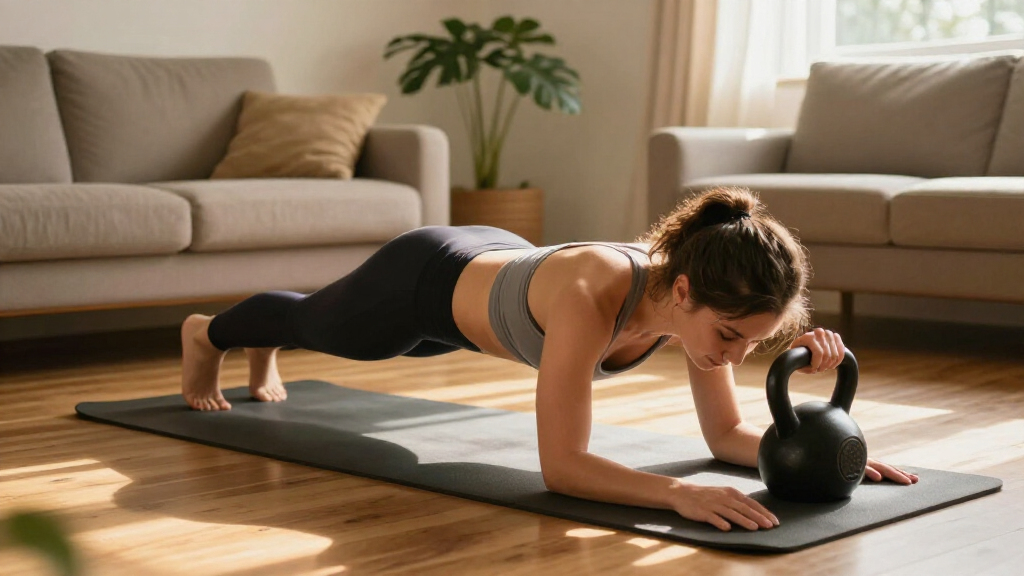
Fit&Well has published a three-move kettlebell workout intended to take about 10 minutes and help people train core stability at home. The routine, attributed to certified kettlebell specialist Faith Ellis, combines a half-kneeling halo, a single-arm suitcase carry and a dead bug with a kettlebell pullover; the source presents it as workout guidance, not as evidence from a clinical or training study.
The routine is prescribed for three sets of each exercise. For the half-kneeling halo, the instructions call for four circles in each direction on each side, starting with a 10-18 lb (4-8 kg) kettlebell. The exerciser kneels with one knee down, holds the bell at chest height by its horns and circles it around the head while keeping the hips square. The source says the movement works the obliques, shoulders, upper back and deep core.
Next is the single-arm suitcase carry: walk at a controlled pace for 30 seconds while holding a kettlebell at one side, then switch hands. Fit&Well suggests starting around 18-26 lb (8-12 kg) and identifies the obliques, transverse abdominis and posture stabilizers as target areas. The final move is a kettlebell dead bug with a pullover. Lying on the back, hold a light bell above the chest, bring the knees over the hips at 90 degrees, and alternate lowering one leg while moving the bell behind the head. The prescription is six to eight repetitions per side for three sets, starting at 10-18 lb (4-8 kg).
Ellis advises beginners to use a light-to-medium weight and focus on form, breathing and a neutral spine before increasing resistance. Her suggested progression is to add 4-8 lb (2-4 kg), increase repetitions or slow the movement once a set feels easy and can be completed with good form. The source does not specify rest periods or establish that every reader will finish the listed sets within 10 minutes.
A Short Routine for Home Training
The workout offers readers a compact, equipment-light option for adding resistance exercise at home. Its three movements combine a held load with controlled motion: the carries and halos ask the trunk to resist unwanted movement, while the dead bug pairs arm and leg motion with abdominal bracing. That makes the routine distinct from a sequence focused only on repeated trunk flexion.
For people who already own a kettlebell, the plan provides clear starting weights, repetitions and a progression suggestion. It may also help readers judge whether the routine fits their available time and equipment. However, the promised 10-minute duration is the article’s framing, not a measured result in the supplied material, and the listed three-set prescriptions may take different amounts of time depending on pace and rest.
The guidance is best understood as a workout recommendation, not proof that the routine produces a particular level of strength gain. The source gives no comparison with other exercises, no participant data and no measured outcomes. Results will depend on factors such as consistency, load, technique and each person’s starting point.
Products Worth Considering

BowFlex Results Series SelectTech Adjustable Dumbbells, Pair

Garmin Venu 3 Fitness Smartwatch, 45 mm, Black

LEVOIT Vital 200S-P Smart Air Purifier for Large Rooms
As an affiliate, we earn on qualifying purchases.
Ellis’s Core-Training Rationale
Ellis argues that kettlebells can combine strength, mobility and cardiovascular demands in one piece of equipment. She also describes their role in core training as more than simply bending the spine: carrying a weight on one side or moving a bell around the head can require the trunk to resist rotation and side bending. These are Ellis’s explanations for selecting the exercises, rather than findings independently tested in the source report.
The article positions the workout for people beginning home training or leaving a gym routine, and recommends starting conservatively. Its sequence includes one kneeling movement, a walking carry and a floor exercise, allowing different positions and patterns to be trained in one session. The instructions provide no substitute movements for people who cannot kneel, walk safely or lie on the floor.
“Kettlebell exercises require the core to stabilize and transmit force rather than just flex the spine.”
— Faith Ellis, certified kettlebell specialist and founder of The KettleBelle, as quoted by Fit&Well
Timing and Results Are Unverified
The supplied report does not state its publication date, describe a test of the workout or provide evidence that participants completed it in 10 minutes. It also does not report measured changes in core strength, define how long someone should follow the routine, or explain how much rest to take between sets. The 10-minute framing should therefore be treated as an estimate or editorial description, not a guaranteed duration or outcome.
The recommended weights are starting points from the article, not individualized assessments. Readers’ ability, equipment and health circumstances differ, and the source does not give modifications for pain, injury or restricted mobility. It is also not clear whether the three sets are intended to be performed consecutively for each move or as a circuit.
Use Form to Guide Progression
Fit&Well’s published guidance gives readers the exercise sequence and Ellis’s progression suggestions, but the supplied material announces no follow-up study, new program or scheduled update. Anyone trying the routine can begin with a manageable load, move under control and stop if an exercise causes pain. Increase resistance or repetitions only when the movements remain comfortable and technically sound; people with existing injuries or health conditions can seek advice from a qualified professional before starting.
Key Questions
What exercises are in the kettlebell routine?
It includes a half-kneeling kettlebell halo, a single-arm suitcase carry and a kettlebell dead bug with a pullover. Fit&Well prescribes three sets of each, with the repetition or time targets varying by movement.
Does the workout definitely take 10 minutes?
The report describes it as a 10-minute workout, but the supplied material provides no timed test or rest schedule. Actual session length may vary with pace, transitions and breaks.
What kettlebell weight should a beginner use?
Fit&Well suggests 10-18 lb (4-8 kg) for the halo and dead bug, and around 18-26 lb (8-12 kg) for the suitcase carry. These are general starting ranges from the report, not personalized prescriptions; choose a load that allows controlled movement and sound form.
How should someone progress the workout?
Ellis advises adding 4-8 lb (2-4 kg), increasing repetitions or slowing the reps only after a set feels easy and can be performed with good form. The source does not set a weekly progression timetable.
Is the routine suitable for everyone?
The article presents it as beginner-friendly, but it does not include adaptations for injuries, pain or mobility limitations. Stop if a movement causes pain, and consider professional guidance before starting if you have a pre-existing condition.
Source: fitandwell.com