A running watch with offline maps can help you follow routes without carrying your phone, but map access and running features vary widely. I name the COROS PACE Pro my best overall pick for runners who want a sport-focused watch with mapping, while the Garmin Enduro 3 stands out for long outings and the ANYMOVING M1PRO for runners seeking dual-band GPS and offline navigation. The main tradeoffs are route detail, battery life, ease of use, and whether a watch is built for training or general smartwatch use. Some models advertise offline maps, while others in this lineup may suit basic running better than map-led route guidance. Read on for the full breakdown and advice on choosing a watch that fits the way you run.

Get workout gear delivered free with Prime
- Fast, free delivery on millions of items
- Prime Video, Amazon Music and more included
- Member-only deals all year
Complete the kit


Key Takeaways
- Running-first design separates the strongest picks: the COROS PACE Pro and Garmin models are more compelling for structured training than general-purpose watches with large AMOLED screens.
- Battery needs change the shortlist: the Garmin Enduro 3 is the standout for long outings, while compact or display-focused watches may suit shorter runs and daily wear.
- Offline maps are not the same as route guidance: buyers should check whether a watch stores map data, follows an imported route, or offers turn prompts before relying on it away from home.
- Dual-band GPS can matter more than screen size: the ANYMOVING M1PRO and the dual-band military-style option target location tracking in challenging areas, but GPS claims alone do not establish map quality.
- Several models need feature verification before purchase: the Forerunner 165 listing does not identify offline maps, so runners prioritizing map use should confirm its capabilities rather than assume it matches the map-focused picks.
| Garmin Forerunner 165 Running Smartwatch, 43mm, Black |  | Best for Road Runners Who Don’t Need Offline Maps | Case size: 43 mm | Display: AMOLED touchscreen | Battery life: Up to 11 days in smartwatch mode; up to 19 hours in GPS mode | VIEW ON AMAZON | See Our Full Breakdown |
| Cubitt VIVA Pro 2 Smartwatch, 1.85” AMOLED HD, Built-In GPS, Offline Maps, Barometer, Compass, AI Coach, 100+ Sports Modes, 5ATM, 10-Day Battery – Obsidian Black |  | Best for Feature-Packed Offline Mapping | Display: 1.85-inch AMOLED HD | GPS: Built-in; supports five GNSS systems | Offline maps: Supported | VIEW ON AMAZON | See Our Full Breakdown |
| Garmin Enduro 3 Solar 51mm Sapphire Watch with Black UltraFit Nylon Strap |  | Best Premium Choice for Long-Distance Trail Running | Case size: 51 mm | Materials: Titanium bezel, sapphire lens, and UltraFit nylon strap | Weight: 63 g | VIEW ON AMAZON | See Our Full Breakdown |
| AGM Legion Pro Smart Watch with Offline Maps, AMOLED GPS, and Two Straps |  | Best Rugged Pick for Mixed Outdoor Use | Operating system: RTOS | Display: 1.43-inch AMOLED, 466 × 466 resolution, up to 600 nits, 60 Hz | GPS: Built-in; supports BeiDou, GLONASS, GPS, and Galileo | VIEW ON AMAZON | See Our Full Breakdown |
| Amazfit Active Max Smart Watch, 1.5″ AMOLED Display, GPS, iOS/Android |  | Best Battery-Life Balance for Everyday Training | Display: 1.5-inch AMOLED | Battery life: Up to 25 days | Storage: 4 GB | VIEW ON AMAZON | See Our Full Breakdown |
| Mibro GS Active2 GPS Running Smartwatch, 46mm, Dark Gray |  | Best for Structured Run Training | Case size: 46 mm | Weight: 39.9 g with woven strap | Display: 1.32-inch AMOLED touchscreen | VIEW ON AMAZON | See Our Full Breakdown |
| HAYLOU Watch Hyper GPS Smart Watch for Men and Women, 1.97″ AMOLED Display |  | Best for a Large, Readable Map Screen | Display: 1.97-inch AMOLED, 390 × 450 resolution | Display brightness: Up to 1,500 nits | GPS and maps: Built-in GPS with offline maps and route navigation | VIEW ON AMAZON | See Our Full Breakdown |
| ANYMOVING M1PRO Smart Watch, Dual-Band GPS & Offline Navigation |  | Best for Long GPS Sessions and Imported Maps | Display: 1.5-inch AMOLED HD | GPS: L1+L5 dual-band GPS | Satellite support: Five major satellite systems | VIEW ON AMAZON | See Our Full Breakdown |
| COROS PACE Pro GPS Sport Watch, 1.3-inch AMOLED Touchscreen, Grey |  | Best for Endurance GPS Performance | Display: 1.3-inch AMOLED touchscreen | Brightness: 1,500 nits | GPS: Dual-frequency GPS | VIEW ON AMAZON | See Our Full Breakdown |
| Smart Watch for Men with GPS, 1.46″ AI Smartwatch, Bluetooth Call/Text Reply |  | Best for Calls and Everyday Versatility | Display: 1.46-inch HD touchscreen | GPS: Multi-system GPS: GPS, GLONASS, Galileo, and QZSS | Battery: 550mAh | VIEW ON AMAZON | See Our Full Breakdown |
| Military Smartwatch with Dual-Band GPS, Offline Maps, and 1.43-Inch AMOLED Display |  | Best for Outdoor Navigation Tools | Display: 1.43-inch AMOLED, 466 × 466 pixels | GPS and maps: Dual-band L1+L5 GPS with offline maps | Navigation systems: BeiDou, GLONASS, GPS, Galileo | VIEW ON AMAZON | See Our Full Breakdown |
| Amazfit Active 3 Smart Watch, 1.32″ AMOLED, Sapphire Glass, GPS, iOS/Android Compatibility |  | Best for Everyday Running and Scratch Resistance | Display: 1.32-inch AMOLED | Glass: Sapphire | GPS and maps: Built-in GPS with offline map support | VIEW ON AMAZON | See Our Full Breakdown |
| Mibro AeroPace GPS Running Watch with Personalized Coaching and Offline Maps |  | Best Lightweight Pick for Runners | Weight and dimensions: 32 g with woven strap; 44 mm case diameter; 9.2 mm thick | Display: 1.32-inch AMOLED, 466 × 466 pixels, up to 2,000 nits, 60 fps | GPS and maps: Dual-band GNSS; free global vector maps with offline route following | VIEW ON AMAZON | See Our Full Breakdown |
| Amazfit Bip Max Smart Watch, 2.07″ AMOLED Display, GPS, iOS/Android Compatibility |  | Best for Large Map Readability and Long Daily Battery | Display: 2.07-inch AMOLED | GPS and maps: GPS with offline maps | Onboard storage: 4GB | VIEW ON AMAZON | See Our Full Breakdown |
| running watch with offline map | Display | Battery life | GPS | Water resistance |
|---|---|---|---|---|
| Garmin Forerunner 165 Running | AMOLED touchscreen | Up to 11 days in smartwatch mode; up to 19 hours in GPS mode | — | — |
| Cubitt VIVA Pro 2 Smartwatch | 1.85-inch AMOLED HD | Up to 10 days | Built-in; supports five GNSS systems | 5 ATM |
| Garmin Enduro 3 Solar 51mm Sap | — | Up to 90 days in smartwatch mode; up to 320 hours of GPS with solar charging | — | — |
| AGM Legion Pro Smart Watch wit | 1.43-inch AMOLED, 466 × 466 resolution, up to 600 nits, 60 Hz | — | Built-in; supports BeiDou, GLONASS, GPS, and Galileo | — |
| Amazfit Active Max Smart Watch | 1.5-inch AMOLED | Up to 25 days | Built-in; supports five satellite systems | Not specified |
| Mibro GS Active2 GPS Running S | 1.32-inch AMOLED touchscreen | Approximately 15 days daily mode; around 15 hours GPS mode | Dual-band, five-satellite dual-frequency positioning | 5 ATM |
| HAYLOU Watch Hyper GPS Smart W | 1.97-inch AMOLED, 390 × 450 resolution | Up to 12 days typical use; 24 days standby | — | 5ATM |
| ANYMOVING M1PRO Smart Watch | 1.5-inch AMOLED HD | Up to 15 days typical use; 32 hours GPS; 50 days standby | L1+L5 dual-band GPS | — |
| COROS PACE Pro GPS Sport Watch | 1.3-inch AMOLED touchscreen | 38 hours outdoor GPS; 20 days non-stop use | Dual-frequency GPS | — |
| Smart Watch for Men with GPS | 1.46-inch HD touchscreen | — | Multi-system GPS: GPS, GLONASS, Galileo, and QZSS | 5ATM |
| Military Smartwatch with Dual- | 1.43-inch AMOLED, 466 × 466 pixels | — | — | 10 ATM; product description also calls it splash-proof |
| Amazfit Active 3 Smart Watch | 1.32-inch AMOLED | Up to 12 days | — | — |
| Mibro AeroPace GPS Running Wat | 1.32-inch AMOLED, 466 × 466 pixels, up to 2,000 nits, 60 fps | — | — | 50 meters |
| Amazfit Bip Max Smart Watch | 2.07-inch AMOLED | Up to 20 days | — | — |
More Details on Our Top Picks
Garmin Forerunner 165 Running Smartwatch, 43mm, Black
The Forerunner 165 is the running-first choice here, with a light 43 mm case, built-in GPS, workout suggestions, and a bright AMOLED touchscreen. But the roundup is specifically about offline maps, and the supplied product details do not list map storage or offline navigation. That makes it a poor fit for runners who want routes on their wrist without a phone, even though it can record GPS activity. Compared with the Garmin Enduro 3, it gives up preloaded maps and extended outdoor navigation in favor of a simpler running and fitness package. Its up to 11 days of smartwatch battery and incident detection add everyday utility, while Garmin Pay availability varies by country and some safety features need a smartphone. I’d choose it for familiar routes, not remote trail guidance.
Pros:- Lightweight 43 mm design suits everyday running and all-day wear.
- AMOLED touchscreen makes workout and notification information easy to read.
- Up to 11 days of smartwatch battery life reduces charging frequency.
- Running suggestions, activity profiles, and wrist-based heart-rate tracking support routine training.
Cons:- Offline maps are not listed in the provided product details.
- Some safety features and notifications require a connected smartphone.
- Garmin Pay is available only in supported countries.
Best for: Road runners who want Garmin training tools and GPS workout tracking on familiar routes, and do not need offline maps.
Not ideal for: Trail runners or travelers who need downloaded maps and turn-by-turn guidance without relying on a phone.
- Case size:43 mm
- Display:AMOLED touchscreen
- Battery life:Up to 11 days in smartwatch mode; up to 19 hours in GPS mode
- Activity profiles:25+ including running, cycling, HIIT, and strength
- Safety:Incident detection and Assistance
- Payments:Garmin Pay contactless payments; country availability varies
Our verdict“Choose the Forerunner 165 for lightweight running features on known routes, but pick the Enduro 3 or another map-equipped model if offline navigation is a requirement.”
Cubitt VIVA Pro 2 Smartwatch, 1.85” AMOLED HD, Built-In GPS, Offline Maps, Barometer, Compass, AI Coach, 100+ Sports Modes, 5ATM, 10-Day Battery – Obsidian Black
The VIVA Pro 2 puts offline maps at the center of a broad smartwatch feature set: built-in GPS, support for five GNSS systems, a compass, and a barometer give route-focused runners more context than the Forerunner 165, whose supplied details don’t specify offline maps. Its large 1.85-inch AMOLED HD display should make map details and workout data easier to inspect, though the size may feel imposing on smaller wrists. The 10-day battery claim is solid for daily use, but trails with frequent GPS and map checks may call for more cautious expectations. Health tracking, AI coaching, and 100-plus sports modes add range beyond running. The tradeoff is setup: maps may need preparation in the companion app, and some smart features are limited to Android, so I’d check phone compatibility before choosing it.
Pros:- Offline maps work with built-in GPS and support for five GNSS systems.
- Large 1.85-inch AMOLED HD screen gives maps and workout data ample display space.
- Up to 10 days of battery life supports routine wear between charges.
- More than 100 sports modes and broad health tracking extend its use beyond running.
Cons:- Offline map setup may require extra preparation in the companion app.
- Some smart features are limited to Android, and iOS compatibility is not specified.
- The large display may be cumbersome for runners seeking a compact watch.
Best for: Runners and outdoor fitness users who want offline maps, multiple satellite systems, and a large screen, and who are comfortable setting up routes in an app.
Not ideal for: iPhone owners who depend on the listed smart features, or runners who prefer a compact watch and a simple map setup.
- Display:1.85-inch AMOLED HD
- GPS:Built-in; supports five GNSS systems
- Offline maps:Supported
- Battery life:Up to 10 days
- Water resistance:5 ATM
- Sports modes:100+
- Health monitoring:Heart rate, SpO₂, VO₂ Max, body temperature, stress, sleep, and menstrual cycle
- Connectivity:Bluetooth calling, offline music, smart notifications, and quick replies
Our verdict“Pick the VIVA Pro 2 if you want a large-screen offline-map watch with extensive fitness features and are willing to confirm phone compatibility and handle app-based setup.”
Garmin Enduro 3 Solar 51mm Sapphire Watch with Black UltraFit Nylon Strap
For runners who expect long stretches away from charging points, the Enduro 3 is the most purpose-built navigation option in this group. It includes preloaded TopoActive maps and dynamic routing, so it goes beyond the VIVA Pro 2’s stated offline-map support with a more explicitly trail-oriented package. Its up to 320 hours of GPS with solar charging and up to 90 days in smartwatch mode target endurance outings rather than ordinary daily runs; actual battery life depends on use and sunlight. The 51 mm case, sapphire lens, titanium bezel, and 63 g weight balance durability with a relatively light build, but the size and feature depth won’t suit everyone. Compared with the Forerunner 165, it is far more capable for remote routes, yet excessive for runners who mainly train on familiar streets.
Pros:- Preloaded TopoActive maps and dynamic routing support trail navigation without a phone-based map download.
- Solar-assisted GPS battery claim is suited to extended outdoor efforts.
- Sapphire lens and titanium bezel provide a durable build.
- Built-in LED flashlight adds practical visibility at camp or on dark routes.
Cons:- The 51 mm case may feel oversized for smaller wrists or everyday use.
- Advanced navigation and performance features can take time to learn.
- Solar charging and actual battery life depend on usage and environmental conditions.
Best for: Ultra-distance and trail runners who want preloaded topographic maps, dynamic routing, and extended GPS use for remote outings.
Not ideal for: Road runners seeking a compact, straightforward training watch, or casual users who have no need for advanced mapping and long-duration battery features.
- Case size:51 mm
- Materials:Titanium bezel, sapphire lens, and UltraFit nylon strap
- Weight:63 g
- Battery life:Up to 90 days in smartwatch mode; up to 320 hours of GPS with solar charging
- Maps:Preloaded TopoActive maps
- Routing:Dynamic routing
- Additional feature:Built-in LED flashlight
- Tracking:Outdoor performance tracking
Our verdict“Choose the Enduro 3 if remote-route mapping and long GPS outings justify its large, feature-rich design; for everyday road running, the Forerunner 165 is simpler.”
AGM Legion Pro Smart Watch with Offline Maps, AMOLED GPS, and Two Straps
The Legion Pro pairs offline maps with rugged construction, making it a better match for runners who also want a watch for rough outdoor activities. Its GPS supports BeiDou, GLONASS, GPS, and Galileo, while map downloads run through the AGM Nexus app; that app step means routes need preparation before heading out. The 1.43-inch AMOLED display is smaller than the Cubitt VIVA Pro 2’s 1.85-inch screen, which may make this a more manageable wrist presence but leaves less room for map detail. Its 5 ATM, IP68, and MIL-STD-810H ratings distinguish it from products whose supplied details don’t list comparable rugged credentials. Battery life is stated as up to nine days of use, with actual duration varying by use. I’d favor it over the Enduro 3 for a more general rugged smartwatch, not for maximum endurance or preloaded mapping.
Pros:- Offline maps are supported through the AGM Nexus app.
- GPS supports BeiDou, GLONASS, GPS, and Galileo.
- 5 ATM, IP68, and MIL-STD-810H ratings suit demanding outdoor use.
- Includes two bands and a high-resolution AMOLED display with touch and rotary crown controls.
Cons:- Offline maps require downloading through the companion app before a route.
- Up to nine days of use is a stated maximum, and usage affects actual battery life.
- Its RTOS platform may offer a different smart-feature experience from a fuller smartwatch operating system.
Best for: Outdoor users who want offline maps, multiple satellite systems, ruggedness ratings, and compatibility with either Android or iOS.
Not ideal for: Runners who want preloaded maps, very long GPS battery life, or a map experience that does not rely on a companion app.
- Operating system:RTOS
- Display:1.43-inch AMOLED, 466 × 466 resolution, up to 600 nits, 60 Hz
- GPS:Built-in; supports BeiDou, GLONASS, GPS, and Galileo
- Offline maps:Supported through the AGM Nexus app
- Durability:5 ATM, IP68, and MIL-STD-810H
- Battery:370 mAh; up to 9 days of use or 35 days standby
- Compatibility:Android 5+ and iOS 12+
- Included bands:Black and orange
Our verdict“Choose the Legion Pro for a rugged, multi-satellite watch with app-loaded offline maps, but select the Enduro 3 if preloaded topographic mapping and extended GPS runtime matter more.”
Amazfit Active Max Smart Watch, 1.5″ AMOLED Display, GPS, iOS/Android
The Active Max stands out for its claimed 25-day battery life, 4 GB of storage, and offline navigation, a combination that suits runners who want maps and music available without carrying a phone on every outing. It offers more workout modes than the Garmin Forerunner 165, but the supplied details provide less clarity about running-specific training tools and map functions than the Enduro 3’s preloaded TopoActive maps and dynamic routing. Its 1.5-inch AMOLED display gives map information useful space without reaching the VIVA Pro 2’s larger 1.85-inch screen. The key caveat is water protection: no rating is specified, so I would not choose it for swimming or wet-weather confidence without checking further product information. Message replies also require a Bluetooth connection to an Android phone, despite iOS and Android compatibility being listed.
Pros:- Offline navigation and 4 GB of storage support phone-free access to maps and music.
- Up to 25 days of stated battery life is the longest claim among these five products.
- Built-in GPS supports five satellite systems.
- More than 170 workout modes and personalized coaching cover varied training routines.
Cons:- No water-resistance rating is specified in the supplied product data.
- Message replies require a Bluetooth connection to an Android phone.
- The supplied details do not explain map features as clearly as the Enduro 3’s preloaded maps and dynamic routing.
Best for: Everyday runners who want offline navigation, onboard music storage, broad workout tracking, and a long stated battery life.
Not ideal for: Swimmers, frequent wet-weather runners, or buyers who need clearly documented water resistance and detailed map specifications.
- Display:1.5-inch AMOLED
- Battery life:Up to 25 days
- Storage:4 GB
- GPS:Built-in; supports five satellite systems
- Navigation:Offline navigation
- Workout modes:170+
- Compatibility:iOS and Android
- Water resistance:Not specified
Our verdict“Pick the Active Max for long stated battery life and phone-free map and music storage, but look elsewhere if water protection or detailed route guidance is a priority.”
Mibro GS Active2 GPS Running Smartwatch, 46mm, Dark Gray
The Mibro GS Active2 pairs route navigation with built-in plans spanning 5K through marathon distances, so it suits runners who want training guidance alongside offline-route capability. Its dual-band GPS and metrics such as cadence, stride length, and VO₂ max trends give it a more running-focused profile than the broader HAYLOU Watch Hyper. At 39.9 g with the woven strap, it is also a lighter everyday option than the larger ANYMOVING M1PRO. The tradeoff is endurance during recording: roughly 15 hours of GPS use is less suited to long outings than the M1PRO’s stated 32 hours or the COROS PACE Pro’s 38 hours of outdoor GPS. The supplied details mention route navigation but do not specify map-import steps or map storage, so buyers should confirm how offline maps are handled before relying on them away from a phone.
Pros:- Built-in plans cover distances from 5K to full marathon.
- Dual-band GPS and route navigation support outdoor run guidance.
- Tracks running metrics including cadence, stride length, and VO₂ max trends.
- Light 39.9 g build and 15-day daily-mode battery life suit regular wear.
Cons:- Around 15 hours of GPS battery life is shorter than the COROS PACE Pro and ANYMOVING M1PRO figures.
- The provided product details do not clarify offline-map import or storage.
- Not suitable for hot spring baths or hot showers.
Best for: Runners training for a 5K through marathon who want guided plans, detailed run metrics, and a light watch for daily wear.
Not ideal for: Ultrarunners or hikers planning long GPS-recorded outings, and buyers who need clearly documented offline-map storage and setup.
- Case size:46 mm
- Weight:39.9 g with woven strap
- Display:1.32-inch AMOLED touchscreen
- GPS:Dual-band, five-satellite dual-frequency positioning
- Battery life:Approximately 15 days daily mode; around 15 hours GPS mode
- Sports modes:150+
- Water resistance:5 ATM
- Storage:1 GB
Our verdict“Choose the GS Active2 for structured run training and a lightweight fit, but pick a longer-lasting model for extended GPS outings.”
HAYLOU Watch Hyper GPS Smart Watch for Men and Women, 1.97″ AMOLED Display
The HAYLOU Watch Hyper makes a case for runners who value glanceable route guidance: its 1.97-inch AMOLED display is much larger than the 1.3-inch screen on the COROS PACE Pro, and the stated 1,500-nit brightness should help with visibility outdoors. It also explicitly lists built-in GPS, offline maps, and route navigation, making its maps proposition clearer than the Mibro GS Active2’s supplied feature details. With more than 170 sports modes and up to 12 days of typical-use battery, it can cover general activity tracking as well as runs. The tradeoff is limited technical detail: the product information gives no GPS accuracy or update-rate figures and says little about app compatibility. Its large screen may also be less comfortable for smaller wrists and could draw more power at high brightness.
Pros:- Offline maps and route navigation are explicitly listed.
- Large 1.97-inch AMOLED display with stated brightness up to 1,500 nits.
- More than 170 sports modes cover activities beyond running.
- Up to 12 days of typical-use battery life and 5ATM water resistance.
Cons:- GPS accuracy and update frequency are not specified.
- App compatibility details are limited in the supplied product information.
- Large display and high brightness may be less comfortable or use more battery.
Best for: Runners who prioritize a large, bright screen for route guidance and want one watch for a wide range of activities.
Not ideal for: Small-wristed runners or buyers who need documented GPS accuracy, detailed phone-app compatibility, or strong map-specific specifications.
- Display:1.97-inch AMOLED, 390 × 450 resolution
- Display brightness:Up to 1,500 nits
- GPS and maps:Built-in GPS with offline maps and route navigation
- Sports modes:170+
- Battery life:Up to 12 days typical use; 24 days standby
- Water resistance:5ATM
Our verdict“Pick the Watch Hyper if screen size and clearly stated offline maps matter more than detailed GPS performance data.”
ANYMOVING M1PRO Smart Watch, Dual-Band GPS & Offline Navigation
The ANYMOVING M1PRO is the most explicitly map-oriented pick here: it supports offline map import and pairs that with L1+L5 dual-band GPS across five major satellite systems. Its stated 32 hours of GPS battery life gives it more headroom for long routes than the Mibro GS Active2, while its 15-day typical-use claim is competitive for daily wear. The 1.5-inch AMOLED screen, music storage, and voice memo add useful extras for outdoor sessions. That breadth comes with a learning curve: map importing and the AI fitness features may be more involved than a simpler running watch, and smartphone compatibility details are limited. Its larger build may also be a poor fit for smaller wrists. Compared with the COROS PACE Pro, it offers a more clearly stated offline-map import feature, while COROS provides a longer listed GPS runtime.
Pros:- Offline map import is explicitly supported.
- L1+L5 dual-band GPS and five satellite systems support positioning across outdoor routes.
- Stated 32-hour GPS runtime suits longer sessions better than the Mibro GS Active2.
- Includes music storage, voice memo, and health tracking alongside 170+ sports modes.
Cons:- Large size may not fit smaller wrists comfortably.
- Smartphone compatibility details are limited.
- The combination of map import and advanced features may take time to learn.
Best for: Runners and outdoor users who want to load maps for offline route use and record long GPS sessions without frequent charging.
Not ideal for: Buyers with smaller wrists, those wanting a simple running interface, or anyone who needs clear phone-compatibility details before purchase.
- Display:1.5-inch AMOLED HD
- GPS:L1+L5 dual-band GPS
- Satellite support:Five major satellite systems
- Offline navigation:Offline map import
- Battery life:Up to 15 days typical use; 32 hours GPS; 50 days standby
- Sports modes:170+
- Health monitoring:Heart rate, stress, and sleep
- Music storage:Yes
Our verdict“Choose the M1PRO for imported offline maps and extended GPS recording, provided its size and feature complexity suit you.”
COROS PACE Pro GPS Sport Watch, 1.3-inch AMOLED Touchscreen, Grey
The COROS PACE Pro is the strongest fit in this group for runners who put GPS runtime and route planning ahead of smartwatch extras. Its stated 38 hours of outdoor GPS exceeds the ANYMOVING M1PRO’s 32-hour figure and is far beyond the Mibro GS Active2’s roughly 15 hours, giving longer efforts more recording margin. Dual-frequency GPS, customizable route planning, and a bright 1.3-inch AMOLED touchscreen make it a focused sports watch rather than a general-purpose notification hub. The compromise is that the supplied details do not explicitly confirm offline map storage or map import, unlike the M1PRO and HAYLOU Watch Hyper, so route planning should not be assumed to mean downloadable maps. It also has fewer everyday smart features than the Bluetooth-calling model in this roundup.
Pros:- 38 hours of stated outdoor GPS runtime is the longest among these five products.
- Dual-frequency GPS supports accurate route tracking.
- Customizable route planning suits runners who want to plan outings.
- 1,500-nit AMOLED display and USB-C charging.
Cons:- The supplied product details do not confirm offline map storage or import.
- Smartwatch features beyond fitness tracking are limited.
- Its 1.3-inch screen is smaller than the HAYLOU Watch Hyper’s map-friendly display.
Best for: Endurance runners who prioritize long GPS recording, dual-frequency positioning, and customizable routes over broad smartwatch functions.
Not ideal for: Buyers who require explicitly documented offline map downloads, Bluetooth calling, or a large map display.
- Display:1.3-inch AMOLED touchscreen
- Brightness:1,500 nits
- GPS:Dual-frequency GPS
- Battery life:38 hours outdoor GPS; 20 days non-stop use
- Wrist size:130–220 mm
- Band width:22 mm
- Charging:USB-C
Our verdict“Choose the PACE Pro for long GPS sessions and sports-focused route planning, but verify offline-map support if downloaded maps are a requirement.”
Smart Watch for Men with GPS, 1.46″ AI Smartwatch, Bluetooth Call/Text Reply
This GPS smartwatch is the most everyday-oriented choice here: it combines offline maps with Bluetooth calling, text replies, health tracking, and two interchangeable straps. That makes it more versatile for someone moving between workouts and daily wear than the sports-focused COROS PACE Pro, though the COROS lists much more specific GPS runtime data. The watch supports four satellite systems and more than 100 sports modes, but its map description is thin: no map detail level or navigation workflow is provided. The 550mAh battery is specified without a runtime figure, so buyers cannot compare its GPS endurance directly with the M1PRO’s 32 hours or the Mibro GS Active2’s roughly 15. Its feature mix may suit people who want calls and translation, but could feel cluttered for runners seeking a straightforward training interface.
Pros:- Offline maps are listed alongside multi-system GPS.
- Bluetooth calling and text replies add everyday utility beyond the COROS PACE Pro’s fitness focus.
- Includes genuine leather and silicone straps for different settings.
- 5ATM water resistance and more than 100 sports modes support varied activity.
Cons:- Offline-map detail and navigation behavior are not specified.
- Battery capacity is given, but no usage or GPS runtime is provided.
- A broad feature set may take time to learn and may distract runners seeking a simpler training watch.
Best for: Runners who also want wrist-based calls, text replies, health tracking, and interchangeable straps for everyday use.
Not ideal for: Map-focused trail runners who need detailed offline-map specifications or endurance athletes who require a stated GPS battery runtime.
- Display:1.46-inch HD touchscreen
- GPS:Multi-system GPS: GPS, GLONASS, Galileo, and QZSS
- Battery:550mAh
- Water resistance:5ATM
- Sports modes:100+
- Compatibility:iOS 9.0+ and Android 5.0+
- Straps:Genuine leather and silicone
- Listed features:Bluetooth calling, offline maps, health monitoring, and AI translation
Our verdict“Pick this model if calls and daily versatility matter as much as offline maps, but choose a sports-focused watch for clearer GPS endurance data.”
Military Smartwatch with Dual-Band GPS, Offline Maps, and 1.43-Inch AMOLED Display
I’d choose this model when offline maps are only one part of an outdoor-focused toolkit. Its dual-band L1+L5 GPS works without a phone, while the compass, altimeter, barometer, waypoint return, and weather alerts add useful context for route finding. The built-in flashlight is another practical extra that the more running-focused Mibro AeroPace doesn’t list. Its 1.43-inch AMOLED display is also larger than the Amazfit Active 3’s, which may make map details easier to read at a glance. The tradeoff is a less clearly documented specification set: Android compatibility differs across the supplied details, and the 7–10-day battery claim depends on use with Bluetooth calling enabled. I’d pick it for varied outdoor outings, not for buyers who want the clearest software and compatibility documentation.
Pros:- Standalone dual-band GPS and offline maps support phone-free route tracking.
- Compass, altimeter, barometer, weather alerts, and waypoint return broaden its outdoor navigation toolkit.
- Large 1.43-inch AMOLED display offers more screen area than the Amazfit Active 3.
- Includes Bluetooth calling, health tracking, and a built-in LED flashlight.
Cons:- Android compatibility is listed inconsistently across the supplied product details.
- The 7–10-day daily-use estimate depends on use, and GPS workout battery duration is not specified.
- Health metrics are for fitness reference, not medical diagnosis.
Best for: Runners and hikers who want offline route guidance plus a compass, barometer, altimeter, and waypoint return features on the watch.
Not ideal for: Buyers who need unambiguous Android compatibility details or want battery life stated for a specific GPS workout schedule.
- Display:1.43-inch AMOLED, 466 × 466 pixels
- GPS and maps:Dual-band L1+L5 GPS with offline maps
- Navigation systems:BeiDou, GLONASS, GPS, Galileo
- Battery:550 mAh; up to 7–10 days daily use with Bluetooth calling; up to 60 days standby
- Water resistance:10 ATM; product description also calls it splash-proof
- Case materials:Aluminum alloy bezel and composite body; product details also list stainless steel
- Connectivity:Bluetooth 5.3; iOS 9.0+ and Android compatibility listed, with conflicting Android minimum versions
- Health and sports:Heart rate, SpO2, stress, HRV, sleep, and 178+ sports modes
Our verdict“Choose this watch if you want offline maps backed by a broad set of outdoor tools, and skip it if you need clearer compatibility and GPS battery-life details.”
Amazfit Active 3 Smart Watch, 1.32″ AMOLED, Sapphire Glass, GPS, iOS/Android Compatibility
The Amazfit Active 3 makes the most sense for runners who want offline maps in a daily-wear smartwatch rather than a watch centered on rugged expedition extras. Its sapphire glass gives the display a more scratch-resistant surface than the listed Corning Gorilla Glass on the Mibro AeroPace, while the stated up-to-12-day battery life tops the AeroPace’s eight-day daily-use claim. The 1.32-inch screen is smaller than the Military Smartwatch’s 1.43-inch display, so it gives up some viewing area for a more compact presentation. Amazfit also includes structured training and personalized coaching, but the supplied information doesn’t spell out map controls or GPS workout runtime. I’d favor it for routine training and day-to-day wear; buyers who need detailed navigation-tool specifications or broad app support should verify those points first.
Pros:- Offline-map GPS support is paired with structured training and personalized coaching.
- Sapphire glass offers a scratch-resistant display surface.
- Up to 12 days of stated battery life exceeds the Mibro AeroPace’s daily-use estimate.
- Tracks heart rate, blood oxygen, stress, and sleep, with Bluetooth calling.
Cons:- The 1.32-inch screen is smaller than the Military Smartwatch’s 1.43-inch display.
- The supplied details do not specify GPS workout battery life or map-navigation controls.
- Voice replies are limited to Android; iOS is listed for calls, and third-party app support is not specified.
Best for: Runners who want offline maps, structured training, and a durable sapphire-covered display in a watch for everyday wear.
Not ideal for: Runners who need detailed documentation of route-navigation controls, GPS workout endurance, or third-party app support before buying.
- Display:1.32-inch AMOLED
- Glass:Sapphire
- GPS and maps:Built-in GPS with offline map support
- Battery life:Up to 12 days
- Compatibility:iOS and Android
- Health monitoring:Heart rate, blood oxygen, stress, and sleep
- Connectivity:Bluetooth calls and Zepp app
- Training:Structured training and personalized coaching
Our verdict“Pick the Active 3 for sapphire protection and longer stated daily-use battery life, but look elsewhere if you need fully documented navigation and app details.”
Mibro AeroPace GPS Running Watch with Personalized Coaching and Offline Maps
For runners who care about watch weight as much as route guidance, the AeroPace stands out: it weighs 32 g with the woven strap and includes both woven and silicone bands. Its dual-band, five-system GPS and free global vector maps support offline route following, while the 2,000-nit AMOLED display is specified for bright conditions. Compared with the Amazfit Active 3, the AeroPace gives more concrete detail about satellite systems, display brightness, and GPS modes; the Active 3 counters with a longer stated daily-use battery life. The AeroPace’s up-to-eight-day daily-use figure doesn’t tell the whole story for long runs: GPS Performance Mode is listed for up to 12 hours. Personalized plans also require a subscription after the 30-day trial, so I’d choose it for its light running-first design, not for subscription-free coaching.
Pros:- Light 32 g build includes both woven and silicone straps.
- Dual-band, five-system GNSS and free global vector maps support offline route following.
- AMOLED display is specified at 2,000 nits and 60 fps.
- Tracks running metrics, heart rate, recovery, sleep, and training load.
Cons:- GPS Performance Mode is listed for up to 12 hours, shorter than its daily-use battery estimate might suggest.
- Mibro Coach requires a subscription after the 30-day free trial.
- The supplied satellite-system list names four systems despite describing the GPS as five-system GNSS.
Best for: Road and trail runners seeking a light watch with detailed offline route guidance, dual-band GPS, and included strap options.
Not ideal for: Runners who regularly spend longer than the stated 12-hour GPS Performance Mode limit on route-tracked outings, or who want ongoing coaching without a subscription.
- Weight and dimensions:32 g with woven strap; 44 mm case diameter; 9.2 mm thick
- Display:1.32-inch AMOLED, 466 × 466 pixels, up to 2,000 nits, 60 fps
- GPS and maps:Dual-band GNSS; free global vector maps with offline route following
- Satellite systems:BeiDou, GLONASS, GPS, and Galileo listed
- Battery:230 mAh; up to 8 days daily use; GPS Performance Mode up to 12 hours, Smart Mode up to 15 hours, Low-Power Mode up to 20 hours
- Water resistance:50 meters
- Case and bands:Glass fiber reinforced nylon case; woven and silicone straps included
- Training:Personalized plans of 4–20 weeks; 30-day Mibro Coach trial followed by a subscription
Our verdict“Choose the AeroPace for a lightweight, running-focused design with well-detailed offline navigation, provided its GPS runtime and coaching terms fit your routine.”
Amazfit Bip Max Smart Watch, 2.07″ AMOLED Display, GPS, iOS/Android Compatibility
The Bip Max is the clearest fit for buyers who want a large screen and long daily-use battery claim more than a compact running-watch shape. Its 2.07-inch AMOLED display is much larger than the 1.32-inch Amazfit Active 3 screen, giving map views and workout information more room. It also lists 4GB of onboard storage for offline maps and media, plus up to 20 days of battery life. Those headline figures are appealing, but the supplied details don’t explain map features, GPS battery life, or water resistance. That makes this a less certain choice for regular route-tracked runs than the Mibro AeroPace, which specifies GPS modes and offline route following. I’d shortlist the Bip Max for casual fitness and everyday wear, but seek clearer specifications before relying on it for wet or long-distance training.
Pros:- Large 2.07-inch AMOLED display offers more screen area than the Amazfit Active 3.
- 4GB of onboard storage is specified for offline maps and media.
- Up to 20 days of stated battery life is the longest daily-use claim among these four options.
- Supports GPS, 150+ sports modes, and iOS and Android compatibility.
Cons:- The supplied details do not state a water-resistance rating.
- GPS workout battery life and offline-map navigation functions are not described in detail.
- Limited specification detail makes it harder to judge suitability for demanding running and navigation.
Best for: Everyday fitness users who prefer a large map-friendly display, onboard storage, and a long stated interval between charges.
Not ideal for: Dedicated runners who need a documented water-resistance rating, GPS workout runtime, or detailed offline route-guidance features.
- Display:2.07-inch AMOLED
- GPS and maps:GPS with offline maps
- Onboard storage:4GB
- Battery life:Up to 20 days
- Compatibility:iOS and Android
- Sports modes:150+
- Materials:Lightweight aluminum alloy
- Health and fitness:Health monitoring and fitness tracking
Our verdict“Choose the Bip Max if you prioritize a large display and long stated daily-use battery life, but favor the AeroPace if documented running-navigation details matter more.”
How We Picked
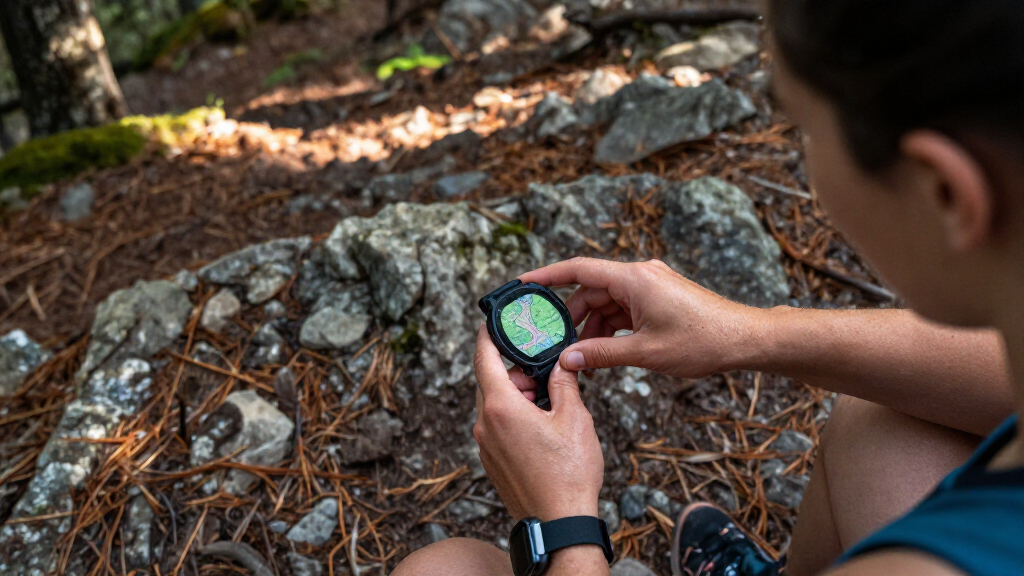
I compared these watches around the needs behind the search: carrying and following routes offline, recording runs, and making route decisions without depending on a phone connection. Ranking factors included whether offline maps are explicitly identified in the product name or description, the presence of GPS and navigation-oriented hardware, battery and display considerations, and whether the watch is positioned for sport training or broader smartwatch use. I gave more weight to clear route-focused claims and running-oriented design than to a large screen or a long list of general features.
The order reflects how directly each option appears to serve runners who want offline maps, not a claim that every model provides the same map detail or guidance. Where a listing does not clearly identify offline mapping, I treat that as a limitation rather than assume the feature is present. I also considered practical fit: a rugged, long-battery watch may suit extended routes better than a compact everyday model, while an entry-level runner may value straightforward GPS and training basics over advanced navigation. Buyers should confirm map coverage, route import steps, and phone compatibility with the manufacturer before purchase.
Factors to Consider When Choosing Running Watch With Offline Maps
Choosing a watch for offline routes takes more than spotting the words “offline maps” in a listing. I would check how maps are stored and used, then weigh that against the kind of runs you do, how long you are away, and how much training data you want. These checks can prevent paying for features that do not solve your route problem.
Check What “Offline Maps” Actually Means
Offline map support can refer to a full map on the watch, a saved route line, or turn-by-turn prompts, and those are not interchangeable. A route breadcrumb may be enough for a familiar trail, but junctions and detours are easier to handle when the display gives useful surrounding context. Look for instructions on downloading map regions, importing routes, and updating map files before you buy. Also check whether navigation works with the watch disconnected from your phone, not merely whether it can record GPS without a connection. A common mistake is treating “GPS” as proof of offline maps; GPS locates you, while map data and route guidance are separate functions. If the listing is vague, ask the maker for the exact offline workflow.
Match Route Guidance to the Places You Run
Runners on marked paths may need little more than a saved course and a clear indication when they drift off route. City runners often benefit from readable street context and reliable prompts at frequent turns, while trail runners may prioritize landmarks, elevation context, and the ability to retrace a route. Consider the map’s level of detail in your usual area rather than relying on a broad claim about global coverage. Dual-band GPS can help location tracking in difficult environments such as dense urban blocks or tree cover, but it does not by itself make a map more detailed. Check whether route planning happens on the watch or in a companion app, since that changes how much preparation is needed. Choose navigation that fits your terrain, not the longest feature list.
Treat Battery Life as a Navigation Requirement
GPS use, bright displays, and frequent map checks can drain a watch faster than basic timekeeping, so headline battery figures may not reflect a long mapped run. Check for separate estimates for GPS activity and for features such as always-on display or dual-band tracking. If you run ultras, take long trail days, or use navigation across several days, prioritize activity endurance over a large, vivid screen. For short daily runs, charging more often may be an acceptable trade for a display that is easier to read at a glance. A useful habit is to leave a reserve for unexpected route changes instead of planning to finish at the stated maximum. When manufacturers do not explain how their battery estimates were measured, treat them as a guide rather than a guarantee.
Balance Screen Readability Against Size and Comfort
A map is only useful if you can read it while moving, but a bigger display can add bulk and feel less comfortable during everyday wear. AMOLED screens can make color and contrast stand out, while a smaller or simpler screen may be easier to live with during long training blocks. Think about whether you need to inspect the map frequently or mainly glance at a route cue at intersections. Button controls can be easier to operate with sweaty hands or gloves than touch-only interaction, particularly in rain or on rough trails. Try to judge case dimensions and strap style alongside screen size, since fit affects whether you will wear the watch consistently. Avoid choosing by display specifications alone if the watch is intended for long runs.
Separate Training Tools From General Smartwatch Extras
Offline maps solve route-following, but a running watch may also need reliable activity records, training metrics, and controls that are easy to use mid-run. A sport-focused model can make workout setup and run data more central, while a general smartwatch may put calls, notifications, or broad activity modes first. Decide which features you will use every week rather than letting a long sports-mode list drive the choice. If you follow a training plan, check what workout guidance and run metrics are included, and whether any depend on an app or subscription. Runners who mainly want to explore routes can prioritize mapping and battery over advanced coaching. That distinction can keep you from paying in complexity for features that do not support your goals.
Verify Phone, Map, and Route Compatibility
Offline use does not eliminate setup: many watches still rely on a phone app to download maps, create routes, or sync activities. Confirm that the companion app supports your phone and that you can export or import routes from the services you already use. Check whether maps are free, whether map regions are limited, and how much storage is available for route data. It is also worth confirming whether a saved map remains available after a software update or a phone change. Buyers often focus on the watch itself and discover later that the route workflow does not match their habits. A short compatibility check before buying can matter more than another sensor or sport mode.
Frequently Asked Questions
Does the Garmin Forerunner 165 have offline maps?
The product name provided for the Forerunner 165 does not identify offline maps, so I would not choose it on the assumption that it offers the same map functions as models explicitly described with offline navigation. GPS tracking and offline map storage are different capabilities. Check Garmin’s current feature list for the exact model and software version, and verify whether it supports map downloads or only route guidance. If offline maps are your main reason for buying, a clearly map-focused listing is the safer starting point.
Is a watch with GPS enough to follow a route without my phone?
No. GPS can record your position without a phone connection, but the watch also needs locally stored map or route data to show where you are going. Some watches display a saved route as a line without showing nearby streets or trails, while others provide more map context or turn prompts. Check the product details for offline map storage, route import, and navigation behavior separately. If you run in unfamiliar areas, a route line alone may not give enough context when you need to change course.
Should I choose dual-band GPS or a watch with a larger map display?
Choose based on the problem you face most often. Dual-band GPS is aimed at improving position tracking in places where signals can be obstructed or reflected, such as dense city streets or wooded routes. A larger display can make map information easier to inspect, but it does not guarantee stronger location accuracy or better route data. Neither feature replaces checking the watch’s offline map detail and guidance options. For many runners, reliable positioning and a readable route view matter together, so assess both against your usual terrain.
Can I rely on offline maps for a long trail run if the battery estimate looks sufficient?
Do not base a long outing on a general battery figure alone. GPS tracking, active navigation, frequent screen checks, and bright display settings can reduce runtime compared with basic smartwatch use. Look for activity-specific battery estimates and check whether they apply to the GPS mode you plan to use. Leave a reserve for slower progress, detours, or a longer return than expected, and carry a backup navigation method for remote routes. The Enduro 3 is the lineup’s clearest long-outing pick, but its suitability still depends on your settings and route length.
What should I check before buying a watch that advertises offline maps?
Confirm how to download maps, whether you can save the areas you run in, and whether the watch can follow routes without a phone connection. Check if the feature is a full map, a breadcrumb line, or turn prompts, then look for route import support and any app requirements. Verify map availability for your region and whether downloads or updates have limits. It is also sensible to confirm compatibility with your phone and the route services you already use. If the manufacturer’s description does not answer these points, treat the feature claim as unverified before making a decision.
Conclusion
For most runners seeking a sport-focused option with offline mapping, I would start with the COROS PACE Pro as best overall, then verify that its map workflow suits the routes you run. The Garmin Enduro 3 is my best premium pick for extended outings where battery endurance and a rugged build matter more than compact size. For a best value starting point, compare the Cubitt VIVA Pro 2 and Mibro GS Active2, but confirm the exact map and route features before relying on either for navigation. The best choice for beginners is the simplest watch that offers the offline route guidance they need; the Forerunner 165 may suit basic running, but its supplied listing does not establish offline maps. For runners focused on dual-band GPS and offline navigation, the ANYMOVING M1PRO is a distinct option to investigate. My final check for every buyer: confirm map coverage, route handling, and phone-app compatibility before choosing.