
TL;DR

Get workout gear delivered free — and shop member deals
- Fast, free delivery on millions of items
- Access to Prime Big Deal Days deals on October 6–7
- Prime Video, Amazon Music and more included
A Fit&Well report presents an equipment-free barre routine recommended by instructor Lotty Campbell Bird, who says bodyweight resistance can make the workout challenging. The six exercises target the legs, glutes and core and take about 15 to 20 minutes once through; the report does not provide research comparing barre with other strength workouts.
Fit&Well has published a six-exercise, equipment-free barre workout that instructor Lotty Campbell Bird says can challenge muscles using bodyweight resistance. The routine takes about 15 to 20 minutes when completed once, offering readers a short home workout that does not require weights, bands or a ballet barre.
The routine combines standing and floor-based exercises: curtsy lunges, wide second-position pliés, single-leg lifts on all fours, slow-motion mountain climbers, tabletop toe taps and alternating leg extensions. The prescribed repetitions vary by move, with several exercises performed on both sides. Some also include short holds or pulses.
Campbell Bird, identified in the report as an instructor and founder of Collective Fitness, says the method relies on controlled movement rather than momentum. She describes barre as drawing on ballet positions while being, in practice, more similar to Pilates. Her comments are expert guidance reported by Fit&Well, not findings from a study included in the source.
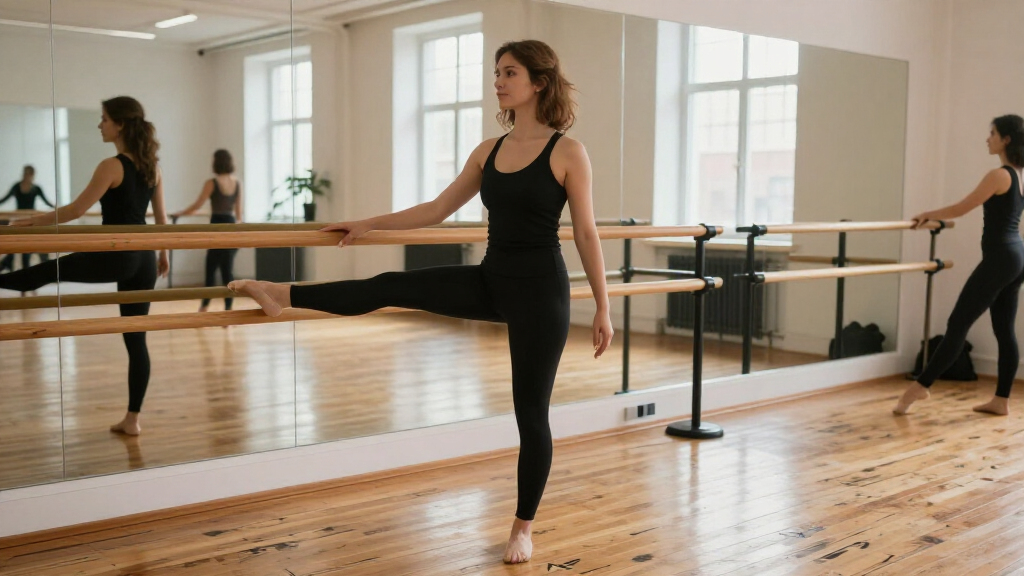
For support with balance, the routine can be done near a sturdy chair, kitchen worktop or wall, Campbell Bird says; a ballet barre is not required. Fit&Well suggests completing the sequence once for a 15-to-20-minute session, or repeating it two or three times for a longer workout. The source does not specify rest periods or present an individualized training plan.
A Short Routine With No Gear
The routine may be useful to readers who want to try strength-focused movement at home without buying equipment or arranging access to a gym. Its mix of standing leg work and floor exercises gives the session a clear structure, while the suggested household support can help with balance. These practical features make it easier to try, but do not establish that barre is better than other ways of training.
Campbell Bird’s central point is that resistance does not have to come from external weights: bodyweight exercises can provide a challenge when performed with control. The report offers that as an instructor’s assessment, not as a guarantee of strength gains for every participant. Results can depend on factors such as a person’s starting fitness, technique, consistency and how the exercises are progressed over time.
The short format also gives readers a concrete starting point rather than a general recommendation to exercise. However, the article does not give a progression schedule, specify how often to repeat the workout, or explain how to adjust every movement for different abilities. Those details matter for anyone looking to build a sustained program rather than try a single session.
As an affiliate, we earn on qualifying purchases.
How Barre Uses Bodyweight
Fit&Well’s report describes barre as inspired by ballet principles and positions, while Campbell Bird says it has more in common with Pilates in practice. The workout shown is not a dance sequence: it consists of controlled lunges, pliés, leg lifts, plank-based movement and core exercises performed on the floor.
The report frames the routine as an option for people who may be starting out and assume strength training requires weights. It gives instructions and repetition ranges for six exercises, but the source material does not cite a clinical trial, comparative study or independent assessment of barre’s effects. Its characterization as one of the best workouts is part of the source’s framing and the instructor’s recommendation, rather than a measured ranking established by the material provided.
“Barre is one of my favourite ways to build strength because it uses your own bodyweight for resistance.”
— Lotty Campbell Bird, instructor and founder of Collective Fitness, as quoted by Fit&Well
What the Report Does Not Establish
The source does not provide research showing that barre is among the best workouts for building strength, nor does it compare barre with weight training, Pilates or other bodyweight routines. It also does not report measured outcomes from people who completed this particular sequence. The claim about strength-building should therefore be read as the instructor’s view, not a proven ranking or a guaranteed result.
It is also unclear how frequently readers should do the routine, how to increase its difficulty over time, or what modifications are suitable for people with injuries or health conditions. Fit&Well’s supplied instructions describe movements and repetitions but do not offer individualized advice. Anyone with a pre-existing condition, pain or uncertainty about exercise suitability can seek guidance from a qualified health professional or exercise instructor, and should stop if a movement causes pain.
How to Use the Routine
Fit&Well presents the workout as ready to try: complete each exercise in sequence once for a session of roughly 15 to 20 minutes, or repeat the sequence two or three times for a longer workout. The report does not announce a follow-up study or a scheduled update, so no further development is specified in the source material.
Readers considering the routine can start with the listed repetitions and prioritize steady form over speed, as Campbell Bird advises. A sturdy chair, counter or wall may provide balance support for standing exercises. The source does not set a required pace for progression; people seeking a longer-term plan may need further instruction tailored to their experience and needs.
Key Questions
How long does the barre workout take?
Fit&Well says completing the six-exercise routine once takes about 15 to 20 minutes. Repeating it two or three times makes for a longer session, though the report does not give a total duration for those versions.
Do you need a ballet barre or weights?
No specialized equipment is listed as necessary. Campbell Bird says a sturdy chair, kitchen worktop or wall can offer balance support, while the exercises use bodyweight resistance.
Which areas does the routine work?
The sequence includes leg and glute exercises such as curtsy lunges and pliés, alongside floor-based movements aimed at the core and lower body. The source does not provide an independent assessment of muscle activation.
Is barre proven to be one of the best ways to build strength?
The supplied report attributes that view to instructor Lotty Campbell Bird, but provides no comparative research or measured results establishing a ranking. It presents barre as one equipment-free option, not a guaranteed best choice for everyone.
What if an exercise causes discomfort?
Do not push through pain. The report does not provide personalized modifications; people with a pre-existing condition or concerns about suitability can seek guidance from a qualified health professional or exercise instructor.
Source: rss
Halloween Picks
halloween
As an affiliate, we earn on qualifying purchases.