
This guide helps women choose and fit a compact jump rope for home workouts, travel, or limited storage space. You will compare rope styles, check the handles and cable, adjust the length, and test the setup before starting a workout. No skipping experience is required; allow 15-30 minutes to measure and test the rope.

Get workout gear delivered free with Prime
- Fast, free delivery on millions of items
- Prime Video, Amazon Music and more included
- Member-only deals all year

SPORTBIT Adjustable Jump Rope for Fitness and Exercise
- ✔ Cable length: 118 inches, adjustable by trimming
- ✔ Item length: 124 inches
- ✔ Weight: 130 g

YOTTOY Cordless and Corded Jump Rope with LCD Display (Pink)
- ✔ Design: Corded or cordless
- ✔ Display: LCD with timer, weight, calorie, and jump tracking
- ✔ Rope material: Steel with PVC protection

YOTTOY Cordless and Corded Jump Rope with LCD Display (Green)
- ✔ Design: Corded and cordless use
- ✔ Display: HD LED LCD with timer, jump, weight, and calorie tracking
- ✔ Rope material: Steel with PVC protection
Difficulty: Beginner | Time: 15-30 minutes
What You’ll Need
Tools & Materials:
- Compact jump rope with adjustable cable or a suitable fixed length
- Measuring tape or a clear wall mark for checking cable length
- Flat, nonslip floor with enough overhead and side clearance
- Athletic shoes
Knowledge:
- Basic ability to measure your height or follow the rope maker’s sizing chart
- Ability to make small jumps and stop if you feel pain or dizziness
Rope sizing depends mainly on height, skill, and jumping style, not gender. Handle length and grip comfort vary by hand size, so test those separately. Check the product’s length range and adjustment method before buying.
SPORTBIT Adjustable Jump Rope for Fitness and Exercise
For women who want a compact rope that still behaves like a conventional jump rope, SPORTBIT is our most direct recommendation. Its 118-inch cable can be shortened with kitchen scissors, and the listed weight of 130 g makes it notably lighter than either 0.45 kg YOTTOY option. Once adjusted, this simple cable design is easy to bring along and does not rely on a display or detachable weighted balls.The tradeoff is that customization takes a little care: trimming cannot be undone. We would check the fit before cutting and leave enough cable for the intended movement. The product listing gives both a 118-inch cable length and a 124-inch item length, so those numbers describe different measurements and should not be conflated. Six-inch non-slip handles and smooth 360-degree rotation make it suitable for cardio intervals, boxing drills, and cross-training, but it does not offer YOTTOY’s cordless mode or jump tracking.This pick makes the most sense when a buyer values low weight and familiar rope feedback above feature variety. Compared with YOTTOY, it is simpler and lighter; compared with the cordless setting on those models, it requires clear space for a cable to pass beneath the feet. Its pink finish may suit shoppers seeking that color, but the useful distinction is the adjustable, lightweight cable rather than the color.
Pros:
- Lightweight listed weight of 130 g
- 118-inch cable can be trimmed to adjust its length
- Six-inch non-slip handles are washable
- Smooth 360-degree rotation supports varied workouts
Cons:
- Cable trimming is permanent, so sizing requires care
- The listed cable length and item length differ
- A full cable needs room to swing
Best for: Women who want a lightweight, conventional rope for cardio, boxing, or interval workouts and are comfortable trimming it to fit.
Not ideal for: Anyone who needs reversible length adjustment, a cordless workout mode, or a built-in timer and jump counter.
Bottom line: Choose SPORTBIT for a light, adjustable traditional rope when you are ready to settle on a cable length.
“Choose SPORTBIT for a light, adjustable traditional rope when you are ready to settle on a cable length.”
YOTTOY Cordless and Corded Jump Rope with LCD Display (Pink)
When a full cable is awkward to swing indoors, the pink YOTTOY’s cordless option gives this model a distinct role. It can be set up with a rope or with weighted balls, allowing a buyer to keep a skipping-style workout in rotation where furniture, low ceilings, or nearby people make a full-length cable inconvenient. The handles also include removable counterweights, and the LCD tracks time and jumps along with weight and calories.That flexibility adds parts and compromises. Cordless balls do not feel exactly like a full rope, so someone focused on timing a real cable underfoot may prefer SPORTBIT. The YOTTOY weighs 0.45 kg, considerably more than SPORTBIT’s listed 130 g, and the provided item length of two inches does not explain the usable cable length. We would confirm the actual rope adjustment details before relying on the listing for a precise fit.Compared with the green YOTTOY below, the listed features are substantially the same; this pink version is best differentiated by color preference. Its tracking can help structure sessions, but weight and calorie figures rely on entered weight and estimates, so we would use them as workout references rather than exact measures. Choose it for mode flexibility and a built-in counter; skip it if low weight and traditional rope feedback are the priorities.
Pros:
- Switches between corded and cordless use
- LCD tracks time and jump count
- Silicone handles provide a non-slip grip
- Removable counterweights allow a change in handle feel
Cons:
- Listed item length of two inches does not clarify usable rope length
- Calorie and weight tracking relies on entered information and estimates
- Cordless weighted balls may feel unlike a full-length rope
Best for: Women who want to alternate between cable skipping and a cordless setup in a limited indoor workout area.
Not ideal for: Buyers seeking the lightest possible rope, a clearly stated usable cable length, or the exact feel of uninterrupted full-rope skipping.
Bottom line: Pick the pink YOTTOY when indoor flexibility and session tracking matter more than a light, traditional cable.
“Pick the pink YOTTOY when indoor flexibility and session tracking matter more than a light, traditional cable.”
YOTTOY Cordless and Corded Jump Rope with LCD Display (Green)
The green YOTTOY serves the same core need as the pink model: one set of handles for corded or cordless workouts. Its steel rope has PVC protection, and 360-degree bearings are designed for smooth rotation. For a buyer whose routine moves between a clear outdoor spot and a crowded indoor room, the option to remove the cable is more meaningful than the color or display wording.Because this version largely overlaps with the pink YOTTOY, we would not rank it as a different performance tier. The available descriptions give both models a 0.45 kg weight, silicone non-slip handles, an LCD counter, and weighted cordless balls. The green listing calls its screen an HD LED LCD, but the stated tracking functions remain similar. Choose between the YOTTOY versions by color, rather than assuming the green one provides a different training experience.Against SPORTBIT, the green YOTTOY is more adaptable to cramped spaces and offers time and jump tracking, while SPORTBIT is lighter and more straightforward for traditional skipping. This model also shares the YOTTOY limitation that its listed two-inch item length does not establish usable rope length. And although cordless balls reduce the need for a sweeping cable, they change the rhythm and sensation. It suits buyers who want one compact kit for both modes; those who chiefly want a light cable should look to SPORTBIT instead.
Pros:
- Supports both corded and cordless workouts
- LCD provides time, jump, calorie, and weight tracking
- PVC-protected steel rope and smooth-rotation bearings
- Silicone handles are designed for a non-slip grip
Cons:
- Two-inch item length does not establish the usable rope length
- Cordless weighted balls do not replicate every aspect of a full rope
- Listed weight is heavier than the SPORTBIT rope
Best for: Women who want YOTTOY’s corded and cordless format and prefer the green color option.
Not ideal for: Shoppers who expect this to differ materially from the pink YOTTOY, or who want a very light, conventional rope.
Bottom line: Choose the green YOTTOY for the same space-saving versatility as the pink model, with color as the clearest listed distinction.
“Choose the green YOTTOY for the same space-saving versatility as the pink model, with color as the clearest listed distinction.”
As an Amazon Associate we earn from qualifying purchases.
Before You Start
Clear a space where the rope can turn without hitting furniture, pets, or other people. Check the floor: a hard, even surface is easier to jump on than a thick carpet, while a jump mat can reduce noise and impact. If you have joint, balance, or cardiovascular concerns, choose a low-impact alternative or ask a qualified health professional about suitable activity. Stop if you feel sharp pain, chest discomfort, or unusual shortness of breath.
Step-by-Step Instructions
Step 1: Choose the rope style
Decide where and how you will use the rope. For general fitness, choose a lightweight adjustable cable with comfortable handles and a length range that includes your height. For travel, check that the rope coils or separates easily and that its handles fit in your bag. A cordless rope with weighted end balls can work in a tight room, but it does not provide the same cable feedback as a full rope. Speed cables suit experienced, fast skipping and can feel unforgiving for beginners.
Tip: Check whether the cable can be shortened and secured without cutting it. Some ropes use screw locks or clips; others require trimming.
Check: The rope style matches your space and workout, and its stated length range covers your height.
Step 2: Check handle comfort and build
Hold each handle as you would during a workout. Choose a grip that feels secure without forcing your fingers into an awkward position. Check that the handles turn smoothly and that the cable attachment does not snag. If shopping in person, mimic a few slow wrist rotations. Online, review the handle length, grip material, bearing or swivel design, and return policy.
Tip: Small hands may prefer a slimmer grip; larger hands may need longer handles. A soft foam grip can feel comfortable but may wear faster with frequent use.
Check: You can hold both handles comfortably and rotate your wrists without the handles rubbing, slipping, or catching.
Step 3: Measure the starting length
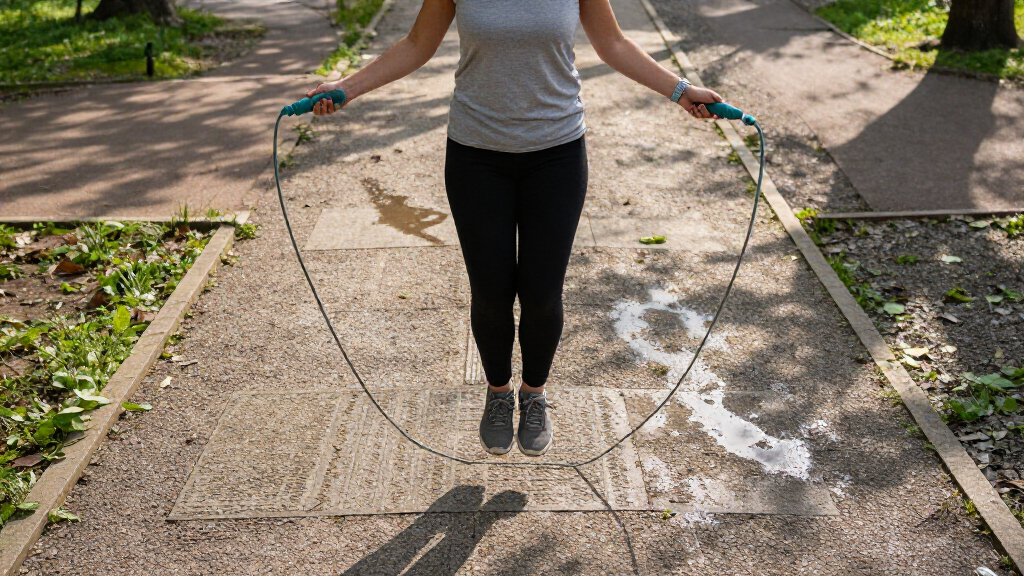
Stand on the middle of the cable with one foot and bring both handles up along your sides. For a beginner’s starting point, the handle ends should reach around the lower chest or armpit area, depending on the rope maker’s chart and your jumping style. Keep the cable taut but do not stretch it. If you already own the rope, use its marked adjustment range as a reference.
Tip: Height charts are a starting point. A relaxed, efficient technique usually needs less cable than wide-arm or high-jump habits.
Check: Both sides of the cable are even, and the handles reach a similar height when you stand on the midpoint.
Step 4: Adjust and secure the cable
Follow the manufacturer’s adjustment instructions to shorten or lengthen the cable. Make small changes, then stand on the midpoint again to recheck both handles. Tighten the lock or fastener fully. If the rope must be cut to length, confirm the fit through a practice test first, then trim only as instructed; leave enough cable for the end caps or locking mechanism.
Tip: Do not cut a cable until you have tested the rope at its longer setting. Some models cannot be lengthened after trimming.
Check: The cable sits evenly, the fastener does not slide when gently tugged, and the remaining cable is secured so it cannot whip loose.
Step 5: Test the rope at low speed
Hold the handles near your hips with elbows close to your sides. Turn the rope slowly using your wrists, then try a few small two-foot jumps. Keep your jumps low and land softly. If the cable repeatedly catches your toes or passes far above your head, stop and adjust the length in small increments. Recheck the fastener after each change.
Tip: Start with short sets and rest between them. Avoid trying speed tricks while you are still learning the rope’s timing.
Check: The rope clears your feet and head with a manageable arc, and you can turn it without flaring your arms widely.
Step 6: Pack or store the rope safely
After testing, coil the cable loosely or detach it if the design allows. Keep it away from sharp bends, heat, and heavy objects that could deform it. Store the rope in its pouch or a clean, dry place. Before each workout, inspect the cable, handles, and locks for fraying, cracks, or looseness.
Tip: A compact rope is easier to carry when the cable is not tightly knotted around the handles.
Check: The rope fits in its storage space without a tight kink, and all parts remain intact and secure.
Common Mistakes to Avoid
- Choosing a rope based on the word “women’s” alone. — Use your height, preferred workout, grip comfort, and the rope’s adjustment range to guide the choice. Gender labels do not determine cable length.
- Cutting the cable before checking the fit. — Test the rope at its longer setting, shorten it gradually, and trim only after confirming the final length and the maker’s instructions.
- Buying a rope that is compact but uncomfortable to hold. — Review handle dimensions and return terms, or test the grip in person. A small packed size does not guarantee a comfortable workout.
- Practicing in a crowded or slippery area. — Clear the rope’s full turning path, secure loose rugs, and use a stable surface with enough overhead clearance.
Troubleshooting
Problem: The rope keeps catching your toes.
Solution: Check that the cable is not too short, keep your elbows near your sides, and turn from the wrists. Try a small length increase if your technique is steady.
Problem: The rope hits the floor loudly or feels slow.
Solution: The cable may be too long, or your hands may be too far apart. Shorten the cable slightly and keep the handles near hip level.
Problem: The adjustment lock slips during use.
Solution: Stop jumping, rethread the cable as shown in the instructions, and tighten the lock. Replace a damaged fastener or rope before using it again.
Problem: The rope feels awkward even after adjustment.
Solution: Check handle comfort and cable weight. A different handle shape or a basic beaded rope may offer better control for learning; return or exchange the rope if the grip remains uncomfortable.
What Success Looks Like
Your compact jump rope is comfortable to hold, adjusted evenly, and secure at its lock. During slow practice, the cable clears your feet and head without forcing wide arm movements. You have a clear, nonslip space to use it, and the rope packs or stores without a tight kink.
Next Steps
Begin with short, easy intervals, such as 20-30 seconds of jumping followed by a recovery period, and adjust the work and rest times to your fitness level. Recheck cable locks before each session and inspect the rope regularly for wear. If your technique changes or the rope keeps catching, make small length adjustments and retest before increasing speed or duration.
Frequently Asked Questions
What length jump rope should a woman use?
Use height as a starting point, then fine-tune the cable to your skill and technique. When standing on its midpoint, a beginner can start with the handle ends around the lower chest or armpit area, while following the maker’s sizing chart.
Are cordless jump ropes effective in a small apartment?
They can support timed cardio practice where a full cable might strike furniture. They do not reproduce the timing and cable feedback of a standard rope, so choose based on your space and training goals.
Can I use a compact jump rope for a beginner workout?
Yes. Choose a manageable cable and comfortable handles, then practice slow turns and low jumps before trying longer sessions. A speed cable may be harder to control at first.
How often should I replace my jump rope?
Replace it when the cable frays, the handles crack, or the adjustment lock no longer stays secure. Check the rope before workouts; lifespan depends on materials, frequency, and storage.