For most home offices, I’d start with the Cybergoing T10: its Bosch motor, 7% incline, 4 mph top speed, and 300-pound capacity make it the strongest all-around balance in this lineup. The 8% incline walking pad suits buyers who want a simpler way to add uphill walking, while the 12% auto-incline model stands out for people who want more grade adjustment. The main tradeoffs are incline and workout range versus compactness and simplicity; added features can also mean more to manage in a shared workspace. I compare all 15 options by their stated features and intended use, with attention to what those differences mean at home. Read on for the full breakdown and a guide to choosing a treadmill that fits your desk, routine, and available space.

Get workout gear delivered free with Prime
- Fast, free delivery on millions of items
- Prime Video, Amazon Music and more included
- Member-only deals all year
Complete the kit


Key Takeaways
- Cybergoing T10 is the clearest all-around pick based on its listed Bosch motor, 7% incline, 0.6–4 mph range, 15-by-36-inch belt, and 300-pound capacity—a more defined spec set than several basic walking-pad listings.
- Incline options vary widely: the 12% auto-incline model has the highest stated grade, while the 8%, 7%, 6%, and 5% models offer a range of less aggressive incline choices.
- Higher capacity and faster speed point to broader use, not just desk walking: the speaker-equipped model lists a 330-pound capacity and 6.2 mph top speed, but those extras may matter less to someone seeking quiet, steady workday movement.
- Handle bars and folding designs trade a cleaner under-desk setup for added support and storage flexibility. Models from Ulfario, Qyraenix, and WELLFIT are worth comparing if stability or stowing the treadmill matters more than a minimal footprint.
- Several listings provide few distinguishing specifications. For the compact and remote-control models, buyers should verify dimensions, speed range, weight capacity, and storage details before choosing over a better-documented option.


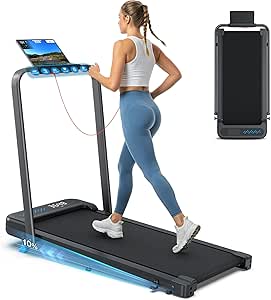
| under desk treadmills for home | Dimensions | Maximum speed | Motor | Item weight |
|---|---|---|---|---|
| Walking Pad Treadmill with 8% | 43.1 x 18.5 x 4.6 inches | 4 MPH | 2.5 HP | 28.7 lbs |
| Cybergoing T10 Walking Pad Tre | 5.7 x 19.3 x 42.3 inches (listed) | 4 MPH | Bosch motor | 36.4 lbs |
| Walking Pad Treadmill for Home | 42.91 x 19.68 x 4.33 inches | 4 MPH | 2.5 HP | 36.4 lbs |
| Walking Pad Treadmill for Home | 42.91 x 19.69 x 4.33 inches | 4 MPH | 2.5 HP | 36.4 lbs |
| Walking Pad Treadmill for Home | 41 x 19.2 x 4.1 inches | — | 2.5 HP | — |
| Walking Pad Treadmill with 12% | 48 × 21 × 6 in | 4 mph | — | 44 lb |
| Ulfario Folding Walking Pad Tr | 40 × 18 × 3.9 in | 6 km/h (approximately 4 mph) | — | 17.5 kg |
| Walking Pad Treadmill for Home | 45.67 × 19.09 × 4.52 in | 6.2 mph | — | — |
| Qyraenix Walking Pad Treadmill | — | 4 mph | — | 39 lb |
| Wilpkracy Walking Pad Treadmil | 111 × 56 × 12 cm | — | — | 17 kg listed; description also states 16.25 kg |
| MJWW 6% Incline Walking Pad | 25 × 10 × 35 inches | — | 2.5 HP | — |
| Walking Pad Treadmill for Home | 45.53 × 21.17 × 37.4 inches | 3.8 mph | 2.5 HP | — |
| OLIXIS 3-in-1 Walking Pad Trea | 35.43 × 19.2 × 3.58 inches | 5 mph | 1.75 HP | — |
| Yagud Walking Pad Treadmill fo | 42 × 19.6 × 5.5 inches | 3.8 mph | 2.5 HP | — |
| WELLFIT Folding Treadmill for | — | 6.2 mph | 3 HP | — |
More Details on Our Top Picks
Walking Pad Treadmill with 8% Incline, 2.5HP Quiet Portable Under Desk Treadmill for Home Office, 265 lbs Capacity, 15″ x 35.4″ Belt
The 8% adjustable incline gives this compact pad a more flexible walking routine than the Cybergoing T10, whose incline is fixed at 7%. That difference lets home-office users vary the effort without moving to a larger treadmill, while the 0.6–4 MPH range suits steady walking rather than running. Its stated noise level below 45 dB and shock-absorbing belt are useful for shared rooms and work calls. The tradeoff is a 15 x 35.4-inch belt, which offers less walking length than the 40-inch deck on the Walking Pad Treadmill for Home, model B0H2PZSM3D. At 28.7 pounds it is easier to reposition, but its lighter build may feel less planted during faster walking. I’d rank it for incline flexibility, not high-speed workouts.
Pros:- Adjustable incline up to 8% adds effort without requiring a larger treadmill.
- Quiet operation rated below 45 dB suits shared living and work spaces.
- Compact, 28.7-pound design is relatively easy to move and store.
- Shock-absorbing belt supports more comfortable everyday walking.
Cons:- Maximum speed of 4 MPH rules out running and faster training.
- The 35.4-inch belt is shorter than the 40-inch deck on model B0H2PZSM3D.
- Lightweight construction may feel less stable during vigorous walking.
Best for: Home-office walkers who want adjustable incline in a compact machine and do not need running speeds.
Not ideal for: Taller users who want a longer walking deck, runners, or anyone who prioritizes a heavier-feeling base.
- Maximum speed:4 MPH
- Motor:2.5 HP
- Maximum incline:8%
- Belt size:15 x 35.4 inches
- Maximum weight recommendation:265 lbs
- Dimensions:43.1 x 18.5 x 4.6 inches
- Item weight:28.7 lbs
- Display size:4 inches
Our verdict“Choose this model if adjustable incline matters more than a long deck or running capability.”
Cybergoing T10 Walking Pad Treadmill with Bosch Motor, 7% Incline, 15×36 Belt, 0.6-4 MPH, 300 lb Capacity, App & Remote Control
The 300-pound capacity makes the Cybergoing T10 a stronger fit for buyers who need more stated load support than the 264- or 265-pound limits on models B0H2PZSM3D and B0HMQZ29R2. Its Bosch motor, app, and remote add a more connected control setup than those simpler remote-operated pads. The fixed 7% incline provides a steady uphill walk, but unlike the 8% adjustable incline on the B0GTYY2FLL, it cannot be changed to suit different sessions. Speeds stop at 4 MPH, so this is for walking, not running. The 15 x 36-inch belt is also fairly compact, and there are no handrails for extra support. I’d put it ahead of basic models for capacity and controls, but not for incline flexibility.
Pros:- 300-pound maximum load exceeds the limits listed for the other compact pads in this batch.
- Bosch motor and app-plus-remote controls distinguish it from simpler remote-only models.
- Fixed 7% incline adds a consistent uphill challenge without a bulky frame.
- Compact form is suited to home or office walking.
Cons:- The manual incline is fixed and cannot be changed during use.
- Maximum speed of 4 MPH is not suitable for running.
- No handrails provide extra balance or support.
Best for: Home walkers who need a higher stated weight capacity and want app and remote control options.
Not ideal for: Runners, users who need handrails, or households that want to adjust incline between workouts.
- Maximum speed:4 MPH
- Motor:Bosch motor
- Incline:7% manual incline
- Belt size:15 x 36 inches
- Maximum load:300 lbs
- Dimensions:5.7 x 19.3 x 42.3 inches (listed)
- Item weight:36.4 lbs
- Warranty:12 months
Our verdict“Pick the T10 if its higher capacity and app controls matter more to you than adjustable incline or handrails.”
Walking Pad Treadmill for Home – Compact Under Desk Treadmill with Remote Control
Among the basic, no-incline options here, this model offers the longest stated deck at 40 inches, giving walkers more fore-and-aft room than the 35.4-inch belt on the B0GTYY2FLL or the 36-inch Cybergoing T10. That extra length can make a difference for people with a longer stride, though the 16-inch width is still a compact walking surface. A 2.5 HP motor, remote, and slim profile keep the setup focused on uncomplicated walking while working or relaxing. It supports up to 264 pounds, slightly below the capacity of the Cybergoing T10. The 1.4-inch display is small, and there are no built-in programs or incline adjustments. I’d favor it over the narrower-deck alternatives for stride room, but skip it if workout variety is a priority.
Pros:- 40-inch deck is longer than the listed belts on the other compact models in this batch.
- Remote control and LED display keep basic speed operation straightforward.
- Slim folded dimensions make it suitable for storage under furniture.
- 2.5 HP motor and steel frame support everyday walking routines.
Cons:- Maximum speed of 4 MPH limits use to walking rather than running.
- Small 1.4-inch display offers limited workout information.
- No incline or built-in programs for changing the workout.
Best for: Desk workers who want a compact treadmill with more deck length for a longer natural walking stride.
Not ideal for: Users who want incline settings, detailed workout tracking, built-in programs, or capacity above 264 pounds.
- Maximum speed:4 MPH
- Motor:2.5 HP
- Maximum weight support:264 lbs
- Deck length:40 inches
- Deck width:16 inches
- Dimensions:42.91 x 19.68 x 4.33 inches
- Folded size:41.3 x 19.3 x 4.1 inches
- Display size:1.4 inches
- Item weight:36.4 lbs
Our verdict“Choose this pad for extra deck length in a simple walking setup, not for training variety.”
Walking Pad Treadmill for Home – Compact Under Desk Mini Treadmill with Remote
This compact mini treadmill is a practical pick for buyers who expect to move their walking pad between rooms: it includes built-in transport wheels, a feature not listed for the otherwise similar B0H2PZSM3D. The dimensions and 264-pound support limit are close to that model’s, but B0H2PZSM3D lists a 40-inch deck, while this product’s deck size is not provided. Both keep things simple with remote control and a small 1.4-inch display; neither offers workout programs or an incline. Its quiet operation and compact profile suit light home or office walking, but the 4 MPH ceiling makes it a poor match for running. I’d choose this over the longer-deck alternative when easy repositioning is the priority, not when stride space or tracking detail comes first.
Pros:- Built-in transport wheels help with moving the pad around the home.
- Compact dimensions suit tight spaces and storage under furniture.
- Remote control and LED display simplify basic operation.
- Noise-reduction design is intended for home and office use.
Cons:- Maximum speed of 4 MPH is limited to walking.
- No built-in workout programs or incline settings.
- Deck dimensions are not provided, making stride fit harder to judge against B0H2PZSM3D.
Best for: People in small homes or shared workspaces who plan to roll the treadmill out of the way after walking.
Not ideal for: Taller users who want a confirmed longer deck, people seeking incline or programs, and anyone who needs more than 264 pounds of capacity.
- Maximum speed:4 MPH
- Motor:2.5 HP
- Maximum weight support:264 lbs
- Dimensions:42.91 x 19.69 x 4.33 inches
- Folded size:41.3 x 19.3 x 4.1 inches
- Display size:1.4 inches
- Item weight:36.4 lbs
- Material:PVC and carbon steel
Our verdict“Choose this model if rolling a compact treadmill between rooms matters more than deck information or workout features.”
Walking Pad Treadmill for Home – Under Desk Portable Electric Treadmill with Adjustable Speed and Remote
At just 4.1 inches high, this is the lowest-profile option by listed dimensions in this group, making it a useful choice for buyers measuring clearance under a sofa or bed. Its 41-inch length is also shorter than the 42.91-inch bodies listed for B0H2PZSM3D and B0GGB9BV77, though the product data does not give a belt size. The 0.6–4 MPH speed range, remote, and LED display cover the basics, while the anti-slip belt and shock absorption are aimed at comfortable everyday walking. Unlike the Cybergoing T10, it has no app controls or incline; it also requires a corded power connection, so storage flexibility does not mean placement freedom. I’d select it for tight storage clearance, not for a feature-rich or cable-free setup.
Pros:- Listed height of 4.1 inches is lower than the other models’ listed heights in this batch.
- Remote-controlled speed adjustments suit uncomplicated desk walking.
- Anti-slip belt and shock-absorbing features support everyday comfort.
- Carbon-steel construction and a 265-pound weight recommendation suit routine home use.
Cons:- Maximum speed of 4 MPH is not suitable for running.
- No incline, app controls, or built-in workout programs.
- Corded electric power limits placement to locations near an outlet.
Best for: Apartment dwellers who need a slim walking pad that can fit beneath low furniture between work sessions.
Not ideal for: Buyers who want incline, app controls, built-in programs, or freedom to place a treadmill away from an outlet.
- Speed range:0.6–4 MPH
- Motor:2.5 HP
- Maximum weight recommendation:265 lbs
- Dimensions:41 x 19.2 x 4.1 inches
- Material:Carbon steel
- Power source:Corded electric
- Color:Black
Our verdict“Pick this walking pad when low-clearance storage is your main constraint and a corded, basic setup works for your room.”
Walking Pad Treadmill with 12% Auto Incline, Under Desk Design
I’d choose this model when adding uphill effort matters more than running speed. Its 12% auto incline with nine levels offers more workout variation than the Wilpkracy’s fixed 5% manual incline, and automatic adjustment means you can change the challenge without stopping to reposition the treadmill. The 450-pound capacity is also the highest listed among these five options. At 4 mph, though, it is built for walking rather than running; the 6.2-mph model in this lineup is a better fit for faster workouts. Bluetooth, a speaker, and an RGB display add tracking and entertainment, but there are no preset workout programs. Its 44-pound weight and 21-inch overall width may also make storage less effortless than the lighter, narrower options.
Pros:- Nine automatic incline levels reach 12% for varied uphill walking.
- 450-pound stated weight capacity is the highest among these five products.
- Bluetooth connectivity, built-in speaker, and RGB display add workout feedback and audio.
- Foldable design supports storage when the treadmill is not in use.
Cons:- Maximum speed of 4 mph rules out running workouts.
- No built-in preset workout programs.
- At 44 pounds and 21 inches wide, it may be awkward for frequent solo moving or tight storage.
Best for: Home walkers who want adjustable uphill workouts, a high stated weight capacity, and Bluetooth audio or tracking.
Not ideal for: Runners seeking higher speeds, or people who need a particularly light treadmill to move and store frequently.
- Maximum speed:4 mph
- Maximum incline:12%, 9 adjustable levels
- Motor power:2.5 hp
- Maximum weight recommendation:450 lb
- Dimensions:48 × 21 × 6 in
- Item weight:44 lb
- Deck size:41 × 16.5 in
- Connectivity and display:Bluetooth, built-in speaker, RGB display
Our verdict“Pick this if adjustable incline and a high stated capacity matter more than running speed or especially easy portability.”
Ulfario Folding Walking Pad Treadmill with Handle Bar
For a home office where the treadmill needs to disappear between work sessions, the Ulfario’s flat-folding 4-inch profile and built-in wheels make storage its clearest advantage. The removable handlebar gives it more support than the handle-free Wilpkracy, while its 17.5-kg weight is far below the 44-pound incline model in this group. A remote control and LED readout keep basic operation straightforward without relying on an app. The tradeoff is a modest 120-kg capacity and a 90 × 38-cm running area, so it is less suited to larger users or anyone wanting a roomier deck. It tops out at 4 mph, too, and removing the handrails requires unscrewing bolts rather than a quick release.
Pros:- Folds to a 4-inch height for storage under a bed or desk.
- Built-in wheels and 17.5-kg weight make it easier to move than heavier models.
- Removable handlebar and phone holder add flexibility for walking sessions.
- Remote control and LED display provide simple speed and workout feedback.
Cons:- 120-kg capacity may not suit users who need a higher stated limit.
- 90 × 38-cm running area is relatively compact.
- Removing the handrail requires unscrewing bolts, and the 4-mph maximum limits workout pace.
Best for: Apartment dwellers and home-office users who need a lightweight walking pad that folds flat and can be rolled under furniture.
Not ideal for: Heavier users, people who want a wide walking surface, or anyone expecting speeds suitable for sustained running.
- Maximum speed:6 km/h (approximately 4 mph)
- Motor power:440 W; 2 hp listed
- Maximum weight capacity:120 kg (264 lb)
- Dimensions:40 × 18 × 3.9 in
- Folded size:40 × 18 × 4 in
- Running area:90 × 38 cm
- Item weight:17.5 kg
- Controls and display:Remote control; LED screen for time, speed, calories, and distance
Our verdict“Choose the Ulfario if compact storage and easy movement matter more than a large deck, higher capacity, or faster workouts.”
Walking Pad Treadmill for Home with Built-in Speaker, 6.2 MPH, 10% Incline, APP Control, Remote, 330 lbs Capacity
This is the most versatile pace option in the group: a 6.2-mph maximum leaves room for brisk walking and light running, unlike the 4-mph Ulfario and Qyraenix. Its 10% incline, 12 HIIT modes, and three countdown modes also make it better suited to planned workouts than the incline model, which has no preset programs. A stated noise level under 35 dB may appeal in shared homes, though actual sound can depend on speed and flooring. The app, remote, and built-in speakers offer several ways to manage sessions, but app features depend on having a compatible smartphone. At 330 pounds, its capacity is lower than the 450-pound incline pick, and the listed maximum speed still falls short of what dedicated runners typically seek.
Pros:- 6.2-mph maximum speed supports faster sessions than the 4-mph models here.
- 10% incline and 12 HIIT modes offer more structured workout options.
- 330-pound stated capacity exceeds the Ulfario and Qyraenix limits.
- App control, remote, and built-in speakers provide multiple control and audio options.
Cons:- Maximum speed is still limited for serious running.
- App functions require a smartphone, which may be inconvenient for some users.
- Assembly may take more effort than the Wilpkracy, which is listed as ready to use without assembly.
Best for: Home users who want a walking pad that can also support light running, incline sessions, and app-guided workout variety.
Not ideal for: Dedicated runners needing higher speeds, buyers who avoid smartphone-based controls, or users needing the highest weight capacity in this group.
- Maximum speed:6.2 mph
- Maximum incline:10%
- Motor power:2.75 hp
- Weight capacity:330 lb
- Dimensions:45.67 × 19.09 × 4.52 in
- Noise level:Under 35 dB (listed)
- Workout programs:12 HIIT modes and 3 countdown modes
- Connectivity and audio:App control and built-in speakers
Our verdict“Pick this for the broadest pace and workout range in this group, provided light running is enough and app-dependent features suit you.”
Qyraenix Walking Pad Treadmill with Handle Bar – Foldable, Portable, Quiet, Black
The Qyraenix is a sensible choice for users who want a handlebar for balance and a straightforward setup for regular walking. Its carbon-steel frame, non-slip belt, and honeycomb shock-absorbing pads emphasize a supported, cushioned feel, while the LED display and remote keep controls simple. Compared with the Ulfario, it has a slightly higher stated weight capacity at 110 kg (listed as 265 lb), but it weighs 39 pounds—more than twice as much as that model—so moving it around takes more effort. Its 4-mph ceiling also puts it in the walking category, not the faster-workout class of the 6.2-mph model. The foldable design and transport wheels help with storage, but the listed dimensions are unusual and are worth checking against your available space before buying.
Pros:- Handlebar offers added support compared with handle-free walking pads.
- Non-slip multi-layer belt and shock-absorbing pads prioritize footing and comfort.
- LED display and remote control make basic operation accessible.
- Foldable frame and transport wheels help with storage and repositioning.
Cons:- At 39 pounds, it is heavier to move than the 17.5-kg Ulfario.
- Maximum speed of 4 mph is not suited to serious running.
- The listed unfolded dimensions are unusual, so buyers should verify the required floor space.
Best for: Home walkers who want a handlebar, cushioning features, and simple remote-controlled operation in a foldable design.
Not ideal for: People seeking light, frequent portability, faster running workouts, or a clearly specified deck footprint for a very tight space.
- Maximum speed:4 mph
- Motor power:2 hp
- Maximum weight capacity:110 kg (listed as 265 lb)
- Unfolded dimensions:40 × 4 × 20 in (listed)
- Folded dimensions:104 × 48.7 × 10.5 cm
- Item weight:39 lb
- Frame and belt features:Carbon steel frame; multi-layer non-slip belt; honeycomb shock-absorbing pads
- Controls and display:Remote control and LED display
Our verdict“Choose the Qyraenix if you value a handlebar and cushioned walking surface more than a light frame or higher speed.”
Wilpkracy Walking Pad Treadmill with 5% Incline
The Wilpkracy makes the strongest case for a simple, ready-to-walk setup: it requires no assembly, has a low-profile body, and lists a 17-kg weight that is easier to handle than the 44-pound incline model. Its manual 5% incline adds some uphill effort, but it is less flexible than the 12% auto incline on the first pick: changing the setting is not an on-the-fly adjustment. The 1–6-km/h range is aimed at walking, much like the Ulfario and Qyraenix, rather than the faster pace offered by the 6.2-mph treadmill. A five-layer non-slip belt, widened side rails, and steel frame support steady home or office use. One data issue stands out: the listed weight differs between the description and product information, so I would verify the exact figure before relying on it for handling or storage.
Pros:- No assembly required, so it is ready for use without setup work.
- Manual 5% incline adds walking resistance compared with a flat pad.
- Five-layer non-slip belt and widened side rails support stable footing.
- Compact, low-profile dimensions suit storage under furniture.
Cons:- Manual incline is less convenient to change than the 12% auto incline on the first pick.
- Maximum speed of 6 km/h is for walking rather than fast running.
- Product information lists conflicting item weights: 16.25 kg in the description and 17 kg in the specs.
Best for: Buyers who want a compact walking pad that arrives ready to use, with a modest incline and no assembly steps.
Not ideal for: People who want adjustable incline during a workout, faster running speeds, or fully consistent product weight information.
- Speed range:1–6 km/h
- Maximum incline:5%, manual
- Maximum weight recommendation:120 kg
- Running deck:38 × 90 cm
- Dimensions:111 × 56 × 12 cm
- Item weight:17 kg listed; description also states 16.25 kg
- Belt and frame:Five-layer diamond-pattern non-slip belt; high-strength steel frame
- Assembly:No assembly required
Our verdict“Choose the Wilpkracy if you want a no-assembly walking pad with a fixed incline and can accept walking-focused speed.”
MJWW 6% Incline Walking Pad – Smart AI Under‑Desk Treadmill for Home
The MJWW stands out for pairing a 6% incline with a motor rated below 45 dB, making it a stronger fit for adding effort to walking without bringing a loud machine into a shared home. Its 0.6–3.8 mph range stays focused on walking rather than running, while the 300-pound capacity and alloy-steel frame give it a sturdier stated limit than the Yagud, which is aimed at similar under-desk use but lists a 200 kg recommendation. At 41 pounds and a 4.5-inch profile, the MJWW is also practical to roll under furniture. The tradeoff is control: its coaching and automatic speed features depend on the PitPat app, and the remote may feel less straightforward than a basic setup. Choose it for quiet, inclined workday walks; skip it if you want a simple, app-free machine or running speeds.
Pros:- 6% incline adds walking intensity without requiring a separate treadmill.
- Motor is rated below 45 dB for use around meetings or sleeping household members.
- 300-pound capacity and alloy-steel frame offer a sturdy stated setup.
- Slim 4.5-inch profile, 41-pound weight, and built-in wheels simplify storage.
Cons:- 3.8 mph maximum speed is limited for running.
- Using the AI coaching and automatic speed features depends on the PitPat app.
- Remote-based operation may be less convenient for buyers who want simple onboard controls.
Best for: Remote workers who want quiet, incline-assisted walking and value a 300-pound stated capacity.
Not ideal for: Runners or buyers who prefer uncomplicated, app-free controls; its top speed is 3.8 mph and its enhanced coaching relies on the PitPat app.
- Speed range:0.6–3.8 mph
- Maximum incline:6%
- Motor:2.5 HP
- Weight capacity:300 lbs
- Dimensions:25 × 10 × 35 inches
- Product weight:41 lbs
- Noise level:<45 dB
- Frame material:Alloy steel
Our verdict“Pick the MJWW for quiet, app-assisted incline walks at home, but not for running or minimal-tech operation.”
Walking Pad Treadmill for Home with Incline and Handle Bar
This walking pad is the more confidence-focused choice in this group: sturdy handles give beginners a place to steady themselves, while the LED display shows speed, distance, time, and calories without relying on app coaching. Its 4% incline and 3.8 mph ceiling support purposeful walking, though the MJWW offers a steeper 6% grade for buyers seeking more challenge. The listed 45 dB noise level suits shared rooms, but the machine’s nearly 46-inch depth and almost 40.5-inch folded height make its storage less discreet than the slim, 4.5-inch MJWW. Its 265-pound weight recommendation is also lower. The handles and straightforward display are useful if balance and visible controls matter more than compact storage; skip it if you need to tuck the treadmill beneath low furniture or have a higher capacity requirement.
Pros:- Sturdy handles provide support while walking.
- LED display tracks speed, distance, time, and calories.
- Adjustable incline reaches 4% for added walking effort.
- 45 dB operating noise is suited to shared home spaces.
Cons:- 265-pound maximum weight recommendation is lower than the MJWW’s 300-pound capacity.
- Folded height of 40.47 inches limits storage beneath desks or low furniture.
- 3.8 mph maximum speed is intended for walking rather than running.
Best for: New home walkers who want handholds, visible workout metrics, and a moderate incline for steady sessions.
Not ideal for: People with low-clearance storage space or users above its 265-pound stated limit; its folded height is about 40.47 inches.
- Maximum speed:3.8 mph
- Maximum incline:4%
- Motor:2.5 HP
- Weight recommendation:265 lbs
- Dimensions:45.53 × 21.17 × 37.4 inches
- Folded size:45.53 × 21.17 × 40.47 inches
- Noise level:45 dB
- Display:LED
Our verdict“Choose this model if beginner-friendly handholds matter more than low-profile storage or a higher capacity.”
OLIXIS 3-in-1 Walking Pad Treadmill for Home Office
At just 3.58 inches tall, the OLIXIS is the most clearly storage-oriented pick here: its slim, non-folding deck can roll under desks, beds, or cabinets when the workday ends. That makes it a better match for low-clearance spaces than the handlebar model, whose folded height is over 40 inches. The tradeoff is a 200-pound weight recommendation, below the MJWW’s 300-pound capacity and the Yagud’s listed 200 kg recommendation. Its 5 mph maximum also gives it more speed headroom than those walking-focused models, but the supplied data does not establish that it is suited to regular running. Cushioned, anti-slip support and a safety key add practical reassurance. Buyers should accept that the deck does not fold and that its lower capacity narrows who it suits.
Pros:- 3.58-inch profile and transport wheels suit storage beneath furniture.
- 5 mph maximum gives more speed range than the MJWW and Yagud.
- LED display tracks time, speed, distance, and calories.
- Cushioned anti-slip support and a safety key add comfort and a stop mechanism.
Cons:- 200-pound maximum weight recommendation is lower than the other products in this batch.
- Non-folding design may be harder to store in spaces without clearance beneath furniture.
- 1.75 HP motor specification is lower than the 2.5 HP motors listed for the MJWW and handlebar model.
Best for: Apartment dwellers and home-office users who need a low-profile treadmill to roll beneath furniture between sessions.
Not ideal for: Heavier users or anyone who needs a folding deck; its listed user limit is 200 pounds and the frame does not fold.
- Maximum speed:5 mph
- Motor:1.75 HP
- Weight recommendation:200 lbs
- Dimensions:35.43 × 19.2 × 3.58 inches
- Material:Metal
- Display:LED
- Controls:Remote control
- Safety feature:Safety key
Our verdict“Choose the OLIXIS for a slim, roll-away fit if its 200-pound limit and non-folding design work for your space.”
Yagud Walking Pad Treadmill for Home Office, Portable Under Desk Treadmill with Remote Control and LED Display
The Yagud’s standout distinction is its listed 200 kg maximum weight recommendation, which is higher than the capacities supplied for the OLIXIS and handlebar model. Its 36.5-pound weight and 42-inch length also make it a portable option for home-office walking, with a remote and LED display covering basic operation and workout metrics. Compared with the MJWW, it has no stated incline, so it is less suited to buyers who want to increase effort without speeding up; its 3.8 mph ceiling keeps it in the walking-and-jogging category. The description calls out a non-slip, cushioned belt, but assembly may take more effort than the MJWW’s zero-assembly setup. Pick Yagud for its higher stated capacity and basic remote control, not for incline training or faster running.
Pros:- 200 kg maximum weight recommendation exceeds the OLIXIS and handlebar model’s listed limits.
- 36.5-pound product weight supports moving it between rooms.
- Remote control and LED display provide convenient access to speed and workout metrics.
- Non-slip, cushioned belt supports walking comfort and footing.
Cons:- No incline specification is provided, unlike the MJWW’s 6% incline.
- 3.8 mph top speed limits it to walking and light jogging.
- Assembly may be challenging for some buyers.
Best for: Home walkers who need a higher listed user-capacity recommendation and want a portable machine with remote controls.
Not ideal for: Buyers seeking incline workouts, high-speed running, or a zero-assembly setup; incline is not listed, speed tops out at 3.8 mph, and assembly may be challenging.
- Maximum speed:3.8 mph
- Motor:2.5 HP
- Maximum weight recommendation:200 kg
- Dimensions:42 × 19.6 × 5.5 inches
- Product weight:36.5 lbs
- Folded size:47.2 × 19.6 × 4.6 inches
- Frame material:Alloy steel
- Metrics:Distance, speed, time, calories burned
Our verdict“Choose the Yagud if its higher stated capacity and portable controls matter more than incline or running speed.”
WELLFIT Folding Treadmill for Home, Walking Pad with Incline and Handle Bar
The WELLFIT is the most workout-oriented option here: its 6.2 mph top speed, 10% incline, and 350-pound weight recommendation go beyond the walking-first limits of the MJWW and Yagud. It also offers several control routes—handlebar, remote, app, and voice—so it can suit households that want more than a basic remote, though relying on app-linked features adds setup complexity. Its 36 × 16-inch deck provides a cushioned walking surface, but that footprint may feel restrictive for taller users or anyone taking a longer stride. The foldable design and wheels help with storage, yet its folded length is about 49 inches, so it is not as compact as the slim OLIXIS for tight furniture clearance. Choose it for a broader home workout range, not for the smallest under-desk footprint.
Pros:- 10% maximum incline and 6.2 mph top speed provide more workout range than the MJWW or Yagud.
- 350-pound weight recommendation is the highest among these five products.
- Handlebar, remote, app, and voice controls offer several operating options.
- Auto-alignment belt and foldable, wheeled design support upkeep and storage.
Cons:- 36 × 16-inch deck may restrict longer strides, especially for taller users.
- Folded length of 49.21 inches may be awkward in compact rooms.
- Full functionality depends partly on power and app connection.
Best for: Home users who want incline walking, faster sessions, multiple controls, and a higher stated weight capacity in one foldable machine.
Not ideal for: Taller users needing a longer stride or people with very limited storage length; its deck is 36 inches long and folded length is about 49 inches.
- Maximum speed:6.2 mph
- Motor:3 HP
- Maximum incline:10%
- Weight recommendation:350 lbs
- Deck dimensions:36 × 16 inches
- Product weight:41.7 lbs
- Folded size:49.21 × 21.25 × 6.1 inches
- Materials:ABS and alloy steel
Our verdict“Pick the WELLFIT for a higher-capacity, incline-capable home workout machine if its deck and folded length fit your space.”
How We Picked
I compared the 15 listed models through the needs of a home-office buyer: whether the stated speed and incline suit walking while working, whether the belt and capacity provide useful fit information, and whether controls, folding features, or a handle bar could make daily use easier. I gave more weight to listings with specific, relevant details—such as the Cybergoing T10’s speed range and belt dimensions—than to names that offer little information beyond “compact” or “portable.”
The ranking logic favors practical balance first, then distinct use cases. A model with a useful mix of speed, incline, capacity, and clear controls ranks ahead of one whose appeal rests on a single feature, while specialized options remain relevant for buyers prioritizing auto incline, extra speed, or a handle bar. Product claims here reflect the supplied listing details; where specifications are missing, I treat that uncertainty as a buyer drawback rather than assuming the feature is present.
Factors to Consider When Choosing Under Desk Treadmills For Home
Choosing a treadmill for a home office involves more than comparing headline speed or incline. I’d first match the machine to the way you plan to work, then check whether the room, desk, and storage routine can accommodate it.
Match the belt and speed to your workday
A walking pace that feels comfortable while reading email may be distracting during calls or detailed typing, so a wide speed range is less useful if the controls make small adjustments difficult. Look for the stated minimum and maximum speed, and decide whether you expect slow, steady movement or occasional faster walking. Belt dimensions matter too: a short or narrow deck can feel restrictive, especially if your stride is longer. The Cybergoing T10 lists a 15-by-36-inch belt and a 0.6–4 mph range, details that make it easier to judge fit than a listing that only says “compact.” Don’t assume a higher top speed means a better desk treadmill; for many work sessions, control at a comfortable walking pace matters more. Measure your available floor area and check the belt dimensions before buying.
Choose incline for your actual routine
Incline adds variety and can make an easy-paced walk feel more demanding, but a steeper grade may be awkward during typing or video calls. The lineup ranges from the listed 5% and 6% models to 7%, 8%, 10%, and a 12% auto-incline option. Decide whether you want a set incline for occasional workout sessions or expect to adjust it throughout the day; auto adjustment is most useful when you will actually change grades. Check whether a listing describes manual or automatic incline rather than inferring the mechanism from the percentage alone. If your main goal is low-distraction movement, a modest grade—or no incline—may suit you better than the highest available number. A steep incline also changes how you stand and walk, so leave room to use the treadmill comfortably beneath your desk.
Treat capacity as a fit and stability check
Weight capacity is a useful screening specification, but it does not tell the whole story about stability, deck feel, or long-term durability. The supplied listings include stated capacities of 265 pounds for the 8% incline model, 300 pounds for the Cybergoing T10, and 330 pounds for the speaker-equipped model; several other entries do not provide a figure in their names. When capacity is not stated, confirm it with the seller before relying on the treadmill for regular use. Avoid choosing a model whose listed limit leaves little margin for your body weight and any carried items. A handle bar can offer a point of support, but it does not replace checking the machine’s capacity or stability details. Treat clear specifications as a practical advantage, not proof of performance.
Plan for desk height, posture, and support
A treadmill raises your standing height, so the desk that works for seated use may leave your arms and shoulders poorly positioned once you start walking. Check whether the desk can adjust high enough for comfortable typing, and leave enough clearance for your head and arms. A handle bar can be reassuring for some users, but it may occupy the space where a chair or desk legs need to go. That makes folding models with bars, including the Ulfario, Qyraenix, and WELLFIT listings, a different kind of fit from a minimal under-desk pad. Consider where the bar sits and whether it can be folded or removed before treating it as a benefit. If you expect to alternate between sitting and walking, plan the chair’s parking spot as carefully as the treadmill’s footprint.
Check storage, noise, and setup details before committing
“Portable” and “quiet” are useful descriptions, but they do not substitute for measurements, machine weight, or details about how the treadmill moves and stores. Confirm its folded dimensions, whether it has transport wheels, and whether you can lift or roll it without help. In an apartment or shared home, motor noise and footfall can affect other people, so look for specific noise information rather than treating a quietness claim as a guarantee. Also check the power cord location and whether the controls are easy to reach from your desk. Remote control appears across several listings, but app control is called out for the Cybergoing T10 and the speaker-equipped model; choose the control method you will genuinely use. A few minutes spent checking these details can prevent an awkward fit that no incline feature can fix.
Pay for useful range, not feature count
Extra features are worthwhile when they solve a clear problem: auto incline for frequent grade changes, an app if you want connected controls, or a folding handle bar if you need support and compact storage. Speakers or a higher top speed may be less useful if your treadmill will mainly run at a slow pace under a desk. Basic listings with remote control can suit buyers who want straightforward operation, but sparse specifications make it harder to compare their belt, capacity, and storage fit. Before choosing a feature-rich model, ask whether it will change how often or how comfortably you walk. Before choosing a simpler one, verify the missing details that affect fit and safety. The best match is the model whose stated features address your routine without adding controls or bulk you do not need.
Frequently Asked Questions
Can I use an under-desk treadmill while typing or taking video calls?
Many people use walking pads for light movement during lower-focus tasks, but comfort depends on pace, desk height, and how steady you feel while walking. Start at a slow speed and try routine tasks before using the treadmill during calls or detailed work. A desk that is too low can pull your shoulders forward, while a pace that is too fast can make typing less comfortable. If your work requires precise hand movements or frequent camera use, plan to stop walking for those tasks. A treadmill’s listed top speed does not indicate the pace that will work best for your desk routine.
Is a higher incline better for an under-desk treadmill?
Not automatically. A steeper incline can add challenge at a lower walking speed, but it may also make balance and desk work less comfortable. This lineup includes options from a stated 5% incline up to 12% auto incline, so buyers can choose based on whether they want occasional workout intensity or gentle movement during work. If you expect to type or join calls while walking, a modest grade may be easier to manage. Check how the incline is adjusted and whether the listing clearly states that it is automatic before paying for that feature.
What should I do when a treadmill listing does not state belt size or weight capacity?
Ask the seller for the missing figures before choosing, especially if you have a longer stride or need a particular capacity. A short belt may feel limiting even when the machine is described as compact, and an unstated weight limit makes it difficult to judge whether the model suits your needs. Compare the answers with the explicit dimensions and capacity in better-documented listings, such as the Cybergoing T10 or the 8% incline model. If the information remains unavailable, treat that uncertainty as a real drawback rather than assuming the specs are typical. Clear details make it easier to judge fit before the treadmill arrives.
Should I choose a walking pad with a handle bar or one without?
A handle bar may provide a support point and can suit someone who wants a more treadmill-like setup. It can also take up room under a desk, limit where a chair fits, and add a folding or storage step. Models such as the Ulfario, Qyraenix, and WELLFIT are listed with handle bars, while several other options are positioned as compact under-desk pads. Check whether the bar folds or can be removed, and compare the folded dimensions with your storage space. If you need the clearest possible under-desk area, a handle-free design may be easier to fit.
Is a faster treadmill a better choice if I mainly plan to walk while working?
Usually, the maximum speed should not be your main deciding factor for desk walking. The speaker-equipped model lists a 6.2 mph top speed, while the Cybergoing T10 lists a range up to 4 mph; that difference matters more if you plan to use the machine for faster sessions away from your desk. For workday walking, a comfortable low-speed setting, simple controls, and a suitable belt may matter more than the top end. Check the minimum speed as well as the maximum, since the slowest setting affects how gently you can start. Choose a faster model only if you expect to use that extra range.
Conclusion
For the best overall balance, I’d choose the Cybergoing T10 because its motor, speed range, incline, belt dimensions, capacity, app, and remote give buyers more concrete fit information than many entries. The best incline-focused choice is the 12% auto-incline model for shoppers who want the greatest stated grade, while the 8% incline walking pad is a simpler alternative with a listed capacity and belt size. For a premium-style feature set, I’d look at the speaker-equipped 6.2 mph model, particularly if its higher stated capacity and broader speed range suit uses beyond desk walking. Beginners may prefer a straightforward remote-control model, but should verify its speed, belt, and capacity details before purchase. If support or stowability matters most, compare the folding handle-bar listings; if you need a minimalist workspace, prioritize a compact handle-free design with clear dimensions. My final choice would depend on desk fit and verified specifications, not on the longest feature list.
Halloween Picks
halloween
As an affiliate, we earn on qualifying purchases.