

Running can affect your glutes in different ways. If you're distance running, you'll tone your glutes without much size increase. On the other hand, sprinting can lead to noticeable growth due to the engagement of type II muscle fibers. Uphill running also boosts glute strength. To maximize size, you might want to combine running with strength training and pay attention to your nutrition. There's so much more to discover about optimizing your routine for better glute gains.

Get workout gear delivered free with Prime
- Fast, free delivery on millions of items
- Prime Video, Amazon Music and more included
- Member-only deals all year
Key Takeaways
- Distance running tones glutes but does not significantly increase size due to the activation of type I muscle fibers.
- Sprinting promotes hypertrophy and noticeable glute growth by engaging type II muscle fibers effectively.
- Uphill running enhances glute activation and strength, contributing to muscle development.
- Combining running with strength training exercises, like squats, maximizes glute size enhancement.
- Proper nutrition, including a caloric surplus, is essential for muscle growth alongside running.
glute strengthening resistance bands
As an affiliate, we earn on qualifying purchases.
As an affiliate, we earn on qualifying purchases.
How Running Affects Glute Muscle Composition

Running considerably influences your glute muscle composition, depending on the type of running you choose. The intensity and duration of your runs can dictate how your gluteal muscles are developed, with sprinting typically leading to more muscle growth compared to long-distance running. However, a common concern among runners is whether is running bad for knees, as repetitive impact can sometimes lead to joint discomfort or injuries. To mitigate these risks, it’s essential to incorporate proper form, strength training, and adequate rest into your routine.
If you focus on distance running, you'll primarily activate type I muscle fibers, leading to toned but not considerably larger glute muscles.
On the other hand, sprinting engages type II muscle fibers, promoting hypertrophy and resulting in noticeable growth of the gluteus maximus.
If you're uphill running, the increased glute activation demands greater push-off strength, enhancing muscle development even further.
Therefore, the overall impact of running on your glutes varies considerably.
While distance running offers endurance and toning, sprinting and hill runs are more effective for increasing glute size and strength, giving you those fuller, more muscular glutes you're aiming for.
The Impact of Distance Running vs. Sprinting
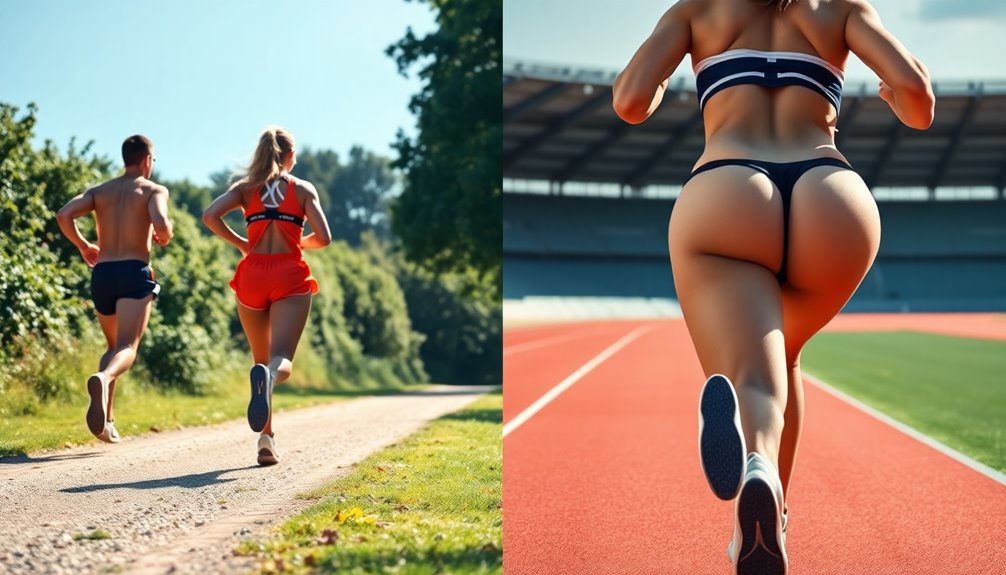
When comparing distance running to sprinting, the differences in glute development become quite apparent.
Distance running primarily activates type I muscle fibers, enhancing endurance but not greatly increasing glute muscle size.
In contrast, sprinting engages type II muscle fibers, leading to hypertrophy and noticeable growth in your glute muscles, particularly the gluteus maximus.
Elite sprinters often showcase larger glutes due to the explosive movements involved in their training.
Uphill running further emphasizes glute engagement, enhancing strength and contributing to a more pronounced appearance.
While both activities improve cardiovascular health, the varying muscle fiber activation patterns result in distinct outcomes for glute size and composition.
If you want more muscle growth, sprinting might be your best bet!
Understanding Muscle Fiber Types in Relation to Running

Understanding muscle fiber types is vital for optimizing your running routine and achieving specific fitness goals. Your body primarily uses Type I and Type II muscle fibers during running.
Type I fibers, activated during distance running, support endurance but don't greatly enhance glute size. In contrast, Type II fibers are engaged during sprinting, allowing for hypertrophy and noticeable glute growth.
If you focus solely on distance running, you'll develop toned glutes without considerable increases in size. Incorporating sprinting into your training activates more Type II fibers, essential for building muscle mass in your glutes.
Nutrition and Strength Training for Optimal Glute Development

To achieve ideal glute development, it's important to complement your running routine with proper nutrition and targeted strength training. Focusing on muscle hypertrophy requires adequate protein intake, ideally between 1.2 to 2.0 grams per kilogram of body weight. Incorporate strength training exercises like squats, deadlifts, and glute bridges to specifically target your glutes. A caloric surplus, achieved through a balanced diet rich in healthy fats and lean proteins, enhances muscle engagement during resistance training. Don't forget recovery time; consistent strength training paired with rest days fosters muscle adaptation and growth. Additionally, including anti-inflammatory herbs in your diet can support muscle recovery and overall performance.
| Exercise Type | Benefits | Recommended Frequency |
|---|---|---|
| Glute Bridges | Targets gluteus maximus | 2-3 times/week |
| Squats | Builds overall lower body strength | 2-3 times/week |
| Deadlifts | Enhances posterior chain strength | 1-2 times/week |
| Resistance Band Work | Increases intensity | 2-3 times/week |
| Recovery Days | Promotes muscle growth | 1-2 days/week |
The Takeaway: Enhancing Glute Size Through Running and Strength Training

Enhancing the size of your glutes requires a strategic combination of running and strength training. Focus on sprinting and high-intensity intervals to activate your gluteus maximus and promote hypertrophy.
Uphill running can further boost glute activation by demanding more push-off strength. While distance running primarily engages slow-twitch fibers, it won't greatly increase muscle size.
To achieve muscle growth, you must also maintain a caloric surplus through proper nutrition. Incorporate strength training exercises like squats, lunges, and glute bridges to effectively target your glutes.
This balanced approach will improve your overall body composition and guarantee you build a fuller, stronger butt. Remember, consistency in both running and strength training is key to achieving your glute goals.
Frequently Asked Questions
Does Running Increase Glute Size?
Running primarily tones your glutes without greatly increasing their size.
If you're focusing on distance running, you'll activate smaller muscle fibers, which enhances endurance rather than bulk.
However, when you incorporate sprinting or uphill runs, you're engaging larger muscle fibers that can lead to hypertrophy, helping your glutes grow.
Will Cardio Ruin My Glute Gains?
Cardio won't necessarily ruin your glute gains, but balance is key.
If you overdo cardio without strength training, you might lose muscle mass, including in your glutes.
To preserve and even enhance your glute development, pair your running with exercises like squats and lunges.
This way, you can enjoy the benefits of cardio while still focusing on building and maintaining your glute muscles.
Just remember to fuel your body properly!
Does Running Activate Your Glutes?
When you hit the pavement, your glutes are hard at work, playing a starring role in your stride. Each step you take engages those powerful muscles, helping stabilize your body and propel you forward.
While distance running focuses on endurance, sprinting and hill workouts really fire up those fast-twitch fibers, giving your glutes a robust workout.
What Causes an Increase in Buttocks Size?
An increase in buttocks size can come from a few key factors.
When you engage in high-intensity exercises, like sprinting or strength training, you stimulate muscle growth in the glutes.
If you're in a caloric surplus, you might also accumulate fat in that area.
Genetic and hormonal influences play a role too, affecting where your body stores fat.
Understanding these elements can help you achieve your desired results effectively.
Conclusion
To sum up, while running can tone your glutes, it won't necessarily make them bigger on its own. Curiously, studies show that sprinting can activate up to 60% more muscle fibers in your glutes compared to distance running. So, if you're aiming for a fuller backside, consider integrating sprints into your routine. Pair that with strength training and proper nutrition, and you'll be well on your way to achieving those enhanced glutes you've been dreaming of!
Columbus Day / Indigenous Peoples' Day Picks
long weekend sales
As an affiliate, we earn on qualifying purchases.