TL;DR
Fit&Well has outlined three no-equipment hip mobility moves for people who sit for long periods: the 90/90 stretch, adductor rock backs and a hip-flexor-to-hamstring sequence. The report suggests starting with one to three sets two or three times a week, while warning readers to stop if a move causes sharp pain and to seek medical advice when relevant.
Fit&Well has published three hip mobility exercises for people who spend long periods sitting: the 90/90 stretch, adductor rock backs and a kneeling hip-flexor stretch that moves into a hamstring rock back. The routine uses no equipment beyond a mat or soft surface, and the report recommends easing in rather than treating the moves as a substitute for medical advice.

Get workout gear delivered free with Prime
- Fast, free delivery on millions of items
- Prime Video, Amazon Music and more included
- Member-only deals all year
The report presents the exercises as ways to move the hips through different positions and stretch muscles around them. Its author says prolonged sitting can tighten the hip flexors and adductors and decondition the glutes; those are the report’s rationale for suggesting mobility work, not a finding established by the exercise instructions themselves. The routine is recommended for personal-training clients, though the source does not provide research testing its effects.
For the 90/90 stretch, sit with both knees bent at roughly right angles and legs on the floor, one in front and one to the side. Lift and rotate the knees and torso to switch which leg is in front, then move back. The prescribed amount is five repetitions each way, with an elongated torso and engaged core.
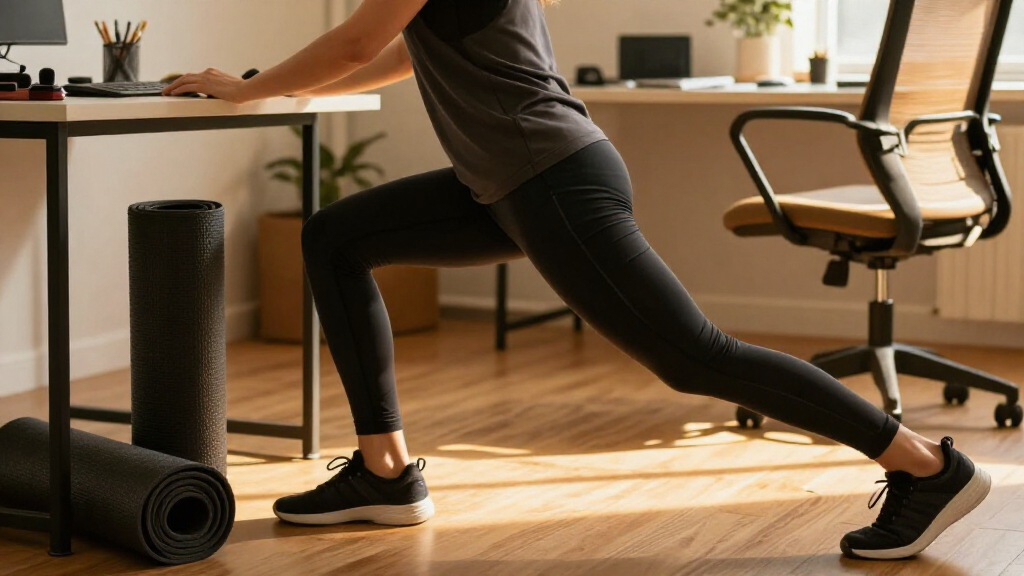
For adductor rock backs, start on hands and knees, extend one leg to the side and shift the hips back until the inner thigh feels a stretch. Return forward and repeat 10 times per side, keeping the back neutral. The third move starts in a kneeling lunge: shift forward, then back while straightening the front leg and directing the hips toward the rear heel. Repeat five times per side. A cushion under the knee is suggested if extra padding is needed.
A Short Routine for Desk-Bound Days
The exercises offer readers a brief, equipment-free option for adding varied hip and leg movements to a week dominated by sitting. The report’s practical value is its step-by-step guidance, set and repetition suggestions, and modifications such as padding for sensitive knees. It does not establish that the routine prevents injury, reverses the effects of sitting or produces a particular health outcome.
The suggested schedule is gradual: begin with one to three sets two or three times a week, then build toward daily practice if comfortable. The author also says sets can be split across the day, such as one in the morning and one in the evening, with a midday set added later. Readers can use that as a plan to try, not a required prescription.
Products Worth Considering

Garmin Venu 3 Fitness Smartwatch, 45 mm, Black

BowFlex Results Series 552 SelectTech Adjustable Dumbbell

Philips Sonicare 6500 Series Rechargeable Electric Toothbrush with 2 Brush Heads, White
As an affiliate, we earn on qualifying purchases.
How the Three Moves Differ
The sequence covers more than one direction of movement. The 90/90 exercise involves rotating between bent-leg positions, while the rock backs focus on the inner thigh and the final move alternates between a forward hip position and a hamstring stretch. Together, the report describes them as addressing external and internal hip mobility and stretching larger muscles around the hips.
Each exercise can be scaled within the instructions, but the source does not set out a clinical assessment or tailor the routine to individual conditions. The movements are demonstrated on a mat or other suitable soft surface. For knee discomfort during the kneeling exercises, it advises using a pillow or rolled towel; the adductor rock-back instructions also recommend turning the extended leg slightly inward so the inside of the foot stays in contact with the mat.
“I like these moves as they work your external and internal hip mobility, as well as stretching out some of the big muscles surrounding your hips.”
— Fit&Well report author
Evidence and Individual Suitability
The source gives exercise instructions and the author’s rationale, but does not cite clinical research or quantify whether the moves improve mobility, reduce discomfort or offset health effects associated with sitting. It also does not specify how quickly a person might notice a change, or define a standard way to measure progress.
Whether each position is suitable can depend on a reader’s mobility, pain and medical history. The report does not give modified versions for every condition. It advises stopping immediately for sharp pain and consulting a doctor, and says people with prior injuries should check with their medical team. Its frequency guidance is a recommendation from the report, not individualized medical care.
Start Gently and Watch for Pain
The report’s next step for readers is to try a modest schedule: one to three sets of each movement, two or three times a week at first, and increase frequency gradually only if the exercises feel comfortable. Its suggested approach allows sets to be split between morning and evening, with a midday set added as mobility improves.
Readers should stop if they experience sharp pain and seek medical advice; anyone with a prior injury is advised to consult their medical team before beginning. The source provides no follow-up results or evaluation plan, so whether the routine helps an individual remains something the report does not establish.
Key Questions
What are the three hip mobility moves?
The Fit&Well routine includes the 90/90 stretch, adductor rock backs and a kneeling hip-flexor stretch that shifts into a hamstring rock back.
How often does the report recommend doing them?
It suggests starting with one to three sets two or three times a week and gradually building toward daily practice if comfortable. This is the report’s guidance, not a schedule tailored to each person.
Do the exercises require equipment?
No special equipment is listed. The moves use a yoga mat or another suitable soft surface; a pillow or rolled towel can cushion the knee when needed.
What should someone do if an exercise hurts?
The report says to stop immediately if a move causes sharp pain and consult a doctor. It also advises people with prior injuries to check with their medical team before trying the routine.
Source: fitandwell.com