TL;DR

Get workout gear delivered free with Prime
- Fast, free delivery on millions of items
- Prime Video, Amazon Music and more included
- Member-only deals all year
A Fit&Well writer said she ran progressively farther before knee pain began during a two-week routine that included a daily standing stretch and changes to the stretch in week two. Pain returned at 4.5 miles on her final run, and the account does not establish that stretching alone caused the improvement.
A Fit&Well writer reported that she ran farther before knee pain began during a two-week routine that included a standing stretch performed daily, but the pain returned when she attempted to reach five miles. Her account offers a personal progress report, not evidence that the stretch itself treated the condition or will work for other runners.
The writer said she had paused running during pregnancy and postpartum recovery and returned after receiving medical clearance. She described a history of iliotibial band (IT band) syndrome, which had limited her early postpartum runs to about three miles before knee pain began. During the experiment, she ran twice a week and performed the stretch every day.
For the first seven days, she held the position for 30 seconds on each side; in the second week, she increased the hold to 45 seconds and leaned toward the stretched side. On run days, she did the stretch both before and after running. She reported reaching 3.25 miles and then 3.5 miles before pain during early runs, followed by four miles without the same pain in week two.
On the final run, she aimed for five miles but stopped at 4.5 miles when pain returned. The writer said she planned to reduce her running progression and keep the stretch alongside hip-strengthening exercises. The report provides no controlled comparison, clinical measurements or evidence that separates the effect of the stretch from changes in running, recovery or other factors.
Progress Without a Guaranteed Fix
The account is relevant to runners returning after a break because it shows both a reported improvement and the limit of a short personal trial: the writer increased her pain-free distance but still experienced pain after extending the run. That distinction matters. A better early run does not establish that an injury has resolved, and trying to make a rapid jump toward a previous distance may bring symptoms back.
Physical therapist Dr. Zaki Afzal, identified in the report as the owner and founder of Optimize Physical Therapy and Performance, said hip strength and the ability to respond to force matter during running. His comments place the stretch within a broader approach rather than presenting it as a stand-alone remedy. Readers should treat the writer’s results as an individual experience, not a predicted outcome or medical recommendation.
Products Worth Considering

Fitbit Sense Advanced Smartwatch – Sage Grey/Silver (One Size, S & L Bands Included)

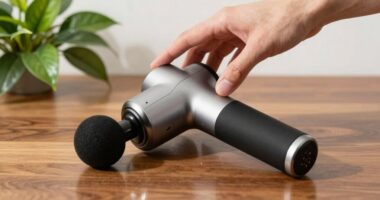
TheraGun Relief Massage Gun – 3 Speed, Black

Garmin Forerunner 165 GPS Running Smartwatch, 43 mm, Black
As an affiliate, we earn on qualifying purchases.
What the Therapist Says About the IT Band
Afzal describes IT band syndrome as pain on the outside of the knee that can be related to the hip and lateral hip muscles. The IT band is dense connective tissue running from the tensor fasciae latae (TFL) area at the hip toward the outside of the knee. In his explanation, irritation and compression near the knee contribute to symptoms.
He cautioned that calling the exercise an “IT band stretch” is not anatomically precise. Afzal said the band itself is not readily lengthened by a conventional stretch because it is firmly anchored along the thigh bone. The movement may instead affect the TFL and nearby hip muscles, which could change how the area feels. He also said that running loads are handled through muscle or structures such as the IT band, depending on the runner and the demands placed on the body.
The exercise described involves standing with feet about hip-width apart, crossing one leg behind the other, bending forward toward the toes and holding before switching sides. The report says beginners may want instruction from a certified trainer or physical therapist. It also advises consulting a doctor before trying the move if knee pain may have another cause.
What the Two-Week Trial Cannot Show
The report does not show whether the stretch caused the writer’s reported increase in pain-free distance. She changed the hold time and how she leaned into the movement during the experiment, and she also ran on a schedule that included rest between outings. There was no comparison period without the stretch and no clinical assessment of symptoms reported alongside the results.
It is also unclear what specific diagnosis, if any, was confirmed for the knee pain during this return to running, or how long the improvement lasted after the two weeks. The source does not establish that the routine is safe or effective for every person with lateral knee pain. Afzal and the report caution that pain can have other causes and that exercise guidance may need to be tailored.
A Slower Return to Distance
The writer said she would dial back her running progression after pain returned at 4.5 miles, and continue the stretch alongside hip-strengthening work. The report gives no later update on her symptoms or whether she reached five miles without pain.
For readers, the immediate takeaway is to avoid treating one person’s two-week result as a plan for managing knee pain. Anyone with persistent or recurring symptoms can seek advice from a doctor or physical therapist, particularly before increasing distance or changing an exercise routine. The source does not provide a scheduled follow-up or further clinical findings.
Key Questions
Did the stretch make the writer’s knee pain go away?
The writer reported running farther before pain began during the two-week routine, but pain returned at 4.5 miles on her final run. The report cannot establish that the stretch caused the change or that the pain was resolved.
What stretch did the writer perform?
She crossed one leg behind the other while standing, bent forward toward her toes and held the position on each side. She used 30-second holds in the first week and 45-second holds in the second.
Can the IT band itself be stretched?
Afzal said the IT band is firmly anchored along the thigh and is not meaningfully lengthened by a conventional stretch. He said the movement may affect the TFL and other lateral hip muscles instead.
Should runners try the stretch for knee pain?
The report advises consulting a doctor if knee pain could have another cause and suggests beginners get guidance from a certified trainer or physical therapist. It does not establish the stretch as a treatment for knee pain.
Source: rss