TL;DR
Physiotherapist Will Harlow recommends calf raises, toe raises and single-leg balance as a routine to build ankle strength and control. The Fit&Well report describes the exercises and suggested progressions, but it does not provide evidence that this specific routine prevents falls or sprains.
A Fit&Well report outlines three ankle exercises recommended by physiotherapist Will Harlow: calf raises, toe raises and single-leg balance. Harlow says the movements train the calf, shin and balance responses used in walking and recovery from a stumble; the report does not establish that the routine will prevent an individual from spraining an ankle or falling.

Get workout gear delivered free with Prime
- Fast, free delivery on millions of items
- Prime Video, Amazon Music and more included
- Member-only deals all year
Harlow, who specializes in physiotherapy for people over 50, recommends performing three sets of 8 to 15 calf raises. Stand while holding a counter or wall, rise onto the balls of the feet, then lower the heels slowly, taking about three seconds. If two-legged raises become easy, he suggests progressing to one leg and later standing with the balls of the feet on a step so the heels can lower below it.
The second exercise is a toe raise, also called a tibialis raise. Harlow’s guidance is to lean against a wall with the feet roughly a foot-length forward, lift the toes and front of the feet, then lower them with control. The suggested amount is three sets of 15 to 20 repetitions. The movement targets muscles at the front of the shin that lift the foot while walking.
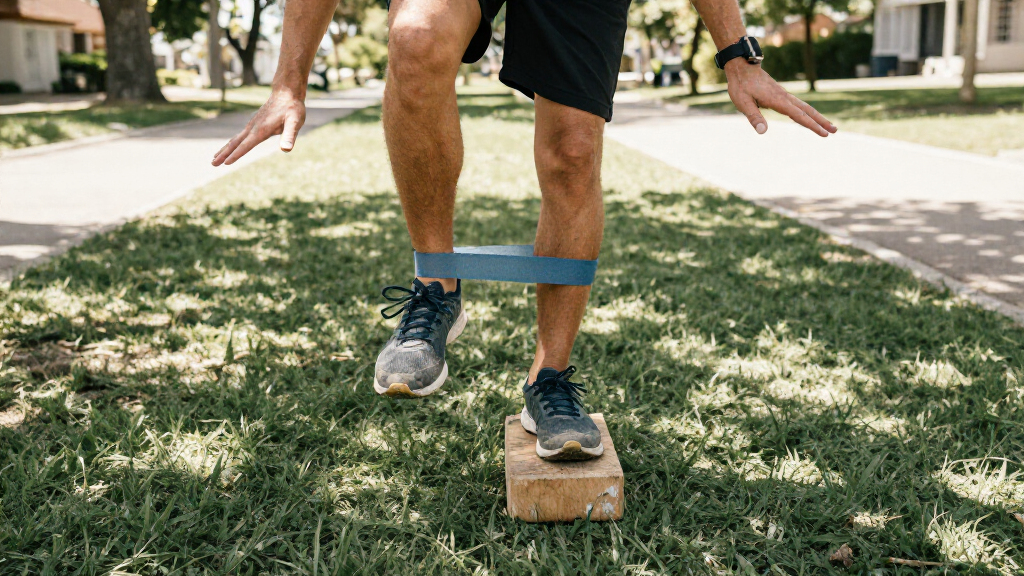
For balance, Harlow advises standing beside a counter or other support, lifting one foot and holding a single-leg balance for 30 seconds. Repeat three times on each side. He says this exercise can be done daily, while recommending the strengthening exercises around three times a week and gradual progression. Once 30 seconds feels comfortable, suggested challenges include closing the eyes, standing on a cushion or slowly turning the head. Those variations make the task harder and should be approached with support close by.
Training Strength and Balance Together
The routine addresses three different functions rather than focusing on one muscle group: calf strength for push-off, shin strength to lift the foot, and balance practice for ankle reactions. These functions matter in ordinary activities such as walking and climbing stairs, as well as when someone needs to steady themselves after a misstep.
Harlow says weaker ankle muscles in older adults are linked with poorer balance and a higher risk of falls. He also describes a possible cycle after a sprain: a person protects the ankle, loses strength and control, and may experience further instability. These are his explanations in the report, not a guarantee that the three exercises will prevent injury. The practical value is a simple, equipment-light routine readers can discuss with a clinician or adapt to their abilities.
Products Worth Considering

BowFlex Results Series SelectTech Adjustable Dumbbells (Pair)

BowFlex Results Series 552 SelectTech Adjustable Dumbbell

Oral-B iO Series 7 Rechargeable Electric Toothbrush, Black, with 2 Brush Heads and Charging Travel Case
As an affiliate, we earn on qualifying purchases.
Why Ankle Control Matters
Harlow says ankle strength is often overlooked compared with training larger muscle groups such as the glutes, quadriceps and core. Yet the ankle has to respond quickly when a person trips. The report identifies both muscle strength and neuromuscular control—the ability to sense joint position and react—as relevant to stability.
It also highlights the calf’s role in walking, including its contribution to push-off. The supplied report refers to roughly 70% of walking push-off power coming from the calf muscles, but does not give the underlying study details or define how that estimate was measured. It says calf strength can decline with age and that this may be associated with slower walking and shorter steps. These points provide context for Harlow’s recommendation; they do not amount to a finding that this particular exercise plan prevents falls.
“Ankle strength is one of the most overlooked areas of health and fitness, and it is particularly important as you age.”
— Will Harlow, physiotherapist specializing in people over 50, as quoted by Fit&Well
Limits of the Exercise Advice
The report provides exercise instructions and Harlow’s rationale, but the supplied material does not identify a clinical trial testing these three exercises together or quantify how much they reduce sprains or falls. It also does not specify how long someone should follow the routine before expecting changes. The headline’s prevention framing should not be read as a promise of protection.
Individual ability, health conditions, previous injuries and the safety of balance progressions vary. Readers with pain, recent injury, significant balance problems or health conditions should seek advice from a qualified health professional before starting or making an exercise harder. The report does not give a modified version for people unable to balance safely without assistance.
How Readers Can Apply the Routine
The next step described in the report is gradual practice: begin with support available, use controlled movements, and only progress when the current version feels manageable. Harlow suggests about three weekly sessions for the three exercises, with balance work daily; readers should not treat those frequencies as individualized medical advice.
The source also points to a separate Harlow video featuring two additional exercises, but the supplied material does not describe them in enough detail to report their instructions or evidence. No further research findings, official guidance or follow-up results are included in the source material.
Key Questions
Which three exercises does Will Harlow recommend?
He recommends calf raises, toe raises (tibialis raises) and single-leg balance, which target calf strength, the muscles that lift the foot and balance control.
How often does the report suggest doing them?
Harlow suggests doing the three exercises around three times a week and gradually making them harder. He separately recommends single-leg balance daily. The report does not present this schedule as a personalized plan.
How can the exercises be made harder?
For calf raises, the report suggests moving from two legs to one, then raising the forefoot on a step. For balance, it suggests trying eyes closed, a cushion or slow head turns after a 30-second hold becomes comfortable. Keep a stable support nearby when practicing.
Are these exercises proven to prevent ankle sprains and falls?
The supplied report does not provide a trial or outcome data showing that this exact routine prevents sprains or falls. It presents Harlow’s recommendations and explanation of how the exercises train ankle strength and control.
Who should get advice before trying the routine?
People with pain, a recent ankle injury, marked balance difficulties or an existing health condition should ask a qualified health professional about suitable exercises and safe progressions before beginning.
Source: fitandwell.com