Finding the right headlamp for night runs comes down to three questions: how much light you actually need, how much weight you’re willing to carry on your head, and whether you want a dedicated running design or a budget all-rounder. After comparing 12 popular options, the Fenix HL18R-T V2.0 stands out as the best overall choice for runners, thanks to its true trail-running beam pattern, balanced fit, and rechargeable battery. If grams matter most, the Nitecore NU25 MCT UL is the ultralight pick serious runners keep coming back to, while the Blukar Rechargeable 2000L delivers the best value for casual evening joggers. The biggest tradeoff in this category is brightness versus comfort: cheap high-lumen lamps flood the trail but bounce and overheat, while premium running models prioritize beam quality, stability, and battery honesty. Keep reading for the full breakdown of all 12 headlamps, including who each one is for and who should skip it.

Get workout gear delivered free with Prime
- Fast, free delivery on millions of items
- Prime Video, Amazon Music and more included
- Member-only deals all year
Complete the kit


Key Takeaways
- Lumen claims are the worst way to compare these headlamps — the 2000-lumen Blukar floods everything evenly, while the 800-lumen Fenix throws light farther down the trail because of its focused reflector design, which matters more for pace and confidence at speed.
- Weight separates real running headlamps from general-purpose ones: the Nitecore NU25 MCT UL and Petzl Tikka sit around half the weight of the wide-beam budget models, and that difference is obvious by kilometer three.
- The 230° wide-beam lamps (both the single and 2-pack versions) are excellent for peripheral awareness on roads and bike paths but lack the punchy center spot needed for technical trail running at pace.
- Motion-sensor wave controls appeared on four of the twelve models and proved genuinely useful for runners, not a gimmick — being able to switch modes with a muddy, gloved hand mid-stride is a real safety feature.
- Brand-name models (Petzl, Fenix, Black Diamond, Nitecore) cost more per lumen but deliver honest run-time claims, better water resistance, and replaceable or better-managed batteries; the budget lamps win on raw output and bundled extras instead.
| Blukar Rechargeable LED Headlamp, 2000L | 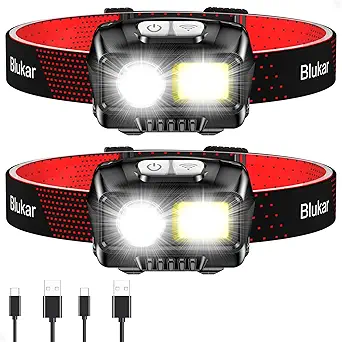 | Best Value Motion-Sensor Pick | Light source: COB and XPG LEDs | Lighting modes: 8 (5 standard, 3 sensor) | Brightness adjustment: Stepless, 100% to 30% | VIEW LATEST PRICE | See Our Full Breakdown |
| Nitecore NU25 MCT UL 400-Lumen USB-C Rechargeable Headlamp | 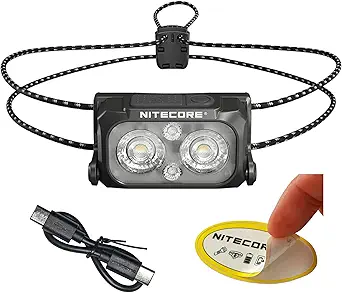 | Best Ultralight Trail Pick | Maximum brightness: 400 lumens | Maximum beam distance: 144 yards | Weight: 1.65 oz | VIEW LATEST PRICE | See Our Full Breakdown |
| Rechargeable LED Headlamp with 230° Wide Beam and Motion Sensor |  | Best Wide-Beam Visibility | Beam angle: 230° | Lighting modes: 6 | Motion sensor range: Within 10 cm | VIEW LATEST PRICE | See Our Full Breakdown |
| Blukar Rechargeable LED Headlamp with 3 Lights |  | Best High-Output Budget Option | Light source: 3 LEDs | Brightness: 8000 lumens (claimed) | Lighting modes: 5 | VIEW LATEST PRICE | See Our Full Breakdown |
| Foxelli MX20 LED Headlamp with White and Red Light |  | Best AAA Backup Runner | Beam distance: 165 ft | Light modes: White and red, including SOS and strobe | Tilt angle: 45° | VIEW LATEST PRICE | See Our Full Breakdown |
| Petzl ACTIK Headlamp, Black |  | Best Premium Beam Quality | Maximum brightness: 350 lumens | Light modes: Flood and mixed beams; white and red lighting | Power source: Three AAA batteries or CORE rechargeable battery (sold separately) | VIEW LATEST PRICE | See Our Full Breakdown |
| LHKNL Rechargeable LED Headlamp with Motion Sensor, 8 Modes |  | Best Value Two-Pack | Brightness: 1200 lumens maximum | Lighting modes: 8, including red light and SOS strobe | Battery: 1500 mAh rechargeable lithium-ion polymer | VIEW LATEST PRICE | See Our Full Breakdown |
| Lepro Rechargeable LED Headlamp, IPX4 Waterproof, 5 Modes, Black |  | Best for Marathon Battery Life | Maximum brightness: 300 lumens (150-lumen white setting) | Light modes: 3 white settings and 2 red modes | Beam distance: Up to 500 feet | VIEW LATEST PRICE | See Our Full Breakdown |
| Petzl Tikka 350-Lumen Headlamp, Blue |  | Best for Beginners | Maximum brightness: 350 lumens | Light modes: Three white levels, red lighting, strobe | Power source: 3 included AAA batteries; CORE rechargeable compatible | VIEW LATEST PRICE | See Our Full Breakdown |
| Fenix HL18R-T V2.0 800-Lumen Trail Running Headlamp |  | Best for Technical Trails | Maximum output: 800 lumens | Maximum beam distance: 136 yards | Light modes: 4 white, 4 warm white, 2 red | VIEW LATEST PRICE | See Our Full Breakdown |
| Black Diamond Cosmo 350 Headlamp |  | Best Weatherproof Pick | Maximum brightness: 350 lumens | Power source: 3 AAA batteries (included) or BD 1500 rechargeable Li-ion battery (sold separately) | Lighting modes: Dimming, strobe, red night vision | VIEW LATEST PRICE | See Our Full Breakdown |
| 2-Pack Rechargeable LED Headlamps with Motion Sensor and 230° Wide Beam |  | Best Budget Two-Pack | Pack size: 2 headlamps | Beam angle: 230° wide COB beam | Brightness: 350 lumens | VIEW LATEST PRICE | See Our Full Breakdown |
| running headlamps for night run | Water resistance | Weight | Lighting modes | Light modes |
|---|---|---|---|---|
| Blukar Rechargeable LED Headla | IPX5 | 2.96 oz | 8 (5 standard, 3 sensor) | — |
| Nitecore NU25 MCT UL 400-Lumen | IP66 | 1.65 oz | — | Warm/natural/cool white, red, SOS, beacon |
| Rechargeable LED Headlamp with | IPX4 | 2.47 oz | 6 | — |
| Blukar Rechargeable LED Headla | IPX6 | — | 5 | — |
| Foxelli MX20 LED Headlamp with | IPX5 | 3.2 oz with batteries | — | White and red, including SOS and strobe |
| Petzl ACTIK Headlamp | IPX4 | 3.52 ounces | — | Flood and mixed beams; white and red lighting |
| LHKNL Rechargeable LED Headlam | IPX4 | 1.87 ounces | 8, including red light and SOS strobe | — |
| Lepro Rechargeable LED Headlam | IPX4 | 2.86 ounces | — | 3 white settings and 2 red modes |
| Petzl Tikka 350-Lumen Headlamp | — | 94 g (3.31 oz) | — | Three white levels, red lighting, strobe |
| Fenix HL18R-T V2.0 800-Lumen T | IP66 | 3.63 ounces with SPORT headband | — | 4 white, 4 warm white, 2 red |
| Black Diamond Cosmo 350 Headla | IP67; submersible up to 1 meter for 30 minutes | — | Dimming, strobe, red night vision | — |
| 2-Pack Rechargeable LED Headla | IPX4 (splash resistant) | — | 5: COB high, COB low, XPE high, XPE low, strobe | — |
More Details on Our Top Picks
Blukar Rechargeable LED Headlamp, 2000L
For runners who want gesture control on a budget, this Blukar covers the bases: eight lighting modes, stepless dimming from 100% down to 30%, and a washable headband that survives sweaty miles better than most cheap straps. The USB-C charging is a genuine plus at this tier — the Foxelli MX20 still runs on disposable AAA cells, so the Blukar wins on long-term convenience and running cost. Compared with the 230° Wide Beam headlamp, the Blukar’s IPX5 rating handles heavier rain, though its beam is narrower and less immersive on dark trails. The tradeoff is transparency: no stated runtime or charge time, so runners doing long pre-dawn sessions won’t know exactly how much battery they’re carrying. Its 2000-lumen claim should also be taken loosely — real-world output matters more than the sticker number.
Pros:- Eight lighting modes including three motion-sensor options
- Stepless brightness adjustment from 100% down to 30%
- IPX5 water resistance handles rain and snow
- Removable, washable headband for sweaty use
Cons:- No manufacturer-stated battery runtime
- No charging time specified
Best for: Budget-minded runners who want motion-sensor convenience and USB-C charging without paying premium-brand prices
Not ideal for: Runners who plan multi-hour predawn routes and need a trustworthy, manufacturer-stated runtime before heading out
- Light source:COB and XPG LEDs
- Lighting modes:8 (5 standard, 3 sensor)
- Brightness adjustment:Stepless, 100% to 30%
- Battery capacity:1200mAh
- Charging port:USB-C
- Water resistance:IPX5
- Weight:2.96 oz
- Lamp tilt:45°
Our verdict“A sensible pick for casual night runners who value features per dollar over verified performance numbers.”
Nitecore NU25 MCT UL 400-Lumen USB-C Rechargeable Headlamp
At 1.65 oz, the NU25 MCT UL is the lightest option in this lineup by a wide margin, and that weight savings is exactly what matters on hilly or technical night runs where a bouncing lamp destroys rhythm. The standout feature is three color temperatures — warm, natural, and cool white — letting runners cut fog glare or boost contrast depending on conditions, something no other pick here offers. Its IP66 rating outclasses the IPX4 on the 230° Wide Beam model and the IPX5 on the Foxelli. The honest tradeoff: 400 lumens trails the Blukar 3 Lights dramatically, so it’s built for efficiency and beam quality (144 yards of throw) rather than raw flood. Runtime is a legit 45 hours on low, with a fast one-hour recharge.
Pros:- Featherweight 1.65 oz design eliminates bounce
- Warm, natural, and cool white plus red light options
- IP66 waterproof and 1-meter impact resistance
- 45-hour max runtime with one-hour recharge
Cons:- Lower peak brightness than high-lumen competitors
- Premium build means fewer spare-budget compromises elsewhere
Best for: Trail and ultramarathon runners counting grams who need reliable waterproofing and tunable light quality
Not ideal for: Runners who want maximum flood brightness on dark roads — 400 lumens is modest next to high-output rivals
- Maximum brightness:400 lumens
- Maximum beam distance:144 yards
- Weight:1.65 oz
- Light modes:Warm/natural/cool white, red, SOS, beacon
- Charging:USB-C
- Maximum runtime:45 hours
- Recharge time:Just over 1 hour
- Water resistance:IP66
Our verdict“The pick for serious trail runners who treat weight and weatherproofing as non-negotiable.”
Rechargeable LED Headlamp with 230° Wide Beam and Motion Sensor
Where most headlamps light a tunnel, this one lights a panorama — the 230° beam mimics the flood-style vision of dedicated running lamps at a fraction of the cost. That wide coverage is the real argument for it: on winding paths, you spot sidewalk cracks, curbs, and off-leash dogs in your periphery rather than only dead ahead. Compared with the Blukar 2000L, the trade is weatherproofing — IPX4 handles sweat and drizzle but falls short in sustained rain. The wave-to-activate motion sensor is handy mid-stride, though it only registers within 10 cm, so the gesture needs to be deliberate. A built-in spotlight rounds it out for checking street signs or trail markers ahead.
Pros:- 230° wide beam illuminates the full running path
- Dedicated spotlight for distance checks
- Motion sensor enables hands-free switching
- Lightweight 2.47 oz build
Cons:- IPX4 only withstands splashes, not sustained rain
- Motion sensor’s 10 cm range requires deliberate gestures
Best for: Urban and suburban night runners who prioritize peripheral visibility over long-range throw
Not ideal for: Runners in wet climates or on exposed trails — IPX4 and limited spotlight punch don’t cover those conditions
- Beam angle:230°
- Lighting modes:6
- Motion sensor range:Within 10 cm
- Weight:2.47 oz
- Water resistance:IPX4
- Headband:Adjustable elastic
- Power:Rechargeable
Our verdict“The best choice if peripheral awareness on dark sidewalks matters more than beam distance or weather sealing.”
Blukar Rechargeable LED Headlamp with 3 Lights
This is the output king of the budget tier: three LED sources, a claimed 8000 lumens, and a zoomable beam that shifts from tight spotlight to broad flood — genuinely useful when a route mixes unlit roads with pitch-dark trail sections. The 90° tilt range doubles the 45° adjustment on both the Foxelli MX20 and the Blukar 2000L, letting you dial beam angle down for uphill stretches without craning your neck. IPX6 sealing also beats most peers here for heavy-rain resilience. The costs are real though: a five-hour full charge requires overnight planning, and the sealed, non-removable battery means the whole lamp is done when the cell eventually fades. Runtime is stated at 20 hours, well short of the Nitecore’s 45.
Pros:- Zoomable spotlight-to-floodlight beam for varied terrain
- 90° adjustable tilt, double most rivals
- IPX6 water resistance for heavy rain
- Works as head or helmet mount
Cons:- Integrated battery can’t be swapped or replaced
- Full charge takes 5 hours
Best for: Runners on unlit rural roads who want maximum brightness and beam flexibility for minimal spend
Not ideal for: Minimalists and gram-counters — this is a heavier, bulkier build than the Nitecore NU25, and the dead battery means replacing the whole unit
- Light source:3 LEDs
- Brightness:8000 lumens (claimed)
- Lighting modes:5
- Beam adjustment:Zoomable; spotlight and floodlight
- Headlamp tilt:90° adjustable
- Charging:USB-C
- Full charge time:5 hours
- Runtime:20 hours
- Water resistance:IPX6
Our verdict“Bright, adaptable, and weather-sealed — a solid rural-road choice if slow charging and a sealed battery don’t bother you.”
Foxelli MX20 LED Headlamp with White and Red Light
In a lineup full of sealed lithium cells, the Foxelli’s AAA power is its defining feature: batteries ship with it, replacements cost pocket change, and a dead lamp never strands you if a gas station is nearby. One-button control over white, red, SOS, and strobe keeps fumbling to zero mid-run — a contrast to the mode-heavy Blukar 2000L, whose eight modes take more clicks to cycle. The 165 ft beam distance is modest next to the Nitecore NU25’s 144-yard throw, so this is a closerange sidewalk and treadmill-adjacent tool rather than a trail lamp. Runtime is competitive at up to 45 hours, and IPX5 sealing matches the Blukar. Long-term cost and battery waste are the honest downsides versus USB-C rivals.
Pros:- AAA batteries included and swappable anywhere
- Single-button control over white, red, SOS, and strobe
- Up to 45-hour runtime
- Comfortable adjustable band at 3.2 oz
Cons:- Ongoing AAA battery expense and waste
- Shorter beam reach than rechargeable competitors
Best for: Runners who want a grab-and-go lamp with swappable power and zero charging logistics
Not ideal for: Eco- and cost-conscious runners who’ll burn through AAA batteries with regular use instead of recharging
- Beam distance:165 ft
- Light modes:White and red, including SOS and strobe
- Tilt angle:45°
- Water resistance:IPX5
- Weight:3.2 oz with batteries
- Runtime:Up to 45 hours
- Batteries:3 AAA Energizer (included)
Our verdict“The no-nonsense choice for runners who value replaceable power and simplicity over rechargeable convenience.”
Petzl ACTIK Headlamp, Black
The Petzl ACTIK stands out for its optical refinement — the flood and mixed beam patterns throw light that feels smoother and more even than budget rivals like the LHKLNL, which prioritizes raw lumen count over beam shape. For road and trail runners, that quality matters more than the 350-lumen peak: a clean mixed beam makes potholes and roots readable without harsh hotspots. The red light mode preserves night vision on early group runs, and the reflective headband adds a genuine safety margin when a headlamp is your only visibility aid. Power flexibility is a plus, since it runs on AAA cells or Petzl’s CORE rechargeable pack — though the CORE is sold separately, which stings at this price point. The lock function prevents the dreaded dead-battery discovery mid-week.
Pros:- Smooth flood and mixed beam patterns suited to varied terrain
- Red light preserves night vision during group or pre-dawn runs
- Reflective headband improves visibility to traffic
- Lock function prevents accidental battery drain in a gym bag
Cons:- CORE rechargeable battery is not included
- IPX4 rating handles rain but not sustained downpours or submersion
Best for: Runners who value beam quality and build refinement over headline lumen numbers
Not ideal for: Budget-conscious buyers — the CORE rechargeable battery costs extra, pushing the total investment well above similarly bright alternatives
- Maximum brightness:350 lumens
- Light modes:Flood and mixed beams; white and red lighting
- Power source:Three AAA batteries or CORE rechargeable battery (sold separately)
- Battery life:Up to 110 hours
- Water resistance:IPX4
- Weight:3.52 ounces
- Warranty:1 year
Our verdict“A refined pick for runners who want polished optics and proven brand engineering, provided they accept the extra cost of the rechargeable accessory.”
LHKNL Rechargeable LED Headlamp with Motion Sensor, 8 Modes
Buying one headlamp rarely solves the problem — households lose them, partners borrow them, and backup cars need one. This LHKLNL two-pack solves that in a single purchase, and each unit brings motion-sensor control, a feature the pricier Petzl ACTIK doesn’t offer. A wave of the hand toggles the light, which is genuinely useful mid-run when your fingers are cold or gloved. The eight modes include red light and an SOS strobe for roadside emergencies. At 1.87 ounces, these are among the lightest options here, noticeably lighter than the Lepro at 2.86 ounces. The tradeoff is runtime: 4–10 hours of real-world battery life means frequent recharging if you run most nights, and the headline 1200-lumen figure only holds on the highest, shortest-lived mode. IPX4 covers sweat and drizzle, nothing more.
Pros:- Two headlamps included in one purchase
- Motion-sensor control works well with gloves or cold hands
- Featherlight at 1.87 ounces per unit
- Battery indicator takes the guesswork out of charging
Cons:- Runtime varies widely from 4 to 10 hours depending on mode
- IPX4 water resistance is splash-level, not waterproof
Best for: Households or running partners who need two capable headlamps for the price of one premium unit
Not ideal for: Ultra-distance or nightly runners — the variable 4–10 hour runtime demands constant charging discipline
- Brightness:1200 lumens maximum
- Lighting modes:8, including red light and SOS strobe
- Battery:1500 mAh rechargeable lithium-ion polymer
- Battery life:4–10 hours
- Pivot angle:60°
- Water resistance:IPX4
- Weight:1.87 ounces
- Pack quantity:2 headlamps
Our verdict“The smart choice for families or couples who want motion-sensor convenience in duplicate without paying premium prices twice.”
Lepro Rechargeable LED Headlamp, IPX4 Waterproof, 5 Modes, Black
Where the LHKLNL two-pack demands weekly charging, the Lepro flips the equation with up to 30 hours of runtime per charge — enough for a month of early-morning runs before you reach for the included USB-C cable. That endurance is the whole reason it earns a slot here. The 45° tilt and sweat-resistant band fit comfortably under a running cap, and the red light modes cover dusk situations where full white output would be blinding to oncoming pedestrians. Compared with the Petzl Tikka, you trade a little brightness (300 vs 350 lumens) for rechargeable convenience out of the box. Be aware the marketing mixes numbers: the 300-lumen maximum isn’t the same as the 150-lumen white setting you’ll actually run with, and the power adapter isn’t in the box.
Pros:- Up to 30 hours of runtime per charge
- USB-C charging with cable included
- Comfortable sweat-resistant band with 45° tilt adjustment
- Red light modes add after-dusk versatility
Cons:- USB power adapter is not included
- Usable white brightness (150 lumens) is well below the advertised maximum
Best for: Runners who forget to charge their gear and want weeks of runtime between top-ups
Not ideal for: Speed-focused runners wanting a strong long-distance beam — the usable white output is modest at 150 lumens
- Maximum brightness:300 lumens (150-lumen white setting)
- Light modes:3 white settings and 2 red modes
- Beam distance:Up to 500 feet
- Battery:Rechargeable lithium-ion polymer
- Battery life:Up to 30 hours
- Water resistance:IPX4
- Adjustable angle:45°
- Weight:2.86 ounces
Our verdict“The endurance pick for runners who prioritize weeks of battery life over maximum beam throw.”
Petzl Tikka 350-Lumen Headlamp, Blue
For a first foray into night running, the Petzl Tikka strips away confusion: three white levels, red lighting, a strobe, and batteries in the box. No charging cables to lose, no mode maps to memorize — unlike the LHKLNL with its eight modes, which can feel like overkill when you just want to see the sidewalk. At 3.31 ounces with a washable, recycled-material headband, it’s comfortable enough that new runners forget they’re wearing it, and the battery charge indicator helps build good habits if you later add the CORE rechargeable pack. The 3-year warranty doubles the coverage of the Petzl ACTIK’s single year, a reassuring safety net for a first purchase. Its limitations are honest ones: 350 lumens is road-running territory, not technical trail lighting.
Pros:- Batteries included, ready to run out of the box
- Simple three-level interface with useful red and strobe modes
- 3-year manufacturer warranty
- Washable headband made from recycled materials
Cons:- CORE rechargeable battery is compatible but sold separately
- Ongoing cost of replacing AAA batteries adds up for frequent runners
Best for: New night runners who want a simple, reliable, ready-to-go headlamp with strong warranty backing
Not ideal for: Technical trail runners — 350 lumens with no premium beam shaping won’t illuminate roots and rocks far enough ahead at pace
- Maximum brightness:350 lumens
- Light modes:Three white levels, red lighting, strobe
- Power source:3 included AAA batteries; CORE rechargeable compatible
- Weight:94 g (3.31 oz)
- Light source:LED
- Warranty:3 years
- Included components:Headlamp, headband, 3 AAA batteries
Our verdict“The ideal first night-running headlamp: simple, comfortable, and low-risk for anyone still figuring out their routine.”
Fenix HL18R-T V2.0 800-Lumen Trail Running Headlamp
This is the serious option in this batch. The Fenix HL18R-T V2.0 pairs 800 lumens with a 136-yard beam throw — roughly triple the practical distance of the Lepro’s flood-oriented output — which is exactly what technical trail running demands: spotting that ankle-turning rock three strides early. The warm white light modes are a differentiator nobody else in this lineup offers, cutting glare in fog and dust where standard white beams bounce back blindingly. With an IP66 rating and 1-meter impact resistance, it shrugs off storms and drops that would worry an IPX4-rated Petzl. The dual power system — USB-C or AAA — mirrors the ACTIK’s flexibility, but Fenix includes its rechargeable battery, something Petzl omits. The costs: a full 3-hour charge time and a slightly higher weight than the featherweight LHKLNL.
Pros:- 800-lumen output with 136-yard beam distance for fast trail descents
- Warm white modes cut glare in fog, dust, and rain
- IP66 waterproofing and 1-meter impact resistance
- Rechargeable battery included, with AAA backup flexibility
Cons:- Full USB-C recharge takes 3 hours
- Slightly heavier than the lightest options in this roundup
Best for: Trail runners tackling technical terrain in bad weather who need long throw and rugged durability
Not ideal for: Casual sidewalk runners — the extra output, weight, and price are wasted on well-lit suburban streets
- Maximum output:800 lumens
- Maximum beam distance:136 yards
- Light modes:4 white, 4 warm white, 2 red
- Power options:USB-C rechargeable or 3 AAA batteries
- Charging time:3 hours
- Water resistance:IP66
- Impact resistance:1 meter
- Weight:3.63 ounces with SPORT headband
Our verdict“The trail specialist for runners whose routes include rocks, roots, and weather — overkill for the neighborhood loop, essential for the mountains.”
Black Diamond Cosmo 350 Headlamp
Among all the budget-friendly options in this lineup, the Cosmo 350 stands out for one thing almost none of them can match: an IP67 waterproof rating that survives full submersion. Trail runners who cross streams, sweat heavily, or get caught in downpours will notice the difference compared with the splash-only IPX4 rating on the 2-Pack Rechargeable models below. The dual power system is another practical advantage — it ships with AAA batteries, so there is no downtime waiting for a recharge mid-run, though the BD 1500 rechargeable battery costs extra. Compared with the Petzl Tikka 350, the Cosmo matches its lumen output but adds a full dimming range and a memory function. The tradeoff: 350 lumens is modest next to the Fenix HL18R-T’s 800, so fast runners on technical trails may want more reach.
Pros:- IP67 waterproofing survives submersion up to 1 meter for 30 minutes
- Runs on included AAA batteries or an optional rechargeable BD 1500 pack
- Full dimming, strobe, and red night-vision modes for versatility
- Lightweight and compact enough to forget it’s on your head
Cons:- The rechargeable BD 1500 battery is sold separately
- Must be dried thoroughly after wet use to protect the contacts
- 350-lumen output trails dedicated trail-running lamps like the Fenix HL18R-T
Best for: Trail and all-weather runners who want a headlamp that shrugs off rain, sweat, and stream crossings without failing
Not ideal for: Runners who need long-distance beam throw on fast, technical descents — 350 lumens won’t illuminate far enough ahead
- Maximum brightness:350 lumens
- Power source:3 AAA batteries (included) or BD 1500 rechargeable Li-ion battery (sold separately)
- Lighting modes:Dimming, strobe, red night vision
- Water resistance:IP67; submersible up to 1 meter for 30 minutes
- Dimensions:4 x 3 x 2 inches
- Mounting type:Adjustable head mount
Our verdict“Choose the Cosmo 350 if weather resistance and battery flexibility matter more than raw beam distance.”
2-Pack Rechargeable LED Headlamps with Motion Sensor and 230° Wide Beam
Buying two headlamps for the price of one makes this set the obvious pick for households and running partners who both need light. The headline feature is the 230-degree COB wide beam, which floods your entire peripheral vision rather than the narrow tunnel you get from single-LED lamps like the Foxelli MX20 — genuinely useful on winding paths where hazards come from the sides, not just ahead. The hand-wave motion sensor is another runner-friendly touch, letting you toggle the light mid-stride or with gloves on, something the Black Diamond Cosmo 350 requires a button press for. The compromises are real, though: IPX4 splash resistance only handles light rain and sweat, and the 3–8 hour runtime swings wildly depending on mode, so heavy users will recharge constantly.
Pros:- 230° wide beam plus a side spotlight covers peripheral vision far better than standard single-beam lamps
- Motion-sensor controls work with gloves or a wave mid-run
- Two-hour USB recharge with up to 8 hours of runtime on low modes
- Foldable, compact design with a comfortable elastic headband
Cons:- IPX4 rating is limited to splashes, not rain or submersion
- Runtime drops to about 3 hours on high modes
- No disposable-battery fallback if the charge runs out mid-run
Best for: Couples, families, or running groups who want matching wide-beam headlamps without paying twice
Not ideal for: Runners training in sustained heavy rain or on wet trails — IPX4 splash resistance won’t hold up to serious weather
- Pack size:2 headlamps
- Beam angle:230° wide COB beam
- Brightness:350 lumens
- Lighting modes:5: COB high, COB low, XPE high, XPE low, strobe
- Battery capacity:1,200 mAh rechargeable
- Charging time:Approximately 2 hours
- Runtime:3–8 hours depending on mode
- Water resistance:IPX4 (splash resistant)
- Controls:Hand-wave motion sensor
Our verdict“Grab this two-pack if you want maximum coverage per dollar for two people in fair-weather conditions.”

How We Picked
I judged every headlamp through one specific lens: how well it serves someone running in the dark, not camping, fishing, or working on a car. That meant prioritizing four criteria. First, beam quality and useful output — a focused spot that reaches 20–30 meters down the trail is worth more than a raw lumen number that lights up your shoes. Second, weight and stability: anything over about 150 grams needs a top strap or it bounces, and bounce kills a night run faster than dim light does. Third, battery reality — how long the lamp holds a usable beam on high, how it charges, and whether the runtime claims hold up at running-relevant settings. Fourth, weather resistance and controls, because night runs happen in rain, cold, and sweat, and fiddly buttons are dangerous when you’re moving.
The ranking favors dedicated running designs over general-purpose headlamps, which is why the Fenix and Nitecore sit above the budget flood-beam models despite lower lumen numbers. Value picks earned their spots by nailing the basics at a low price, while premium models had to justify their cost with beam engineering, build quality, or weight savings the cheaper lamps couldn’t match. Every product also carries a ‘who should skip this’ verdict, because the best headlamp for a road jogger is often the wrong one for a trail ultrarunner.
| running headlamps for night run | Water resistance |
|---|---|
| Blukar Rechargeable LED Headla | IPX5 |
| Nitecore NU25 MCT UL 400-Lumen | IP66 |
| Rechargeable LED Headlamp with | IPX4 |
| Blukar Rechargeable LED Headla | IPX6 |
| Foxelli MX20 LED Headlamp with | IPX5 |
| Petzl ACTIK Headlamp | IPX4 |
| LHKNL Rechargeable LED Headlam | IPX4 |
| Lepro Rechargeable LED Headlam | IPX4 |
| Petzl Tikka 350-Lumen Headlamp | — |
| Fenix HL18R-T V2.0 800-Lumen T | IP66 |
| Black Diamond Cosmo 350 Headla | IP67; submersible up to 1 meter for 30 minutes |
| 2-Pack Rechargeable LED Headla | IPX4 (splash resistant) |
Factors to Consider When Choosing Running Headlamps For Night Runs
Before picking a specific model, it helps to understand what actually changes your experience on a dark run. These are the factors that separated the top performers from the rest of this lineup — and the mistakes I see buyers make most often.Beam Pattern Matters More Than Lumens
The single biggest mistake night-run buyers make is chasing the highest lumen number on the box. Lumens measure total light output, not where that light goes. A focused spot beam reaches far down the trail, letting you spot roots, curbs, and potholes early enough to react at pace — this is what the Fenix and Petzl ACTIK do well. A flood or wide beam, like the 230° models in this roundup, spreads light across your whole field of view, which feels impressive but runs out of reach after 10–15 meters. Road runners who mostly need to be seen and to watch the pavement directly ahead can happily use a flood beam. Trail runners need a hybrid or spot-dominant beam, full stop. Also beware of inflated lumen claims on unbranded lamps — measured output often falls well short of the sticker number once the battery sags.
Weight, Bounce, and the Top-Strap Question
Anything strapped to your head moves with every footstrike, and weight is what determines how much. Under about 90 grams, most runners forget the lamp is there — that’s the appeal of the Nitecore NU25 MCT UL. Past 150 grams, and especially with a rear-mounted battery pack, you’ll want a over-the-top strap to stop the unit from seesawing on rough ground. Bounce isn’t just annoying; it makes your beam bounce too, which is genuinely disorienting downhill. If you run technical trails, treat a top strap as non-negotiable. Another underappreciated factor is strap material: sweat-soaked elastic loses tension over months, and cheaper lamps often ship with slippery straps that need constant re-tightening mid-run.
Battery Runtime at Real-World Settings
Manufacturers quote maximum runtime at the lowest brightness, which no runner actually uses. What matters is how long the lamp holds a genuinely bright beam — usually the second- or third-highest setting. As a rule of thumb, buy runtime headroom: if your typical run is 60 minutes, you want a lamp that sustains a strong output for at least 90, because cold weather can cut lithium and lithium-ion performance by 20–30%. USB-C rechargeable models (Nitecore, Fenix, most budget picks here) are convenient and cheap to run, but you can’t swap in a fresh cell on a multi-hour outing the way you can with AAA-powered lamps like the Foxelli MX20 or Black Diamond Cosmo. Ultrarunners and overnight adventurers should think hard about that tradeoff; everyone else will likely prefer the rechargeable life.
Water, Sweat, and Cold-Weather Ratings
IPX ratings get ignored until the first rainy November run ruins a headlamp. IPX4 (splash and sweat resistant, found on the Lepro and most Petzl models) is the realistic minimum for running — you will sweat into this thing and you will get caught in drizzle. Higher ratings matter mainly if you run in sustained heavy rain. Cold adds a second problem: condensation inside the lens after you move between warm indoors and freezing outdoors, which plagues poorly sealed budget lamps. Battery doors are the other weak point on AAA models — check that the seal looks substantial rather than a bare clip-on cover. A lamp that dies at 40 minutes into a cold, wet run isn’t a bargain at any price.
Red Light, Motion Sensors, and Actually Useful Extras
Features are only worth paying for if they solve a running problem. Red light mode (Foxelli MX20, Petzl models, Black Diamond Cosmo) preserves your night vision and avoids blinding oncoming pedestrians and drivers — genuinely useful on shared paths, not just a spec-sheet item. Wave motion sensors, found on the LHKNL and both 230° models, let you change modes without fumbling for a button with gloves or a cold-numb hand; I’d call this a real safety feature, not a gimmick. Reflective trim on the strap, battery-level indicators, and lockout modes (which stop the lamp turning on in your gym bag) are all worth having. Skip paying extra for strobe modes, SOS signals, and cob work-light panels — those are for campsite and job-site users, not runners.
Budget vs. Premium: When to Pay More
The honest dividing line in this category is about purpose. If you run 2–4 times a week on roads or mild paths, a sub-$25 lamp like the Blukar 2000L or Lepro covers your needs, and paying four times more buys durability and refinement you may never notice. Premium lamps earn their price in three situations: technical trails at speed (beam quality and stability), long outings (honest runtime and battery management), and winter or wet-weather regular use (sealing and build quality). The middle ground — Petzl Tikka, Black Diamond Cosmo — suits occasional runners who want a brand with trustworthy specs and easier warranty support. One pattern from this roundup worth repeating: budget lamps bundle more features and higher claimed output, while premium lamps deliver fewer specs that actually work as advertised on the 50th run, not just the first.
Frequently Asked Questions
Is 350 lumens enough for night running, or do I need 1000+?
For most road and well-maintained path running, 300–400 lumens is plenty — the Petzl Tikka and Black Diamond Cosmo prove that a well-shaped 350-lumen beam handles sidewalks, bike lanes, and gentle trails comfortably. High output becomes worth paying for when you’re moving fast over uneven or technical ground, where you need to spot obstacles 20+ meters ahead to react in time. That’s where the Fenix HL18R-T’s 800-lumen focused beam justifies itself. The catch with the 1000+ lumen budget lamps is that their output often drops sharply as the battery drains, and they spread light wide rather than far. Match brightness to terrain and speed rather than assuming more is always better — extra lumens also mean extra weight, heat, and charging anxiety.
Are motion-sensor headlamps a gimmick or actually useful for running?
For runners specifically, they’re more useful than most people expect. The wave-to-activate controls on the LHKNL and the 230° wide-beam models solve a real problem: pressing a small button on your forehead mid-stride, with gloves on, in the dark, while trying not to break pace. Being able to switch to red light when a cyclist approaches, or kill the beam instantly at a road crossing, is a genuine safety improvement. The tradeoff is accidental activation — a motion-sensor lamp can switch on by itself in a gym bag or when you brush a jacket hood, so a lockout mode matters. If you run in cold climates where gloved hands are the norm, I’d weight this feature heavily; fair-weather road runners can safely ignore it.
Should I choose a rechargeable headlamp or one that takes AAA batteries?
It depends entirely on how long you’re out and how organized you are. Rechargeable models like the Nitecore NU25 and Fenix HL18R-T are cheaper to run, seal better against water (no battery door to compromise), and top up from the same cable as your phone — ideal for daily commuters and anyone with a routine charging habit. AAA models like the Foxelli MX20 and Black Diamond Cosmo shine on long or multi-day outings: when the light fades, you swap in fresh cells in 30 seconds instead of ending your run early or carrying a power bank. Cold weather also favors replaceable lithium primaries, which handle freezing temperatures better than built-in lithium-ion packs. If your runs are under two hours and you charge devices regularly, go rechargeable; if you go long or remote, go AAA.
Why do the wide 230° beam headlamps feel so bright but still make trails hard to read?
Because wide beams trade reach for coverage. A 230° beam wraps light around your periphery, which is fantastic for situational awareness — you’ll see the dog walker beside you and the curb at your feet without turning your head. But that light is spread thin, so there’s very little intensity concentrated far ahead. On a technical trail, your eyes need a bright, defined hotspot 15–30 meters down the path to judge footing at speed, and a flood beam simply can’t deliver that. This is why the wide-beam models in this roundup are recommended for roads and paths rather than trails. If you regularly mix terrain, a hybrid lamp with a spot-plus-flood design, like the Petzl ACTIK, covers both jobs better than either extreme.
What’s the minimum waterproof rating I should accept for running?
IPX4 is the practical floor — it protects against splashing water from any direction, which covers sweat, drizzle, and light rain, the conditions virtually every runner eventually faces. The Lepro and Petzl models meet this standard. Below that, you’re gambling: an unsealed lamp might survive dry summer runs but a single wet evening can corrode contacts or fog the lens internally. Ratings above IPX4 (IPX7 and similar) matter mainly for heavy sustained rain or the occasional drop in a puddle, which most road runners rarely encounter. Note that rechargeable lamps often achieve water resistance more easily than AAA models, because they have no battery door gasket to fail. Whatever you buy, let the lamp dry fully after sweaty runs before charging it — moisture in the charging port is the most common way otherwise water-resistant headlamps die.
Conclusion
Matching the right headlamp to your running comes down to terrain, distance, and budget. For the best overall choice, the Fenix HL18R-T V2.0 hits the sweet spot of trail-capable beam, stable fit, and honest battery performance. The Blukar Rechargeable 2000L is my best value pick — it covers everything a road or casual night runner needs at a fraction of the price. Serious gram-counters and ultralight trail runners should go straight to the Nitecore NU25 MCT UL, while the Petzl ACTIK is the best premium option for mixed-terrain runners who want a refined hybrid beam and a trusted build. For beginners who just want a simple, dependable first headlamp, the Petzl Tikka 350 is the easiest recommendation in the lineup — uncomplicated, comfortable, and honest about what it does.
Specific needs round out the list: choose the 230° wide-beam models (single or 2-pack) for maximum road and path awareness, the Foxelli MX20 for long runs where swappable AAA batteries beat recharging, the Black Diamond Cosmo for an affordable brand-name all-rounder with red light, and the LHKNL or Blukar 3-light if motion-sensor control matters for gloved winter running. Whatever you pick, prioritize beam quality and fit over headline lumens — your night runs will feel safer, faster, and a lot less frustrating for it.
Fall Picks
fall essentials
As an affiliate, we earn on qualifying purchases.