Budget running gear for carrying essentials comes down to choosing how much you want to carry and where you want the weight to sit. I name the JUCURRI Slim Running Belt best overall for its three-pocket layout, while the AiRunTech Hydration Running Belt suits runners who want bottles at the waist and the 500ml-bottle running vest offers more storage on longer outings. Slim belts are easier to keep simple, but they leave less room for water and larger items; vests offer more capacity at the cost of extra coverage and adjustment. I compare the 11 options by their intended use, storage, hydration, fit, and practical tradeoffs. Read on for the full breakdown and a guide to choosing the setup that fits your runs.

Get workout gear delivered free with Prime
- Fast, free delivery on millions of items
- Prime Video, Amazon Music and more included
- Member-only deals all year
Complete the kit


Key Takeaways
- The roundup splits into two useful formats: slim belts prioritize a low profile, while chest packs and vests provide more room and, in some cases, space for water.
- JUCURRI stands out for pocket organization with three pockets, a practical advantage for separating small essentials instead of packing them together.
- Hydration changes the tradeoff: AiRunTech carries water at the waist, while the 500ml-bottle vest puts water and additional pockets on the torso.
- Several belt options serve similar minimalist needs. Fit, adjustment, and pocket layout are better reasons to choose between them than expecting every slim belt to carry bulky items comfortably.
- Reflective details and water resistance appear on select vest-style options, giving runners specific reasons to accept more coverage than a simple waist pouch.



| budget running gear | Material | Water resistance |
|---|---|---|
| JUCURRI Slim Running Belt with | Nylon | Water resistant |
| AIKENDO Slim Running Belt for | Spandex | Water resistant |
| AiRunTech Hydration Running Be | Neoprene | — |
| Fitgriff Running Belt for Men | — | — |
| Running Vest Phone Holder for | — | Not specified |
| Slim Running Belt with Phone H | Polyester | Water resistant |
| Running Phone Holder Vest with | Quick-dry, breathable fabric | Water resistant |
| Running Chest Pack Reflective | Durable, water-repellent fabric | — |
| MVRK Water Resistant Running V | Cordura nylon | Water resistant |
| USHAKE Slim Running Belt for W | — | — |
| WATERFLY Running Belt Fanny Pa | Technical spandex fabric | — |
More Details on Our Top Picks
JUCURRI Slim Running Belt with 3 Pockets, Pink
For runners who want separate places for small items, the JUCURRI’s three zippered pockets give it a clear advantage over the AIKENDO Slim Running Belt, which has one expandable pocket. The divisions can keep keys apart from a phone and cash, while the 3.2-ounce nylon design stays light for routine runs. Its 26–38-inch waist range suits many runners, though it is narrower than AIKENDO’s 27–45-inch adjustment range. Water resistance and reflective detailing add practical touches for sweat and low-light outings, but neither makes this a choice for heavy rain or darkness without other visibility gear. The main tradeoffs are spot-clean-only care and less waist-size coverage than some alternatives. This is a useful budget pick when organization matters more than a wide fit range.
Pros:- Three zippered pockets separate essentials
- Lightweight 3.2-ounce nylon construction
- Adjustable fit for 26–38-inch waists
- Reflective detailing for low-light visibility
Cons:- Spot-clean-only care takes more effort than machine washing
- Water resistance may not keep contents dry in heavy exposure
Best for: Runners with a 26–38-inch waist who want separate zippered storage for a phone, keys, and cash.
Not ideal for: Runners outside the stated waist range or anyone who needs a belt that can protect belongings in heavy rain.
- Material:Nylon
- Color:Pink
- Pockets:3 zippered pockets
- Waist size:26–38 inches
- Strap length:37.8 inches
- Dimensions:37.8 × 4.7 × 0.1 inches
- Weight:3.2 ounces
- Water resistance:Water resistant
- Care:Spot clean only
Our verdict“Choose the JUCURRI if you want lightweight, compartmentalized storage and its waist range fits you.”
AIKENDO Slim Running Belt for Men and Women
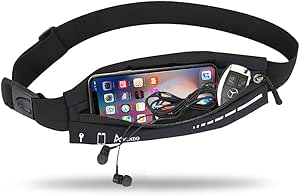
The AIKENDO makes a strong budget case through simplicity: its 2-ounce spandex build carries a phone and a few small essentials without adding much weight. Its 27–45-inch fit range covers more waist sizes than the JUCURRI, making it the more flexible choice for shared use or a changing fit. The expandable zippered pocket keeps the setup streamlined, but it offers less separation than the JUCURRI’s three pockets, so keys and cash share space with other items. Water-resistant material and reflective details help with sweat and low-light runs; they do not make the pouch waterproof. The belt’s main compromise is its single compartment, plus hand-wash-only care. I’d pick it for a light, uncomplicated carry when broad adjustability matters more than organization.
Pros:- Lightweight at 2 ounces
- Adjustable fit for 27–45-inch waists
- Expandable zippered pocket accommodates a phone and small essentials
- Reflective details and water-resistant material
Cons:- One pocket provides little separation between items
- Hand-wash-only care
Best for: Runners seeking a very light phone pouch with a broad 27–45-inch waist range, including households sharing one belt.
Not ideal for: Runners who want separate compartments for keys, cash, and a phone or machine-washable gear.
- Material:Spandex
- Color:Black
- Weight:2 ounces
- Strap length:45 inches
- Fits waist sizes:27–45 inches
- Dimensions:10.24 × 0.39 × 1.57 inches
- Pockets:1 expandable zippered pocket
- Water resistance:Water resistant
- Care:Hand wash only
Our verdict“Pick the AIKENDO for a light, adjustable single-pocket belt; choose the JUCURRI if separate storage matters more.”
AiRunTech Hydration Running Belt with Water Bottles
Unlike the Fitgriff Running Belt, which focuses on carrying a phone and small items, the AiRunTech adds two 175 ml bottles for runners who want water close at hand. Their push-pull nozzles and BPA-free construction make this the most hydration-ready belt in this group, while the pocket fits phones up to 6.5 inches. That added function comes with a noticeable tradeoff: at 6 ounces, it is heavier than the AIKENDO’s 2-ounce pouch, and runners must carry and clean the bottles. Its adjustable fit spans hips from 18 to 51.2 inches, and reflective detailing and race bib toggles suit organized outdoor events. The phone limit may rule out larger devices, and the water-resistant material is not a substitute for a waterproof case. This pick favors access to water over the lightest possible carry.
Pros:- Includes two BPA-free 175 ml bottles
- Push-pull bottle nozzles are designed to resist leaks
- Pocket fits phones up to 6.5 inches
- Wide stated hip fit and removable race bib toggles
Cons:- Heavier than simple phone belts such as the AIKENDO
- Bottles may need several washes before use
- Phone pocket size excludes larger phones
Best for: Runners and walkers who want to carry small amounts of water without holding bottles, especially during races or longer outings.
Not ideal for: Runners prioritizing the lightest possible belt or carrying a phone larger than 6.5 inches.
- Material:Neoprene
- Hip fit:18–51.2 inches
- Strap length:130 cm
- Bottle capacity:2 × 175 ml
- Bottle material:BPA-free
- Phone pocket:Fits phones up to 6.5 inches
- Weight:6 ounces
- Features:Water resistant, reflective tab, headphone hole, removable race bib toggles
Our verdict“Choose the AiRunTech when carrying water matters more than minimizing belt weight.”
Fitgriff Running Belt for Men & Women – Secure Jogging Pouch for Phone, Keys & Essentials
The Fitgriff is a straightforward option for carrying a phone and a few small items, with a main compartment for the phone and a separate small pocket for keys and cash. That layout gives it more organization than the AIKENDO’s single pocket, though it does not match the JUCURRI’s three-compartment setup. Its infinitely adjustable waist straps let the wearer fine-tune the fit, and the two reflector strips add visibility cues for dim conditions. Fitgriff says the pouch accommodates almost all smartphones, but provides no specific size limit, so buyers with unusually large devices have less certainty than they would with the AiRunTech’s stated 6.5-inch maximum. Sweat and splash resistance can help with routine runs, yet the product is not fully waterproof. This makes sense for everyday essentials, not water exposure or gear-heavy outings.
Pros:- Main phone compartment plus a separate small pocket
- Infinitely adjustable waist straps
- Fits almost all smartphones according to the product description
- Two reflector strips for low-light visibility
Cons:- Sweat and splash resistant but not fully waterproof
- No specific phone dimensions or waist range are provided
Best for: Runners who want a phone compartment, separate space for keys and cash, and a waist strap they can adjust closely.
Not ideal for: Runners needing waterproof protection, a defined fit range, or storage for bottles and larger loads.
- Phone fit:Almost all smartphones
- Compartments:Main phone compartment and small compartment for keys and cash
- Protection:Sweat and splash resistant; not fully waterproof
- Adjustability:Infinitely adjustable waist straps
- Reflectors:Two reflector strips
- Intended activities:Running, hiking, cycling, and travel
Our verdict“Choose the Fitgriff for adjustable everyday phone and essentials carry, provided splash resistance is enough.”
Running Vest Phone Holder for Men & Women, Reflective Running Chest Pack, Adjustable Breathable Vest with Multiple Pockets
When a waist belt feels too limited, this adjustable running vest spreads essentials across multiple pockets for easier organization. That gives it a different role from the JUCURRI Slim Running Belt, whose three zippered pockets keep the carry compact around the waist. The vest’s breathable design and reflective details suit running, walking, cycling, and outdoor training, while an adjustable fit offers flexibility for different wearers. Its budget-buying weakness is the lack of concrete capacity information: there is no stated size range, pocket count, bottle capacity, or water-resistance rating. Buyers can’t tell from the supplied details whether it will carry a particular phone or bottle securely, unlike the AiRunTech belt’s defined phone limit and included bottles. This is the choice for someone who values chest-mounted organization, but the sparse sizing and protection details make fit a less certain purchase.
Pros:- Multiple pockets organize essentials
- Adjustable design for men and women
- Breathable construction for active use
- Reflective details aid visibility in low light
Cons:- No specific size range is provided
- Water-resistance details are limited
- Pocket capacity and bottle capacity are unspecified
Best for: Runners and cyclists who prefer chest-mounted storage with multiple pockets and want a breathable, adjustable design.
Not ideal for: Buyers who need a confirmed fit range, specified bottle capacity, or clear water-resistance details before choosing.
- Design:Adjustable, breathable vest with multiple pockets
- Visibility:Reflective detailing
- Intended use:Running, walking, cycling, and outdoor training
- Fit:Adjustable; size range not specified
- Water resistance:Not specified
- Pocket count:Multiple; exact count not specified
Our verdict“Consider this vest if chest storage suits your routine and you can accept limited fit and capacity information.”
Slim Running Belt with Phone Holder
For runners who want to carry a phone without switching to a vest, this 2.4-ounce belt keeps the setup simple. Its adjustable strap covers 27–46-inch waists, a broader stated range than the USHAKE belt’s 26–42 inches, while the expandable zip pocket and water-resistant inner layer help shield small essentials from sweat and light weather. The reflective strips add a visibility detail that is useful on dim routes. The tradeoff is storage: with just one pocket, separating keys from a phone or carrying extra fuel is less convenient than with the six-pocket B0CR8LKMVH vest. Hand washing also takes more care than a machine-washable option. I’d choose this belt for short runs where a close-to-body fit matters more than carrying water or organizing several items.
Pros:- Lightweight at 2.4 ounces
- Adjustable fit covers 27–46-inch waists
- Zippered pocket has a water-resistant inner layer
- Reflective strips support visibility in low light
Cons:- One pocket limits organization and total carry options
- Hand-wash-only care adds upkeep
Best for: Runners who want a lightweight phone belt with a wide adjustable waist range for short outings
Not ideal for: Runners carrying water, gels, and several small items who need multiple pockets
- Brand:U·LANARO
- Model:U99
- Material:Polyester
- Weight:2.4 ounces
- Waist fit:27–46 inches
- Strap length:46 inches
- Storage:1 zippered pocket
- Water resistance:Water resistant
Our verdict“Choose this belt for a light, low-profile phone carry; pick the six-pocket B0CR8LKMVH vest if you need more storage and included water.”
Running Phone Holder Vest with 500ml Water Bottle, Reflective, Adjustable, Lightweight, 6 Pockets, Unisex
This vest earns its place for runners who want hydration and storage in one piece of gear. The included 500 ml soft flask gives it a practical advantage over the belt options in this batch, while six accessible pockets make room for a phone and other run essentials. Breathable, quick-dry fabric and reflective details suit training across changing conditions. Compared with the more compact MVRK chest pack, this vest carries water and offers more pockets, but it also asks the runner to wear a larger setup. The listed sizes span XS–S through L–XL, though fit can vary by body shape, and the product data gives little detail on material durability. I’d favor it for longer training sessions where access to water matters more than keeping the carry minimal.
Pros:- Includes a 500 ml soft flask
- Six easy-access pockets support organized carry
- Breathable, quick-dry fabric suits active use
- Reflective details aid visibility
Cons:- Vest format is more gear to wear than a slim belt
- Fit may vary across body types
- Material durability details are limited
Best for: Runners building longer training sessions who want an included flask and separate pockets for essentials
Not ideal for: Short-distance runners who want to carry only a phone and keys in a minimal belt
- Water capacity:500 ml / 17 oz
- Pockets:6
- Size options:XS–S, M–L, L–XL
- Material:Quick-dry, breathable fabric
- Reflective details:Yes
- Water resistance:Water resistant
- Included:Running vest and soft flask
- Warranty:1 year against manufacturing defects
Our verdict“Pick this vest when water and organized storage matter on longer runs; choose the MVRK chest pack for a smaller, three-pocket carry.”
Running Chest Pack Reflective Vest Water-Resistant Phone Holder Workout Bag for Runners and Cyclists
The front-and-back layout gives this chest pack a broader use case than a simple running belt: it has an 8 × 4.75-inch front pouch and a 9 × 7-inch back pouch for dividing essentials across the chest and back. An anti-bounce mesh compartment, adjustable straps, and reflective elements address comfort and visibility for running, cycling, or hiking. Compared with the MVRK pack, whose listed dimensions are compact and whose device limit is 5.5 inches, this option describes larger separate pouches but does not give a phone-size limit. That leaves some uncertainty for bulky phones and packed loads. Its water-repellent fabric can help with splashes, but the product data does not claim full waterproofing. I’d choose it for varied outdoor activities and skip it for minimal runs where a slim belt is enough.
Pros:- Front and back pouches allow separated storage
- Adjustable straps and anti-bounce mesh support a secure fit
- Reflective elements help with low-light visibility
- Water-repellent fabric suits splash-prone outings
Cons:- Phone size compatibility is not specified
- Hand-wash-only care takes extra effort
- Chest-pack format may be more than needed for short runs
Best for: Runners and cyclists who want separate front and back compartments for activity essentials
Not ideal for: Runners seeking a minimal phone-only carry or certainty that a bulky phone will fit
- Front pouch:8 × 4.75 inches
- Back pouch:9 × 7 inches
- Material:Durable, water-repellent fabric
- Compartments:Front and back pouches
- Reflective elements:Yes
- Straps:Adjustable
- Additional features:Earphone port and anti-bounce mesh compartment
- Care:Hand wash
Our verdict“Choose this pack for running and cycling with gear split between two pouches; choose the MVRK if a compact, specified phone limit suits your carry.”
MVRK Water Resistant Running Vest Chest Pack, Phone Holder for Running, Lightweight Training Pack with Reflective Detail
With three pockets and listed dimensions of 4 × 7 × 0.75 inches, this chest pack aims for a compact carry that sits between a one-pocket belt and larger multi-compartment vests. Cordura nylon, neoprene padding, and adjustable straps add structure, while reflective details suit outdoor training when visibility matters. Its clearest limitation is device fit: the stated maximum phone size is 5.5 inches, which rules out many larger phones. By comparison, the B0D3CK42XN lists larger pouch dimensions but leaves phone compatibility unclear; the B0CR8LKMVH adds a flask and six pockets for runners who want more capacity. This pack is better suited to a small phone and a few essentials than to carrying bulky gear. Hand washing and hang drying also require care.
Pros:- Three pockets offer more organization than a single-pocket belt
- Cordura nylon construction
- Neoprene padding and adjustable straps
- Reflective details support visibility
Cons:- Maximum stated device size is 5.5 inches
- Small dimensions limit bulky-item storage
- Hand wash and hang-dry care adds maintenance
Best for: Runners with a phone up to 5.5 inches who want a compact chest carry with a few organized pockets
Not ideal for: Runners with larger phones or anyone carrying bulky items and hydration
- Material:Cordura nylon
- Dimensions:4 × 7 × 0.75 inches
- Weight:0.2 kg
- Pockets:3
- Phone size limit:5.5 inches
- Padding:Neoprene
- Water resistance:Water resistant
- Straps:Adjustable
Our verdict“Choose the MVRK for a compact chest pack and smaller phone; the B0CR8LKMVH is a better fit when you need water and more storage.”
USHAKE Slim Running Belt for Women Men-Runners Phone Holder Fanny Pack, Adjustable, Bounce Free Waist Pouch bag for Workout, Money Belt, Run Gear Accessories Black
The USHAKE belt stands out for its stated 9 × 4-inch pocket and compatibility with a range of named phone families, including several Pro Max and Ultra models. That makes it a more plausible belt choice for runners whose phone may be awkward in a compact chest pack such as the MVRK, which lists a 5.5-inch device limit. Its adjustable strap fits 26–42-inch waists, a slightly narrower range than the U·LANARO belt’s 27–46 inches. The water-resistant lining is described as protection from sweat and splashes, not immersion, so I would not treat it as waterproof. The supplied data also lacks a weight, material, and pocket count, making it harder to compare build and comfort. It suits phone-first runs, but the belt format offers less organization than multi-pocket vests.
Pros:- Large stated pocket measures 9 × 4 × 2 inches
- Lists compatibility with several popular larger phone models
- Adjustable strap fits 26–42-inch waists
- Water-resistant lining is described for sweat and splashes
Cons:- Water protection is limited to splashes and should not be treated as waterproof
- No supplied weight, material, or pocket count for comparison
- Single waist-pouch format offers less organization than multi-pocket vests
Best for: Runners with a larger compatible phone who want a waist pouch for a phone and a few small essentials
Not ideal for: Runners who need multiple separated pockets, a flask, or a documented lightweight build
- Pocket dimensions:9 × 4 × 2 inches
- Waist fit:26–42 inches
- Phone compatibility:Selected iPhone, Samsung, Sony, LG, and Google Pixel models
- Water protection:Water-resistant lining for splashes; not for immersion
- Strap:Adjustable elastic strap with clip
- Color:Black
Our verdict“Choose the USHAKE belt if your larger phone fits its listed compatibility; choose the U·LANARO belt if a wider waist range matters more.”
WATERFLY Running Belt Fanny Pack for Men and Women
The WATERFLY Running Belt suits runners who want several small essentials close at hand without moving up to a vest. Its four pockets and headphone port give it more organization than the AIKENDO Slim Running Belt, which is the simpler choice for a minimal carry. The adjustable 27–48-inch waist range also gives it flexibility for different fits, while the reflective logo adds a visible detail for low-light outings.
For budget-minded runners, the tradeoff is that its larger capacity may be unnecessary if you only carry a phone and a key. The listing also does not specify water resistance, and some very large phones may not fit. Compared with bottle-carrying options such as the AiRunTech Hydration Running Belt, WATERFLY keeps the setup lighter and less specialized, but it does not address on-run hydration.
Pros:- Four pockets help separate small running essentials
- Adjustable waist accommodates a stated 27–48-inch range
- Technical spandex fabric is described as lightweight and breathable
- Reflective logo adds a visibility detail
Cons:- Very large phones may not fit
- No waterproof feature is specified
- Four-pocket capacity may be more than needed for minimal carry
Best for: Runners who want to organize a phone, keys, and other small essentials in a waist belt with an adjustable fit.
Not ideal for: Runners with very large phones, those who need stated water protection, or anyone who wants bottles integrated into their belt.
- Material:Technical spandex fabric
- Zipper:Heavy-duty SBS zipper
- Waist size:27–48 inches
- Number of pockets:4
- Headphone port:Included
- Reflective logo:Yes
Our verdict“Choose the WATERFLY if you want more pocket organization and an adjustable waist belt; pick a hydration belt if carrying water matters more.”

How We Picked
I ranked these options around the everyday decisions behind budget running gear: whether a runner needs room for a phone and small essentials, wants to carry water, or prefers a compact pouch that stays out of the way. I gave more weight to clear, useful distinctions such as multiple pockets, bottle capacity, adjustable fit, reflective details, and water-resistant construction. A feature matters here when it changes what a runner can carry or how the gear fits into a run, rather than simply adding to a product title.
The order favors versatility for common short-run needs, then recognizes products with a clear use case such as hydration or expanded storage. The JUCURRI leads for its three-pocket organization; the AiRunTech and bottle-equipped vest rank as alternatives for runners who need water. Simpler belts follow for buyers carrying fewer items, while the remaining vests and chest packs suit runners who value torso storage or specific details. Product names alone do not establish durability, fit, or performance, so I avoid treating unverified claims as proof of real-world results.
| budget running gear | Water resistance |
|---|---|
| JUCURRI Slim Running Belt with | Water resistant |
| AIKENDO Slim Running Belt for | Water resistant |
| AiRunTech Hydration Running Be | — |
| Fitgriff Running Belt for Men | — |
| Running Vest Phone Holder for | Not specified |
| Slim Running Belt with Phone H | Water resistant |
| Running Phone Holder Vest with | Water resistant |
| Running Chest Pack Reflective | — |
| MVRK Water Resistant Running V | Water resistant |
| USHAKE Slim Running Belt for W | — |
| WATERFLY Running Belt Fanny Pa | — |
Factors to Consider When Choosing Budget Running Gear
Before choosing a pouch or vest, decide what you need to carry on a typical run and where you want that weight. That simple choice can prevent paying for capacity you will not use or squeezing a phone into a setup meant for keys alone. I would also check how the gear adjusts and which details matter for your route, weather, and distance.
Start With Your Carry List
Write down what you actually take on an ordinary run: perhaps a phone and key, or also cards, gels, and a layer. A slim belt is usually the more sensible format when the list is short and compact. Multiple pockets can help keep small objects separate, but more compartments do not automatically mean more usable space for a large phone. Check the product details against your phone dimensions and any case you use. A common mistake is choosing by the number of pockets before confirming that the main item fits. If your carry list changes between short and long runs, pick a setup that handles the larger list without feeling needlessly bulky on the shorter outing.
Choose Waist or Torso Placement
Where gear sits affects how its bulk feels as you move. Waist belts keep the load low and leave the torso uncovered, while vests and chest packs put storage across the upper body. Neither placement suits everyone, so think about where a strap or pouch might rub and how much adjustment the design offers. If possible, check the adjustment range against your measurements and the clothing you normally run in. A belt that fits over a light shirt may sit differently over a jacket. Avoid assuming that a product marketed as unisex will fit every body shape equally well; adjustability and return terms can matter as much as the label.
Decide Whether You Need to Carry Water
For brief routes where you can drink before and after, a bottle-free belt may be enough and will keep the kit simpler. If you prefer water on the run, compare bottle capacity and placement with the distance and pace you expect to maintain. Waist bottles and torso-mounted bottles distribute space differently, so the better choice depends on how you like a load to sit. A bottle adds weight that can shift as it empties, making fit and secure storage more important than capacity alone. Do not assume a hydration feature replaces planning for longer outings; check what the product includes and how much water it actually carries. Paying for a bottle setup makes most sense when you will use it regularly.
Match Storage to the Run, Not the Product Title
Terms such as “multiple pockets” or “phone holder” say little about whether your essentials will fit together comfortably. Look for dimensions, closure details, and whether the layout separates a phone from keys or other hard objects. Think about whether you need quick access to a gel or card while moving, since a secure compartment can be awkward to open at speed. Bulky cases, larger phones, and extra layers can change what fits even when a pouch looks spacious. A frequent buying error is treating a photo as proof of capacity; check measurements or ask the seller if they are missing. For a short run, carrying fewer items is often more comfortable than adding a larger pack just in case.
Consider Visibility and Weather Exposure
Reflective details can help make a runner more visible when vehicle headlights or low light are part of the route, but they are not a substitute for dedicated visibility gear when conditions call for it. Water-resistant construction may help with light exposure, though the term does not promise that contents stay dry in heavy rain. Look for clear care and material details instead of assuming every chest pack offers the same protection. If you carry a phone, a separate protective case can be a more dependable precaution than relying on a pouch description alone. Also think about warmth: a vest with more coverage may feel less appealing in hot conditions than a narrow belt. Choose features that address conditions you encounter often, rather than buying every possible safeguard.
Know When a Higher-Capacity Setup Is Worth It
Extra storage is useful when a run calls for water, nutrition, or several essentials, but it brings more fabric, straps, and adjustment points into the kit. A compact belt may be the better everyday choice if most of your runs are short and close to home. A vest earns its space when you will use its capacity often enough to justify the added coverage. Before deciding, compare the full setup you need: a belt plus a separate bottle may take up more attention than one integrated carrier, while an unused vest can be cumbersome to store and wear. Product descriptions cannot tell you how a loaded pack will feel at your pace. Favor a simple setup that covers your regular run, then add capacity when your routine calls for it.
Frequently Asked Questions
Should I choose a running belt or a vest for carrying my phone?
Choose based on the size of your phone, what else you carry, and where you prefer the load to sit. A belt is a straightforward option for a phone and a few small essentials, while a vest or chest pack can provide more compartments for a larger carry list. Check product measurements against your phone, including its case, before ordering. Also think about how the gear adjusts over your usual running clothes. If you rarely need extra storage, the lighter format may make more sense for everyday use.
Do I need a running belt with a water bottle?
It depends on your route, distance, access to water, and preference for carrying fluids. Bottle-equipped options in this roundup include the AiRunTech waist belt and a vest with a 500ml bottle, so you can compare waist and torso placement. Carrying water adds weight, which makes a secure fit and comfortable distribution important. For runs where you can drink before and after, a bottle-free belt may be simpler. Choose hydration storage because it suits your routine, not just because it is available.
How can I tell whether a running pouch will fit my phone?
Look for the pouch’s internal dimensions and compare them with your phone including its case. A “phone holder” label does not tell you which phone sizes fit, and a thick case can use up space quickly. Check whether the pocket closes around the device and whether the layout leaves room for keys or other items. If the listing does not give measurements, ask the seller before buying. Packing a crowded pouch can make access harder and put hard objects against the phone.
Are reflective details enough for running in the dark?
Reflective accents can catch light from vehicles, but they do not make a runner visible in every direction or when no light shines on them. Their usefulness depends on the route and conditions. For low-light runs, think about visibility as a separate need and check whether the garment’s reflective elements are positioned where they can be seen. A vest listing that mentions reflective detail should not be treated as a guarantee of complete visibility. Choose additional visibility gear if your route or local conditions call for it.
Is a water-resistant running vest safe for a phone in heavy rain?
“Water-resistant” does not necessarily mean waterproof, and product descriptions may not specify protection during prolonged or heavy rain. If keeping a phone dry is a priority, check the seller’s stated limits and consider a separate waterproof case or pouch. Pay attention to openings and closures, since water can enter through them even when the outer material resists light exposure. A vest can still be useful for carrying essentials without serving as full weather protection. Match the protection to the conditions you expect rather than assuming the label covers every storm.
Conclusion
For most runners who want an organized way to carry essentials, I would start with the JUCURRI Slim Running Belt, whose three-pocket layout gives it the clearest all-around role. The WATERFLY Running Belt is my value-oriented choice for buyers seeking a simple belt format, while the AiRunTech Hydration Running Belt is the better fit when carrying water at the waist is the priority. For beginners, I would choose a slim belt such as the Fitgriff Running Belt if the plan is to carry only a phone and small items. The vest with a 500ml water bottle is the more capable pick for runners who want torso storage and hydration; the MVRK Water Resistant Running Vest suits those drawn to a chest pack with reflective detail and water-resistant construction. In short, choose a belt for a compact everyday load and a vest when your runs call for more space or water.
Fall Picks
fall essentials
As an affiliate, we earn on qualifying purchases.