For speed parachutes sprint training, I’d start with the SKLZ Speed Chute as the best overall pick for runners who want a recognizable, purpose-built option for acceleration work. The Kbands dual-chute set stands out for athletes seeking more training variety, while the BULLETSHAKER 48-inch chute better suits younger or smaller athletes. The main tradeoffs are chute size, waist-belt fit, and whether you need one simple drag tool or a more versatile setup. Lower-cost single chutes may cover basic sprint drills, but details such as belt adjustment, line quality, and storage can shape long-term usability. Read on for the full breakdown and buying advice.

Get workout gear delivered free with Prime
- Fast, free delivery on millions of items
- Prime Video, Amazon Music and more included
- Member-only deals all year
Complete the kit


Key Takeaways
- The SKLZ chute leads for all-around sprint use, while the Kbands set is the distinct choice for athletes who want two chutes and more resistance-training configurations.
- Most listed models use a 56-inch canopy, so the choice often comes down to belt fit, included storage, and product-specific construction details rather than a different stated diameter.
- The 48-inch BULLETSHAKER and LucaSng chutes offer a smaller-canopy alternative that may be easier to manage for younger or smaller athletes.
- Bfsmile’s two listings and KUYOU’s duplicate listing make it especially useful to compare the exact package and included accessories before choosing between near-identical names.
- A single chute is the straightforward starting point; the Kbands two-chute kit makes more sense when training variety matters enough to justify extra setup and equipment.


| speed parachutes sprint training | Material | Resistance | Diameter |
|---|---|---|---|
| EastyGold 56-Inch Running Spee | Polyester | Approximately 15–30 lbs | 56 inches |
| SKLZ Speed Chute Resistance Pa | Nylon | 15 pounds | — |
| Running Parachute for Speed Tr | Polyester | 12–33 lbs of dynamic drag | — |
| BULLETSHAKER Running Speed Tra | Polyester parachute cloth and netting | — | 48 inches |
| Bfsmile 56-Inch Running Resist | Polyester | 12–33 lbs | — |
| KUYOU 56-Inch Running Resistan | Parachute cloth and mesh | 25–50 lb in description; 25–35 lb in specifications | 56 inches |
| LucaSng 48" Speed Training Res | Parachute cloth and netting | 15–20 lb | 48 inches |
| KUYOU 56-Inch Running Resistan | Polyester | 25–50 lb | 56 inches |
| Kbands Training Dual 54 Inch W | — | — | — |
| Uyomal Running Speed Training | Parachute cloth | 11–33 lb | Approximately 56 inches |
| Nusogon Running Resistance Par | Plastic parachutes; described as waterproof-, UV- and tear-resistant | 25–50 lb | — |
| Bfsmile Running Speed Training | Polyester | Varies with running speed; no numeric range provided | 56 inches |
| Running Speed Training | Waterproof-, UV-resistant, quick-drying nylon | 15–30 lb dynamic air resistance | — |
More Details on Our Top Picks
EastyGold 56-Inch Running Speed Resistance Chute
The EastyGold pairs a 56-inch canopy with approximately 15–30 pounds of drag, a broad range suited to sprint sessions where athletes want resistance without adding a separate load. Its mesh panel is intended to steady the chute and limit cord tangling, a practical distinction from the more straightforward SKLZ Speed Chute, which lists a single 15-pound resistance level. The adjustable hook-and-loop belt makes fitting simple, while the quick-drying, waterproof, sun-resistant polyester supports outdoor use in changing conditions.
The tradeoff is that its resistance is approximate, so the actual pull may vary with running speed and conditions. It also needs a clear stretch of space to open and trail properly. I’d choose it for athletes who train outdoors and value weather-friendly materials; those seeking a specified single resistance level may prefer the SKLZ.
Pros:- 56-inch canopy offers a substantial drag surface for sprint drills.
- Approximate 15–30-pound resistance range supports varied training intensity.
- Mesh panel is designed to stabilize the chute and reduce cord tangling.
- Waterproof, sun-resistant, quick-drying fabric and included storage bag suit outdoor use.
Cons:- Resistance is approximate and may vary during a run.
- Large canopy requires a clear running area.
- Hook-and-loop belt closure may be less convenient to adjust quickly than a buckle.
Best for: Outdoor sprint trainees and multi-sport athletes who want a large canopy, adjustable belt, and materials suited to sun or wet conditions.
Not ideal for: Athletes training in a small gym or on crowded paths, since the chute needs open space to deploy safely.
- Brand:EastyGold
- Diameter:56 inches
- Resistance:Approximately 15–30 lbs
- Material:Polyester
- Belt:Adjustable hook-and-loop closure
- Stabilizing feature:Built-in mesh panel
- Weather features:Waterproof, sun resistant, and quick drying
- Included:Portable training bag
Our verdict“Choose the EastyGold if outdoor durability and a broad resistance range matter more than having a precisely stated single load.”
SKLZ Speed Chute Resistance Parachute for Speed and Acceleration Training
The SKLZ Speed Chute is the clearest choice in this group for athletes who want a single stated resistance level rather than a broader estimated range. Its listed 15-pound support gives sprint sessions a straightforward resistance target, while the 54-inch length keeps it close in scale to the 56-inch EastyGold and Bfsmile chutes. That makes it a focused option for acceleration work without the more elaborate fit details offered by the Nusogon and Bfsmile models.
The tradeoff is limited adjustability: the product data lists one resistance level, and does not specify a belt fit range or a carry bag. The nylon construction and multi-sport use are useful, but buyers seeking rotation details, quick-release hardware, or a wider stated drag range may find the Bfsmile more informative. I’d pick the SKLZ for a simple training setup, not for fine-tuning load.
Pros:- Lists a defined 15-pound resistance level for straightforward session planning.
- 54-inch length is comparable in scale to the larger 56-inch options.
- Nylon construction is suited to workout use.
- Listed for multi-sport training.
Cons:- Only one resistance level is listed, limiting load variation.
- Product data does not specify a waist-fit range or belt adjustment details.
- No carry bag is listed among the supplied product details.
Best for: Sprinters or field-sport athletes who prefer a simple chute with a clearly listed resistance level for acceleration drills.
Not ideal for: Buyers who need a documented adjustable waist range, rotating attachment, or multiple resistance settings.
- Brand:SKLZ
- Length:54 inches
- Resistance:15 pounds
- Resistance levels:1
- Material:Nylon
- Item weight:0.2 kg
- Sport use:Multi-sport
- Color:Grey / Black
Our verdict“Choose the SKLZ when a simple, stated resistance level matters more than adjustable load or detailed fit features.”
Running Parachute for Speed Training, 56 inch Resistance Parachute with Adjustable Waist Belt
The Nusogon stands out for combining a 20–42-inch adjustable waistband with a quick-release buckle and 360-degree swivel ring. That setup makes it easier to fit different athletes and supports movement without the belt attachment forcing the runner to face one direction. Its stated 12–33-pound dynamic drag also gives it a wider upper range than the SKLZ’s fixed 15-pound listing, though the force varies with sprint speed rather than staying constant.
Compared with the Bfsmile, the Nusogon shares the same waist range and broad resistance figures, but its supplied data emphasizes the swivel and quick-release details rather than a metal D-ring. It is lightweight and portable, yet the package dimensions are relatively large for a chute listed at about 200 grams, and no warranty is specified. I’d favor it for shared use across different waist sizes, not for tightly controlled resistance work.
Pros:- Adjustable waistband fits a stated 20–42-inch range.
- Quick-release buckle supports fast fitting and removal.
- 360-degree swivel ring accommodates changes in running direction.
- Lightweight design is easy to carry between training locations.
Cons:- Dynamic 12–33-pound drag changes with running speed, making load less predictable.
- Only one parachute is included.
- No warranty is listed, and package dimensions are large relative to the item weight.
Best for: Coaches and training groups sharing one chute among adult athletes with different waist sizes.
Not ideal for: Runners who need a fixed, predictable resistance load or buyers who require a stated warranty.
- Brand:Nusogon
- Material:Polyester
- Resistance:12–33 lbs of dynamic drag
- Waist range:20–42 inches
- Belt attachment:Quick-release buckle with 360° swivel ring
- Item weight:1.6 ounces
- Package weight:0.23 kg
- Included components:One drag parachute
Our verdict“Pick the Nusogon for shared training and flexible fit, but choose a fixed-load option if consistent resistance is your priority.”
BULLETSHAKER Running Speed Training Football Parachute – 48″ for Kids Resistance Sprint Trainer
The BULLETSHAKER is the lineup’s most clearly youth-focused option: its 48-inch canopy is smaller than the 56-inch EastyGold, Nusogon, and Bfsmile models, and its listed age range is 0–12 years. The 15–20-pound resistance range and 360-degree rotating belt suit basic sprint drills where a young athlete needs to run and turn without the attachment restricting direction. A carry bag and quick-drying, weather-resistant fabric also make it practical for outdoor practice.
Its main limitation is the product’s stated 20-pound maximum weight recommendation, which sharply narrows its intended user group. That figure should not be mistaken for a resistance setting; the listed drag range is separate. Compared with the SKLZ, this chute offers a rotating belt and a child-oriented size, but it is a poor fit for most adult sprinters. I’d reserve it for younger users after checking fit and suitability.
Pros:- 48-inch canopy is smaller than the 56-inch options in this lineup.
- 360-degree rotating belt supports changes in running direction.
- Listed 15–20-pound resistance range suits basic resisted sprint drills.
- Lightweight, quick-drying fabric and included carry bag support outdoor practice.
Cons:- Stated maximum weight recommendation of 20 pounds limits its intended users.
- Smaller canopy may provide less drag surface than 56-inch alternatives.
- Only one chute is included, so increasing resistance through multiple units requires additional equipment.
Best for: Parents or youth coaches seeking a smaller sprint chute for young athletes and outdoor football or field-sport drills.
Not ideal for: Adult runners and larger children, given the stated maximum weight recommendation of 20 pounds.
- Brand:BULLETSHAKER
- Diameter:48 inches
- Resistance range:15–20 lbs
- Belt rotation:360 degrees
- Material:Polyester parachute cloth and netting
- Item weight:0.22 kg
- Age range:0–12 years
- Maximum weight recommendation:20 pounds
Our verdict“Choose the BULLETSHAKER for younger athletes who fit its stated limits, not for adult sprint training.”
Bfsmile 56-Inch Running Resistance Parachute with Adjustable Waist Strap and Carrying Bag
The Bfsmile makes a strong case for athletes who want quick-release belt hardware and a broad waist fit without adding much carry weight. Its 56-inch polyester canopy is listed for 12–33 pounds of drag, with resistance increasing as running speed rises. That range resembles the Nusogon’s, but the Bfsmile specifies a rotating metal D-ring as its belt attachment and includes a carrying bag, giving buyers concrete setup details for regular sprint sessions.
The speed-dependent pull can make intensity harder to standardize than the SKLZ’s listed 15-pound level, so this is better for resisted efforts than tightly controlled load comparisons. It also should not be dragged on the ground, which calls for attention to setup and running surface. I’d choose it over the EastyGold when a quick-release buckle and stated waist range matter more than the EastyGold’s weather-related fabric claims.
Pros:- 56-inch canopy provides a large surface for resisted sprinting.
- 12–33-pound drag range increases with running speed.
- Quick-release buckle and rotating metal D-ring support convenient fitting and movement.
- 20–42-inch waist range and included bag make it practical to share and transport.
Cons:- Resistance changes with sprint speed, making training load harder to standardize.
- The chute should not be dragged on the ground.
- Product data does not list weather-resistance features.
Best for: Individual athletes who want a lightweight 56-inch chute with quick-release fitting and a belt sized for a wide range of waists.
Not ideal for: Runners seeking a fixed resistance level or training on rough ground where the canopy may be dragged.
- Material:Polyester
- Parachute diameter:56 inches
- Resistance:12–33 lbs
- Adjustable waist range:20–42 inches
- Belt attachment:Quick-release buckle with 360° rotating metal D-ring
- Item weight:0.16 kg
- Included components:Resistance parachute and carrying bag
- Sport type:Outdoor sports
Our verdict“Choose the Bfsmile for easy fitting and a wide waist range, provided you are comfortable with speed-dependent drag.”
KUYOU 56-Inch Running Resistance Training Parachute
The 360-degree rotating attachment gives this KUYOU a specific advantage for athletes who mix straight sprints with cuts and changes of direction. Its adjustable quick-release belt also makes it easier to fit and remove between efforts than a basic belt setup like the one described for the LucaSng 48-inch chute. The 56-inch canopy is aimed at stronger resistance work, but the listed load is inconsistent: the description says 25–50 pounds, while the specifications say 25–35 pounds. I would not choose it if a precise resistance target matters. Waterproof, quick-drying fabric and mesh support outdoor sessions, though the force still varies with running speed and conditions. It makes most sense for field-sport athletes who value movement flexibility over a clearly defined load.
Pros:- 360-degree rotating attachment supports changes of direction.
- Adjustable 2-inch nylon belt has a quick-release buckle.
- Waterproof, quick-drying canopy suits outdoor sessions.
- Designed for running and multiple field and ball sports.
Cons:- Resistance is listed as both 25–50 pounds and 25–35 pounds.
- Actual pull can vary with speed and conditions.
Best for: Field-sport athletes who want to add directional changes to resisted sprint drills and need a quick-release belt.
Not ideal for: Runners who need a dependable, clearly specified resistance range, since the listed figures conflict.
- Brand:KUYOU
- Diameter:56 inches
- Resistance:25–50 lb in description; 25–35 lb in specifications
- Belt:2-inch adjustable heavy-duty nylon with quick-release buckle
- Attachment:360-degree rotating ring
- Material:Parachute cloth and mesh
- Item weight:7.04 ounces
- Included:One resistance parachute and carrying bag
- Warranty:1 year
Our verdict“Choose this KUYOU for directional field-sport drills, but skip it if resistance consistency is your main priority.”
LucaSng 48″ Speed Training Resistance Parachute for Running & Sports
The 48-inch canopy and 15–20-pound resistance range make the LucaSng a lighter-load alternative to the 56-inch KUYOU models. That smaller stated range may suit runners introducing resistance work without starting with the stronger pull listed for the KUYOU 56-inch parachute, though actual drag can still depend on conditions. Its stated waist fit of up to 42 inches gives buyers a useful fit boundary that the Uyomal listing does not specify. The tradeoff is a simpler feature set: the product details do not list a rotating attachment or quick-release buckle, so it is less clearly suited to multidirectional drills or rapid belt changes. The carrying bag helps with transport, but the listed resistance range and fit make this a more limited pick for larger athletes or varied field-sport sessions.
Pros:- 48-inch canopy offers a smaller alternative to the 56-inch options.
- Stated resistance range is 15–20 pounds.
- Waist fit is specified up to 42 inches.
- Carrying bag supports portable training.
Cons:- Lower stated resistance range may not suit athletes seeking a stronger pull.
- Product details do not specify a rotating attachment or quick-release buckle.
- Specified waist fit may exclude some larger athletes.
Best for: Runners starting resisted sprint work who want a smaller canopy and a stated 15–20-pound resistance range.
Not ideal for: Athletes with waists over 42 inches or those wanting a listed rotating attachment for directional drills.
- Diameter:48 inches
- Resistance:15–20 lb
- Waist fit:Up to 42 inches
- Material:Parachute cloth and netting
- Included:Parachute and belt
- Carrying bag:Included
Our verdict“Pick the LucaSng for a more modest stated resistance range and known waist limit, not for advanced directional drills.”
KUYOU 56-Inch Running Resistance Parachute
This KUYOU stands apart from the single-chute options because its package includes two 56-inch parachutes, giving coaches or training partners a second chute for shared sessions or a two-chute setup. Like the B06XX78ZMN KUYOU, it has a 360-degree rotating ring and quick-release adjustable belt, but its listing presents the 25–50-pound resistance range without the conflicting second figure found on that sibling model. The range is still a stated limit rather than a fixed load: wind and running speed affect the pull. Waterproof, quick-drying polyester suits outdoor work, while the larger canopy and directional attachment call for enough space to run safely. This is a more training-flexible bundle than the LucaSng 48-inch chute, but it is unnecessary for a solo runner who only needs one parachute.
Pros:- Includes two 56-inch parachutes.
- 360-degree ring accommodates movement in different directions.
- Adjustable 2-inch nylon belt has a quick-release buckle.
- Waterproof, quick-drying polyester is suited to outdoor training.
Cons:- The 25–50-pound range does not provide a fixed resistance level.
- Two large chutes and directional drills require adequate training space.
Best for: Coaches, training partners, or athletes who want two chutes for shared or varied resisted sprint sessions.
Not ideal for: Solo runners seeking only one compact, straightforward chute or those without room for running and directional drills.
- Brand:KUYOU
- Diameter:56 inches
- Resistance:25–50 lb
- Material:Polyester
- Belt:Adjustable 2-inch heavy-duty nylon with quick-release buckle
- Rotation:360 degrees
- Included:Two parachutes, one adjustable waist belt, and carrying bag
- Item weight:0.24 kg
- Warranty:1 year
Our verdict“Choose this KUYOU when the included second chute will be used; for a single-runner setup, a one-chute option is simpler.”
Kbands Training Dual 54 Inch Wind Resistance Speed Parachutes | 2 Durable Running Chutes to Increase Sprint Speed with Adjustable Belt
The Kbands package is the clearest choice here for buyers who want two 54-inch chutes plus a digital running progression trainer, rather than a single chute and an open-ended workout. Compared with the KUYOU two-chute model, its standout is the included training guide; the KUYOU listing gives more detail about its rotating ring and adjustable belt, while Kbands provides little technical information beyond the belt and detachable chutes. The listing also says it can be used indoors or outdoors, but does not explain what indoor setup or space is required, so I would confirm that before planning sessions. With no resistance range, material details, or specific belt-fit information supplied, this is difficult to match to a precise training load. It suits athletes who value structured progression more than spec transparency.
Pros:- Includes two 54-inch resistance chutes.
- Digital running progression trainer is included.
- Adjustable belt is listed.
- Listing describes use indoors or outdoors.
Cons:- No resistance range or chute material is provided.
- Belt-fit limits and attachment details are not specified.
- Indoor use details are unclear from the product information.
Best for: Athletes or coaches who want a two-chute package paired with a digital running progression trainer.
Not ideal for: Buyers who need a stated resistance range, chute material, or detailed belt-fit specifications before choosing.
- Chute count:Two
- Chute diameter:54 inches
- Belt:Adjustable belt
- Chutes:Detachable
- Trainer:Digital running progression trainer included
- Listed use:Indoor or outdoor
Our verdict“Choose Kbands for its paired chutes and digital progression guide, but favor a better-documented model if specific resistance and fit details matter.”
Uyomal Running Speed Training, Speed Chute Resistance Parachute for Speed and Acceleration Training 56-Inch
The Uyomal pairs a 56-inch chute with an 11–33-pound stated resistance range, a middle-ground option between the LucaSng’s lighter 15–20-pound range and the higher ceiling listed for the KUYOU 56-inch models. Its 360-degree free-motion ring supports movement in different directions, while the quick-release buckle is useful for repeated acceleration starts. The listing also describes the chute releasing during a run for overspeed training, a feature not stated for the LucaSng or Kbands. Mesh panels are intended to reduce string tangles and stabilize the canopy. However, the product data does not specify belt dimensions, weight, or included accessories, so fit and packability are harder to judge than with the KUYOU listings. It is a feature-rich choice, but buyers should accept those missing details.
Pros:- 56-inch canopy has a stated 11–33-pound resistance range.
- 360-degree free-motion ring supports movement in any direction.
- Quick-release buckle suits repeated acceleration efforts.
- Mesh panels are designed to reduce tangling and stabilize the chute.
Cons:- Belt dimensions and product weight are not specified.
- Included accessories are not listed in the provided product data.
- Resistance still depends on running conditions.
Best for: Runners and field-sport athletes seeking acceleration bursts, directional movement, and a stated mid-range resistance span.
Not ideal for: Buyers who need published belt dimensions, product weight, or a detailed list of included accessories.
- Diameter:Approximately 56 inches
- Resistance:11–33 lb
- Belt:Adjustable waist belt with quick-release buckle
- Rotation:360-degree free-motion ring
- Material:Parachute cloth
- Canopy feature:Built-in mesh panels
- Training use:Speed, acceleration, stamina, and strength training
- Listed sports:Track and field, football, soccer, and basketball
Our verdict“Pick the Uyomal for acceleration-focused drills and directional freedom, provided its unspecified fit and accessory details are acceptable.”
Nusogon Running Resistance Parachutes with Adjustable Waist Belt
The Nusogon stands out for sprint sessions where one resistance setting may not suit every drill: its two 56-inch chutes let athletes vary the drag setup. The stated 25–50 lb resistance range offers more scope than the single-chute Bfsmile 56″ Parachute, whose description emphasizes a lightweight, portable setup rather than a two-canopy arrangement. An anti-tangle mesh and quick-release buckle also address practical issues during repeated starts and stops. Its listed materials are waterproof-, UV- and tear-resistant, which may suit outdoor training, but the description does not explain how resistance changes with each configuration or running speed. The belt’s size range is also unspecified, unlike the Bfsmile model’s stated 20–42-inch fit. I’d favor Nusogon for athletes who want configuration options, not buyers who need clearly documented belt sizing.
Pros:- Two 56-inch canopies allow more than one resistance setup.
- Listed resistance range of 25–50 lb supports varied training demands.
- Quick-release buckle allows rapid removal between repetitions.
- Anti-tangle mesh and weather-resistant material suit outdoor sprint sessions.
Cons:- Waist belt size range is not provided.
- The description does not clarify how the two canopies produce the stated resistance range.
- No warranty information is listed.
Best for: Track, football, or rugby athletes who want to vary drag across sprint drills and can confirm the belt fits before buying.
Not ideal for: Athletes who need a specified waist range or a clearly explained resistance setting for structured training.
- Canopy diameter:56 inches
- Resistance:25–50 lb
- Canopies:2
- Belt:Adjustable nylon waist belt with quick-release safety buckle
- Material:Plastic parachutes; described as waterproof-, UV- and tear-resistant
- Color:Black
- Package weight:0.38 kg
- Included components:2 drag parachutes
Our verdict“Choose Nusogon if you want a two-canopy setup for adjustable sprint drag and do not need a published belt size range.”
Bfsmile Running Speed Training 56″ Parachute with Adjustable Strap and Carry Bag
For an individual sprinter who wants a simple chute that is easy to pack, this Bfsmile pairs a 56-inch canopy with a light 0.22 kg build and a carry bag. Its clearest advantage over the Nusogon is fit information: the 20–42-inch adjustable waist gives buyers a useful sizing check, while Nusogon’s belt range is not specified. The single-chute design is less configurable than Nusogon’s two-canopy set, but it keeps the setup straightforward for solo acceleration drills and field sessions. Resistance is not given as a fixed figure, and the description notes that drag varies with running speed, so it is a less predictable choice for athletes following tightly controlled loading progressions. The maker also advises careful handling and avoiding rough or uneven ground, which limits where I’d use it.
Pros:- 20–42-inch adjustable waist range helps buyers check fit before purchase.
- Lightweight 0.22 kg construction is easy to carry to training.
- Carry bag is included for transport and storage.
- Durable buckle system is described as supporting quick setup.
Cons:- Resistance is not stated as a numerical range and varies with running speed.
- Careful handling is advised to reduce the risk of damage.
- Not recommended for rough or uneven ground.
Best for: Solo runners and field-sport athletes who need a lightweight chute with a clearly stated waist fit and a carry bag.
Not ideal for: Athletes seeking multiple resistance configurations, a stated resistance range, or training on rough and uneven surfaces.
- Diameter:56 inches
- Waist adjustment:20–42 inches
- Material:Polyester
- Weight:0.22 kg (about 200 g)
- Buckle:Durable buckle system
- Included accessory:Carry bag
- Resistance:Varies with running speed; no numeric range provided
Our verdict“Pick this Bfsmile for portable, single-chute sprint work when a published belt range matters more than adjustable canopy configurations.”
Running Speed Training, 56 inch Speed Drills Resistance Parachute Running Sprint Chute Soccer Football Sport Speed Training
This model is the lightest option in this three-product group by its stated weight: 160 g, with an included pouch for carrying between sessions. Its 15–30 lb dynamic resistance gives buyers a stated range, unlike the Bfsmile 56″ Parachute, which does not provide a numeric resistance figure. The 20–42-inch Velcro belt also makes sizing easier to judge than the Nusogon’s unspecified belt range. A grid panel is described as helping limit tangling, and the maker lists use for several field and court sports. The tradeoff is that the Velcro closure may not suit athletes who prefer a buckle-style quick release, and the description’s claim that users can add one to three parachutes leaves the setup and compatibility details unclear. I’d choose it for portable drills, not for buyers seeking thoroughly specified multi-chute rigging.
Pros:- 160 g listed weight and included pouch support easy transport.
- 15–30 lb dynamic resistance range is specified.
- 20–42-inch adjustable belt provides a clear fit range.
- Waterproof-, UV-resistant, quick-drying nylon and grid panel are described for outdoor use and reduced tangling.
Cons:- Uses a Velcro belt rather than the quick-release buckle found on the Nusogon and Bfsmile models.
- Instructions and compatibility details for adding multiple parachutes are not provided.
- The description does not specify a warranty term.
Best for: Multi-sport athletes who want a light, packable chute with a stated resistance range and a defined waist fit.
Not ideal for: Sprinters who prefer a quick-release buckle or need clear instructions for scaling resistance with multiple chutes.
- Canopy diameter:56 inches
- Resistance:15–30 lb dynamic air resistance
- Waist fit:20–42 inches
- Belt closure:Adjustable Velcro belt
- Material:Waterproof-, UV-resistant, quick-drying nylon
- Weight:160 g
- Included accessory:Carrying pouch
- Design feature:Built-in grid panel described as helping prevent tangling
Our verdict“Choose this chute for lightweight, portable multi-sport sprint drills if its Velcro belt and unclear multi-chute setup fit your training needs.”
How We Picked
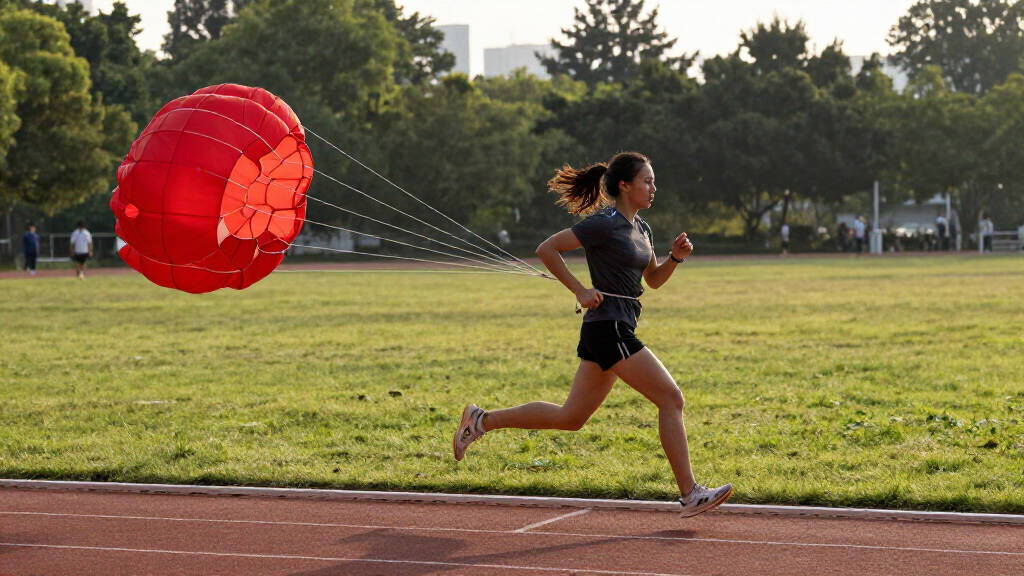
I ranked these options around the job a speed chute needs to do: add controlled drag during sprint starts without making setup, fit, or storage a nuisance. I weighed the stated canopy size, belt adjustability, whether a carrying bag is listed, and whether the product is a single chute or a dual set. I also separated smaller 48-inch options from the many 56-inch models because canopy size can affect how much wind resistance the runner encounters, though actual drag varies with wind and running speed.
The order reflects how clearly each product fits a buyer’s training needs, not a claim that every model has been tested side by side. The SKLZ chute ranks first as a broadly suitable single-chute choice; Kbands ranks higher for specialized variety, while smaller chutes earn a place for younger or smaller runners. Similar or duplicate listings are treated cautiously: buyers should verify the exact seller listing, package contents, belt details, and return terms rather than assume products with matching names are identical.
Factors to Consider When Choosing Speed Parachutes Sprint Training
Choosing a sprint chute is less about chasing the biggest canopy and more about matching resistance to your training and the runner wearing it. I’d check the fit and attachment setup before focusing on small differences between products with similar stated sizes.
Match Canopy Size to the Athlete and Workout
A larger canopy can catch more air, but the resistance is not fixed: wind direction, gusts, running speed, and fabric shape all affect the pull. That makes a 56-inch chute a common all-around size in this lineup, not a guarantee of a particular training load. A 48-inch option may feel more manageable for younger or smaller runners, though it still needs to fit securely and stay clear of the legs. Avoid choosing by diameter alone; the runner’s ability to keep sprint form matters more than maximizing drag. If you train in changeable winds, start with shorter efforts and stop if the chute pulls the torso out of position.
Check Belt Fit and Attachment Security
The waist belt transfers the chute’s pull to the runner, so adjustability and a secure closure matter as much as canopy size. A belt that slides or pinches can distract from sprint mechanics and turn a simple drill into repeated setup adjustments. Check whether the belt can fit the intended athlete over their usual training clothes, especially if several people will share the chute. Inspect the connection points and lines before each session; frayed stitching or damaged clips can make a workout unsafe. For a team, a belt that adjusts quickly between runners may be more useful than a small difference in canopy dimensions.
Decide Whether One Chute Is Enough
Most options here are single chutes, which keep the routine simple: attach the belt, sprint, and pack the equipment away. A dual set such as Kbands’ can support different setups or give coaches more ways to organize resistance work, but it also brings extra gear to manage. More equipment does not automatically mean better sprint training; unplanned resistance can encourage poor posture or overstriding. Pick a dual system when you have a clear progression or group-training use for it. If you mainly want occasional acceleration drills, a single chute is usually the more practical format.
Treat Storage and Portability as Training Features
A carrying bag can help keep the chute, belt, and lines together between sessions, especially when the equipment travels in a gym bag or team kit. It does not make the chute more effective, but it can reduce the chance that a small part goes missing. After use, let damp fabric dry before storing it to limit odor and wear. Avoid leaving a packed chute in a hot car or tossing it into a bag while the lines are tangled. If you train away from home, compare the full packed setup rather than looking only at the canopy.
Set Resistance Without Sacrificing Sprint Form
A chute is meant to add drag while the athlete still runs with crisp mechanics. If the pull forces a runner to lean excessively, shorten their stride unnaturally, or lose control, the resistance is too demanding for that drill. Begin with a few short efforts in open space and allow full recovery between sprints. Wind can change the load from one repetition to the next, so avoid treating every run as an identical resistance test. Coaches should use the chute as one training tool, not a replacement for unresisted sprinting and technique work.
Compare Similar Listings by Package Details
Several products in this roundup have very similar names and stated 56-inch sizes, including repeated KUYOU and Bfsmile listings. When names overlap, compare the actual listing details: what comes in the package, how the belt adjusts, whether a bag is included, and what support or return terms apply. Do not assume that matching product titles mean the same seller, materials, or bundle. Photos can help identify included parts, but written specifications are better for checking fit and package contents. This simple comparison can prevent choosing a near-duplicate listing that lacks an accessory you expected.
Frequently Asked Questions
Is a 56-inch speed parachute too much resistance for a beginner?
Not automatically, but canopy diameter alone cannot tell you how hard the chute will pull. Wind, speed, and the athlete’s size all affect the load, so a beginner should start with short, controlled runs in calm conditions. The 48-inch BULLETSHAKER or LucaSng models may be easier to manage for smaller athletes, while a 56-inch chute can still work if the runner keeps sound sprint form. Stop or reduce the effort if the belt shifts or the athlete’s posture breaks down. Build up gradually rather than trying to make every repetition maximally difficult.
Should I choose the Kbands dual set or a single chute?
Choose the Kbands set if you have a specific use for two chutes, such as coach-led sessions or varied resistance setups. A single model is simpler to pack, fit, and use for standard acceleration drills, and it avoids paying for extra equipment that may stay unused. The dual format does not replace a training plan or guarantee better sprint results. Think about how many athletes will share the gear and how much setup time your sessions allow. If your routine is still taking shape, beginning with one chute is the less complicated choice.
Can I use a sprint parachute for soccer or football training?
Yes, a chute can add resistance to straight-line acceleration drills used by field-sport athletes. It is less suited to drills that require frequent cuts, close contact, or crowded play, since the canopy and lines need clear space behind the runner. Products in this roundup name running, soccer, or football use, but the athlete still needs a safe, open lane. Keep the chute work separate from ball drills unless the setup is specifically designed for that activity. Use unresisted practice as well so the athlete develops speed without drag.
Does a carrying bag matter when choosing a speed chute?
A bag is useful for keeping the belt, chute, and lines together, particularly for athletes who travel between fields or share equipment. It does not change the resistance or sprint performance, so it should not outweigh fit and attachment quality. If you already have a gear bag with a separate pocket, the accessory may matter less. Dry the fabric before packing it away to reduce moisture-related wear and odor. Compare the exact package contents because similar product names may refer to different bundles.
How do I choose between the repeated KUYOU or Bfsmile listings?
Start by checking whether the listings have the same seller, package contents, belt description, and included storage rather than relying on the product name. The roundup contains repeated or very similar names, so the title alone does not establish that the items are identical. Review the stated dimensions and photos for the specific listing you plan to buy, then check its return terms and support details. If the specifications appear indistinguishable, choose based on the clearest listing information and the package that matches your needs. Do not assume a duplicate title means one version has better construction.
Conclusion
For most runners who want one straightforward tool for acceleration drills, I’d choose the SKLZ Speed Chute as best overall. The best value direction is a simple single 56-inch model such as EastyGold, KUYOU, or Bfsmile, provided the exact listing confirms the belt and accessories you need. For a more specialized setup, Kbands is my premium pick because it includes two chutes and offers more training options, though that extra gear will not suit every athlete. Beginners and younger runners can start with a 48-inch option such as BULLETSHAKER, while field-sport athletes should pick a model that fits securely and use it in a clear sprint lane. If portability matters most, prioritize a listing that clearly includes a carrying bag; if you are comparing near-identical listings, verify package details before deciding.