Running watches with GPS track pace and distance without relying on your phone, but accuracy, training tools, battery life, and ease of use vary widely. My best overall pick is the Garmin Forerunner 165, which pairs running-focused tools with a bright AMOLED display. The Forerunner 55 is a simpler choice for runners who want core training guidance, while the Mibro GS Active2 stands out for its dual-band GPS positioning. Less-established models in this roundup may add calling or broad fitness features, but their running capabilities are harder to compare from the available specifications. Read on for the full breakdown and the tradeoffs that matter before choosing.

Get workout gear delivered free with Prime
- Fast, free delivery on millions of items
- Prime Video, Amazon Music and more included
- Member-only deals all year
Complete the kit


Key Takeaways
- The Garmin Forerunner 165 is the strongest all-round running choice in this lineup, with a running-first focus and an AMOLED display; choose the Forerunner 55 if you prefer a simpler feature set.
- Forerunner 55 listings appear in several colors and conditions, including a renewed option. Compare the exact listing and condition rather than assuming each listing represents a different watch.
- Dual-band GPS is a standout differentiator on the Mibro GS Active2 listing, which may appeal to runners whose routes pass through buildings or tree cover, though GPS performance still depends on conditions.
- Some alternatives emphasize calls, large displays, or general fitness tracking rather than established running tools, so feature breadth alone does not make a watch a stronger training companion.
- Battery claims need context: GPS workouts usually draw more power than everyday smartwatch use, so check whether a quoted battery figure applies to continuous GPS tracking or mixed use.
| Garmin Forerunner 165 Running Smartwatch, 43mm, Whitestone |  | Best Overall | Display: AMOLED touchscreen | Case size: 43 mm | GPS battery life: Up to 19 hours | VIEW LATEST PRICE | See Our Full Breakdown |
| HUAKUA Smart Watch for Men and Women with GPS, Bluetooth Calling, and Fitness Tracking |  | Best for Calling on the Run | Display: 1.95-inch HD full-touch screen | GPS: Built-in GPS | GPS battery life: Up to 14 hours | VIEW LATEST PRICE | See Our Full Breakdown |
| Smart Watches for Women, GPS, 2.01″ HD Fitness Watch Rose Gold |  | Best Style-Focused Pick | Display: 2.01-inch HD touchscreen | GPS: Built-in GPS with geotagging | Battery: 360mAh; up to 7 days | VIEW LATEST PRICE | See Our Full Breakdown |
| GPS Running Watch for Men & Women, Waterproof, Long Battery Life, with Heart Rate, Blood Oxygen, and Music Control |  | Best for Long Outdoor Wear | Display: 2.06-inch AMOLED | Water resistance: 50 meters / 5ATM | Battery life: Up to 7 days heavy use; 20 days light use; 30 days standby | VIEW LATEST PRICE | See Our Full Breakdown |
| Smart Watch for Women and Men, GPS Built-in, Answer/Make Calls, Black |  | Best for GPS and Calling | Display: 2.01-inch AMOLED, 360 × 360 resolution | Display brightness: 500 candela per square meter | GPS: Built-in GPS with geotagging | VIEW LATEST PRICE | See Our Full Breakdown |
| Garmin vívoactive® 5, Health & Fitness GPS Smartwatch, 42mm, Ivory |  | Best for Everyday Fitness and Health Tracking | Display: AMOLED | Case size: 42mm | Battery life: Up to 11 days | VIEW LATEST PRICE | See Our Full Breakdown |
| Garmin Forerunner 55 GPS Running Smartwatch, Black |  | Best for Beginner Runners | Display size: 1.04 inches | Weight: 37g | Satellite navigation: GPS, GLONASS, Galileo | VIEW LATEST PRICE | See Our Full Breakdown |
| Amazfit Bip 6 Smart Watch, 1.97″ AMOLED Display, GPS, iOS/Android Compatible |  | Best for a Large Display and Long Battery Life | Display: 1.97-inch AMOLED | Case shape and size: 46mm rectangular | Battery life: Up to 14 days | VIEW LATEST PRICE | See Our Full Breakdown |
| Garmin Forerunner 55 GPS Running Watch with Daily Suggested Workouts, Up to 2 Weeks Battery Life, Aqua | 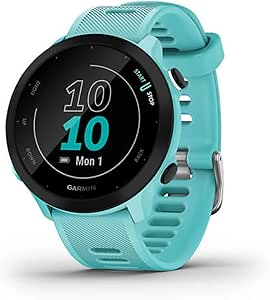 | Best for Guided Training and Battery Life | Display: 1.04-inch transflective MIP, sunlight-visible | Resolution: 480 x 272 | Built-in GPS: Yes | VIEW LATEST PRICE | See Our Full Breakdown |
| Mibro GS Active2 GPS Running Smartwatch with Dual Band GPS, Lightweight |  | Best for Dual-Band GPS and Lightweight Fit | Display: 1.32-inch AMOLED | Weight: 39g | GPS: Dual-band GPS | VIEW LATEST PRICE | See Our Full Breakdown |
| Garmin Forerunner 165 Running Smartwatch, 43mm, Black |  | Best Overall | Display: AMOLED touchscreen | Case size: 43 mm | Satellite navigation: GPS | VIEW LATEST PRICE | See Our Full Breakdown |
| GPS Running Watch for Men & Women with Heart Rate, Blood Oxygen, and 50m Waterproof |  | Best for Long Battery Life | Display: 2.06-inch AMOLED | Water resistance: 50m / 5ATM | Battery life: 7 days heavy use; 20 days light use; 30 days standby | VIEW LATEST PRICE | See Our Full Breakdown |
| Garmin Forerunner 55 GPS Running Watch with Daily Suggested Workouts, Up to 2 Weeks Battery Life, Black |  | Best for Beginner Runners | Display: 1.04-inch sunlight-visible transflective MIP; 208-pixel resolution | Battery life: Up to 2 weeks in smartwatch mode; up to 20 hours in GPS mode | Connectivity: Bluetooth | VIEW LATEST PRICE | See Our Full Breakdown |
| Smart Watch for Men, GPS Fitness Tracker with Heart Rate, Sleep Monitoring, Pedometer, Bluetooth Calls & Notifications, 170+ Exercise Modes, 5 ATM Water Resistance |  | Best for Calls and Everyday Connectivity | Display: 1.43-inch AMOLED, 466×466 resolution | Water resistance: 50 meters (5 ATM) | Exercise modes: 170+ | VIEW LATEST PRICE | See Our Full Breakdown |
| Garmin Forerunner 55 GPS Running Watch (Renewed) |  | Best Renewed Running Pick | Condition: Renewed | GPS battery life: Up to 20 hours | Smartwatch battery life: Up to 2 weeks | VIEW LATEST PRICE | See Our Full Breakdown |
| running watches with GPS | Display | Water resistance | Battery life | Connectivity |
|---|---|---|---|---|
| Garmin Forerunner 165 Running | AMOLED touchscreen | 50 meters | — | Bluetooth, Wi-Fi, and USB |
| HUAKUA Smart Watch for Men and | 1.95-inch HD full-touch screen | IP68 | Up to 7 days | — |
| Smart Watches for Women | 2.01-inch HD touchscreen | 1ATM | — | Bluetooth and GPS |
| GPS Running Watch for Men & Wo | 2.06-inch AMOLED | 50 meters / 5ATM | Up to 7 days heavy use; 20 days light use; 30 days standby | Bluetooth and GPS |
| Smart Watch for Women and Men | 2.01-inch AMOLED, 360 × 360 resolution | Water-resistant; listed as 164 feet | — | — |
| Garmin vívoactive® 5 | AMOLED | 50 meters | Up to 11 days | — |
| Garmin Forerunner 55 GPS Runni | — | 50 meters | Extended battery life; duration not specified | Bluetooth |
| Amazfit Bip 6 Smart Watch | 1.97-inch AMOLED | 50 meters | Up to 14 days | — |
| Garmin Forerunner 55 GPS Runni | 1.04-inch transflective MIP, sunlight-visible | — | Up to 2 weeks | Bluetooth |
| Mibro GS Active2 GPS Running S | 1.32-inch AMOLED | 5ATM | 15 days | — |
| Garmin Forerunner 165 Running | AMOLED touchscreen | Listed as water resistant to 50 meters; description also lists IPX7 | Up to 11 days in smartwatch mode; up to 19 hours in GPS mode | Bluetooth, USB, Wi-Fi |
| GPS Running Watch for Men & Wo | 2.06-inch AMOLED | 50m / 5ATM | 7 days heavy use; 20 days light use; 30 days standby | Bluetooth; iOS and Android |
| Garmin Forerunner 55 GPS Runni | 1.04-inch sunlight-visible transflective MIP; 208-pixel resolution | — | Up to 2 weeks in smartwatch mode; up to 20 hours in GPS mode | Bluetooth |
| Smart Watch for Men | 1.43-inch AMOLED, 466×466 resolution | 50 meters (5 ATM) | — | Bluetooth 5.4 |
| Garmin Forerunner 55 GPS Runni | — | — | — | — |
More Details on Our Top Picks
Garmin Forerunner 165 Running Smartwatch, 43mm, Whitestone
The Garmin Forerunner 165 is my strongest pick here for runners who want a watch centered on training rather than a large general-purpose smartwatch. Its built-in GPS, wrist-based heart-rate tracking, and training plans make it more running-focused than the HUAKUA Smart Watch, whose listed strengths lean toward calling and broad activity tracking. The 43mm AMOLED display is bright and easy to read, while the lighter 1.38-ounce case is less imposing than the larger-screen alternatives in this lineup. Battery life reaches up to 19 hours in GPS mode, giving runners room for regular training without daily charging. The tradeoff is a more involved interface, and safety features and notifications depend on smartphone pairing. Choose it for focused run tracking; skip it if you mainly want a simple calling watch.
Pros:- Built-in GPS and wrist-based heart-rate monitoring support phone-free run tracking
- Up to 19 hours of battery life in GPS mode
- Lightweight 1.38-ounce case with a 43mm AMOLED touchscreen
- Training plans, health tracking, notifications, and contactless payments
Cons:- Some runners may find GarminOS menus and features complex
- Notifications and safety features require smartphone pairing
- 50-meter water resistance is less suitable for deep-water activities
Best for: Runners who want Garmin training features, built-in GPS, and a relatively compact watch for regular road and fitness runs.
Not ideal for: Buyers who want a very simple interface, phone-independent safety features, or a watch intended for deep-water use.
- Display:AMOLED touchscreen
- Case size:43 mm
- GPS battery life:Up to 19 hours
- Smartwatch battery life:Up to 11 days
- Water resistance:50 meters
- Weight:1.38 ounces
- Connectivity:Bluetooth, Wi-Fi, and USB
- Operating system:GarminOS
Our verdict“Choose the Forerunner 165 if running-focused training tools and a lighter, smaller watch matter more than a simple interface or extensive calling features.”
HUAKUA Smart Watch for Men and Women with GPS, Bluetooth Calling, and Fitness Tracking
The HUAKUA Smart Watch suits buyers who want GPS tracking alongside a speaker and microphone for Bluetooth calls. That combination gives it a different emphasis from the Garmin Forerunner 165, which is the more clearly running-oriented pick in this group. HUAKUA lists built-in GPS, so it can record outdoor activity without relying on the phone for location, and its 1.95-inch screen gives pace and workout information plenty of room. More than 100 sport modes add flexibility for people who move between running and other activities. The main compromise is endurance during a workout: the stated battery life falls to 14 hours with GPS, compared with the Forerunner 165’s 19 GPS hours. App compatibility and software-update details are also sparse, making this a less certain choice for runners who prioritize a well-documented training platform.
Pros:- Built-in GPS tracks outdoor activities without phone-based location
- Bluetooth calling with an integrated speaker and microphone
- Large 1.95-inch HD touchscreen
- More than 100 listed activity modes
Cons:- GPS battery life is listed at 14 hours, below the Forerunner 165’s 19 hours
- Battery life drops considerably when GPS is active
- App compatibility and software-update support are not clearly detailed
Best for: Casual runners who want built-in GPS plus Bluetooth calls and a large screen for everyday notifications and mixed workouts.
Not ideal for: Runners who need longer GPS-session endurance or detailed information about the companion app and software support.
- Display:1.95-inch HD full-touch screen
- GPS:Built-in GPS
- GPS battery life:Up to 14 hours
- Battery life:Up to 7 days
- Call functionality:Bluetooth calling with speaker and microphone
- Sport modes:100+
- Water resistance:IP68
- Health monitoring:Heart rate, blood oxygen, and sleep analysis
Our verdict“Pick the HUAKUA if calling and a large display matter as much as casual GPS tracking, but favor the Forerunner 165 for longer, training-focused runs.”
Smart Watches for Women, GPS, 2.01″ HD Fitness Watch Rose Gold
This rose-gold GPS watch is the style-first option in this batch, pairing a 2.01-inch touchscreen with built-in GPS, Bluetooth calling, and more than 110 sport modes. It has a broader smartwatch presentation than the Garmin Forerunner 165, whose smaller 43mm display and training emphasis are better suited to runners who want a dedicated running companion. The large screen can make route and workout information easier to see at a glance, while the listed Android and iOS support gives it appeal for phone users across platforms. Its tradeoffs matter for serious training: battery life is stated as up to seven days, but extended GPS and calls reduce it, and the listed 1ATM water resistance is a poor fit for swimming-focused use. The supplied Wear OS 3.0 claim and app details may also merit verification before purchase.
Pros:- Built-in GPS with geotagging for outdoor activity tracking
- Large 2.01-inch touchscreen and customizable watch faces
- Bluetooth calling and message notifications
- More than 110 listed sport modes
Cons:- Battery life can fall with extended GPS and call use
- Listed 1ATM water resistance is limited for swimming
- Full functionality depends on a compatible smartphone
Best for: Style-conscious runners who want built-in GPS, calling, and a large display for casual outdoor workouts and everyday wear.
Not ideal for: Frequent swimmers or runners seeking long GPS sessions and a clearly documented training-focused platform.
- Display:2.01-inch HD touchscreen
- GPS:Built-in GPS with geotagging
- Battery:360mAh; up to 7 days
- Water resistance:1ATM
- Sport modes:110+
- Connectivity:Bluetooth and GPS
- Compatibility:Android and iOS
- Materials:Aluminum case and silicone band
Our verdict“Choose this rose-gold model for a large, dressier GPS smartwatch for casual workouts, not for swimming or demanding run schedules.”
GPS Running Watch for Men & Women, Waterproof, Long Battery Life, with Heart Rate, Blood Oxygen, and Music Control
This watch stands out for combining built-in GPS with a 50-meter water-resistance rating and a battery claim tailored to less frequent charging: up to seven days under heavy use or 20 days under light use. For runners who also swim or spend long stretches outdoors, that is a more versatile mix than the HUAKUA Smart Watch, whose listed water-resistance details do not specify a meter rating and whose GPS battery life is 14 hours. The 2.06-inch AMOLED display and altimeter and barometer add useful context beyond basic pace and distance, while more than 170 sports modes cover activities beyond running. The tradeoff is that many smartwatch functions rely on a paired phone, and the listing cautions against hot showers and high-velocity water sports. Its large screen may also be less appealing to runners who want a compact fit.
Pros:- Built-in GPS with real-time pace, distance, and route tracking
- 50-meter or 5ATM water-resistance rating
- Battery life listed at up to 20 days with light use
- Altimeter, barometer, and more than 170 sports modes
Cons:- Full functionality requires smartphone pairing
- Listing does not give a specific GPS-mode battery-life figure
- Not intended for hot showers or high-velocity water sports
Best for: Outdoor runners who want GPS, a large AMOLED screen, broad activity tracking, and a watch rated for swimming.
Not ideal for: Runners who prefer a compact, running-specialist design or need clear details about phone-independent features and GPS runtime.
- Display:2.06-inch AMOLED
- Water resistance:50 meters / 5ATM
- Battery life:Up to 7 days heavy use; 20 days light use; 30 days standby
- Sports modes:170+
- GPS and sensors:Built-in GPS, altimeter, and barometer
- Connectivity:Bluetooth and GPS
- Compatibility:Android and iOS
- Materials:Aluminum case with silicone and fabric bands
Our verdict“Choose this model for a versatile outdoor GPS watch with swimming-rated water resistance and long light-use battery life, rather than a compact run-first design.”
Smart Watch for Women and Men, GPS Built-in, Answer/Make Calls, Black
The black GPS smartwatch is a practical fit for runners who want phone-independent location tracking plus Bluetooth calling and notifications in one device. Its built-in GPS with geotagging makes it more suitable for route recording away from a phone than a basic connected fitness tracker, while the 2.01-inch AMOLED screen offers a larger viewing area than the Garmin Forerunner 165’s 43mm display. That size also means it is less compact on the wrist. The watch lists up to seven days of battery life, but heavy GPS and call use can shorten that span; no dedicated GPS runtime is provided. Compared with the HUAKUA Smart Watch, it has a similar call-and-GPS appeal, but its app compatibility details are also limited. This is a broad-use smartwatch choice, not the clearest pick for runners who want documented training tools.
Pros:- Built-in GPS with geotagging for outdoor route tracking
- Bluetooth calling and message notifications
- 2.01-inch AMOLED display with 500-nit listed brightness
- Up to 7 days of listed battery life
Cons:- GPS and call use can reduce battery life, with no separate GPS runtime listed
- App compatibility details are limited
- The 2.01-inch display may feel large for runners who prefer compact watches
Best for: Runners who want built-in route tracking and Bluetooth calls in a large-screen smartwatch for workouts and everyday use.
Not ideal for: Training-focused runners who need a stated GPS-mode runtime, detailed app support, or a smaller watch face.
- Display:2.01-inch AMOLED, 360 × 360 resolution
- Display brightness:500 candela per square meter
- GPS:Built-in GPS with geotagging
- Battery:360mAh; up to 7 days
- Water resistance:Water-resistant; listed as 164 feet
- Operating system:Wear OS 3.0
- Weight:1.6 ounces
- Case and band:Aluminum case and silicone band
Our verdict“Pick this model for a large-screen smartwatch that combines GPS route tracking and calls, but choose the Forerunner 165 for clearer running-focused training support.”
Garmin vívoactive® 5, Health & Fitness GPS Smartwatch, 42mm, Ivory
The vívoactive 5 suits runners who want GPS as part of a broader health-and-fitness watch, rather than a running-first training tool. Its AMOLED display gives workout and wellness information a bright, colorful presentation, while up to 11 days of battery life reduces charging interruptions. Sleep Coaching, HRV and Body Battery add context to daily recovery, and music storage can be useful for runs without a phone. Compared with the Forerunner 55, this model puts more emphasis on health features and screen presentation; the Forerunner offers more explicitly running-focused guidance, including daily suggested workouts on the listed version. The vívoactive 5’s 42mm case and broad activity selection make it versatile, but buyers seeking detailed run-training direction may prefer the Forerunner. Full functionality also depends on pairing a smartphone.
Pros:- AMOLED display makes watch information vivid and easy to read
- Up to 11 days of battery life supports regular wear between charges
- Body Battery, Sleep Coaching and HRV add wellness and recovery context
- Music storage and multiple sports modes extend its usefulness beyond running
Cons:- Less explicitly focused on running workouts than the Forerunner 55
- Some functionality requires a paired smartphone
- 50-meter water resistance is not intended for deep diving
Best for: Runners who want a bright everyday smartwatch with GPS, wellness tracking, music storage and support for several kinds of workouts
Not ideal for: Runners focused on structured run training and running-specific guidance, or buyers who want every smartwatch feature to work without a paired phone
- Display:AMOLED
- Case size:42mm
- Battery life:Up to 11 days
- Water resistance:50 meters
- Operating system:GarminOS
- Supported sports:Cardio, exercise and fitness, running, training, yoga
- Health and wellness features:Body Battery, Sleep Coaching, HRV, menstrual and pregnancy tracking
- Additional features:Music storage, Garmin Pay
Our verdict“Choose the vívoactive 5 if you want GPS running alongside colorful smartwatch features and broad health tracking, rather than a running-first training watch.”
Garmin Forerunner 55 GPS Running Smartwatch, Black
The Forerunner 55 is a straightforward choice for runners who want reliable GPS basics and guidance without a large, feature-heavy watch. Its support for GPS, GLONASS and Galileo gives it multiple satellite systems for positioning, while personalized training suggestions and running metrics can help make regular runs more purposeful. At 37g, it is also a light option for all-day wear. Compared with the vívoactive 5, the Forerunner 55 has a smaller, simpler display and fewer headline wellness and smartwatch extras, but its running focus is clearer. The tradeoff is that the 1.04-inch screen can feel cramped when checking data, and the supplied specifications describe battery life only as extended rather than giving a precise duration. Smartphone pairing is needed for full functionality.
Pros:- Supports GPS, GLONASS and Galileo satellite navigation
- Light 37g design suits runs and everyday wear
- Personalized training suggestions and running metrics support a more guided routine
- Tracks daily activity as well as multiple sports
Cons:- The 1.04-inch display leaves limited room for detailed metrics
- Battery life is described as extended without a specific duration in the supplied specs
- Full functionality requires a compatible smartphone
Best for: New or returning runners who want a light GPS watch with basic training suggestions and multi-satellite support
Not ideal for: Runners who want a large, colorful screen, extensive smartwatch features or a specifically stated battery-life figure
- Display size:1.04 inches
- Weight:37g
- Satellite navigation:GPS, GLONASS, Galileo
- Connectivity:Bluetooth
- Water resistance:50 meters
- Battery life:Extended battery life; duration not specified
- Dimensions:1.65 x 1.65 x 0.47 inches
- Training features:Personalized training suggestions and running metrics
Our verdict“Pick this Forerunner 55 if you want a lightweight, running-focused starting point and can live with a small screen and less specified battery life.”
Amazfit Bip 6 Smart Watch, 1.97″ AMOLED Display, GPS, iOS/Android Compatible
The Amazfit Bip 6 stands out for runners who want their GPS watch to double as a large-screen, multi-sport smartwatch. Its 1.97-inch AMOLED display offers more space for checking information than the 1.04-inch screen on the Forerunner 55, and built-in multi-satellite GPS supports route tracking without relying on a phone for positioning. Up to 14 days of battery life is another draw for people who prefer fewer charging stops. The 140-plus workout modes and health monitoring make it broader in scope than a dedicated entry-level running watch. The tradeoff is that the 46mm rectangular case is substantially larger than the 42mm vívoactive 5, and the supplied details do not specify weight or third-party app support. Some features may also require a smartphone.
Pros:- Large 1.97-inch AMOLED display provides generous screen space
- Built-in GPS with multi-satellite support tracks runs without phone-based positioning
- Up to 14 days of battery life limits charging frequency
- More than 140 workout modes broaden its use beyond running
Cons:- The 46mm rectangular case may feel large on smaller wrists
- Weight and third-party app support are not specified in the supplied details
- Some features may require smartphone connectivity
Best for: Runners who prefer a large, colorful screen, multi-satellite GPS, long battery life and a wide range of workout modes
Not ideal for: Buyers seeking a compact watch, confirmed third-party app support or a product with clearly specified weight
- Display:1.97-inch AMOLED
- Case shape and size:46mm rectangular
- Battery life:Up to 14 days
- GPS:Built-in, multi-satellite support
- Workout modes:More than 140
- Health monitoring:Heart rate, sleep, blood oxygen, stress
- Water resistance:50 meters
- Compatibility:Android 7.0+ and iOS 14.0+
Our verdict“Choose the Bip 6 if a large AMOLED screen and long battery life matter more to you than a compact fit or clearly documented app support.”
Garmin Forerunner 55 GPS Running Watch with Daily Suggested Workouts, Up to 2 Weeks Battery Life, Aqua
This Forerunner 55 is the more training-specific pick for runners who want prompts and recovery features alongside built-in GPS. Daily Suggested Workouts, PacePro, cadence alerts and a Recovery Advisor give it more clearly described running guidance than the health-focused vívoactive 5. Its transflective MIP screen is designed to be sunlight-visible, trading AMOLED color for a display style suited to checking run data outdoors. The listed battery life of up to two weeks also gives buyers a concrete target, unlike the unspecified “extended” duration on the other Forerunner 55 listing. That endurance and guidance come with compromises: the 1.04-inch screen is small, storage is limited to 32 MB, and its listed satellite navigation specifies GPS rather than the multi-system support stated for the black Forerunner 55.
Pros:- Daily Suggested Workouts provide structured training prompts
- PacePro, cadence alerts and Recovery Advisor add running-specific guidance
- Up to two weeks of battery life is clearly stated
- Sunlight-visible MIP display is suited to checking information outdoors
Cons:- The 1.04-inch display is small for viewing several metrics at once
- 32 MB of storage limits onboard space
- The listed satellite navigation specifies GPS only
Best for: Runners who want daily workout prompts, pace and cadence tools, recovery guidance and a stated battery life of up to two weeks
Not ideal for: Runners who want a large AMOLED screen, substantial onboard storage or listed support for multiple satellite systems
- Display:1.04-inch transflective MIP, sunlight-visible
- Resolution:480 x 272
- Built-in GPS:Yes
- Battery life:Up to 2 weeks
- Training features:Daily Suggested Workouts, PacePro, cadence alerts, Recovery Advisor
- Health and fitness tracking:Wrist-based heart rate, stress tracking, Body Battery
- Storage:32 MB
- Connectivity:Bluetooth
Our verdict“Choose this Forerunner 55 if training guidance and a clearly stated two-week battery life outweigh screen size and storage.”
Mibro GS Active2 GPS Running Smartwatch with Dual Band GPS, Lightweight
The Mibro GS Active2 is a strong match for runners who put positioning and a light fit ahead of a well-documented health-tracking package. Its dual-band GPS is the standout distinction here: compared with the Forerunner 55 listings, which specify GPS or multiple satellite systems but not dual-band GPS, this model calls out dual-band positioning directly. At 39g, it is light enough to appeal to runners who dislike a heavy wrist presence, and the stated 15-day battery life is the longest figure among these five options. More than 150 sports modes also make it useful beyond running. The main caveat is the supplied product data: it does not mention heart-rate or other health sensors, and offers little detail on software updates. Its 1.32-inch AMOLED screen is also smaller than the Bip 6’s.
Pros:- Dual-band GPS is specifically listed for positioning
- 39g weight keeps the watch lightweight for extended wear
- Stated 15-day battery life supports longer stretches between charges
- More than 150 sports modes extend its usefulness beyond running
Cons:- The supplied specifications do not mention heart-rate or other health sensors
- Software update support is not detailed
- Its 1.32-inch display is smaller than the Amazfit Bip 6’s 1.97-inch screen
Best for: Outdoor runners who want a lightweight watch with specified dual-band GPS, long stated battery life and many sports modes
Not ideal for: Buyers who need clearly specified heart-rate and wellness sensors, detailed software-update information or a larger display
- Display:1.32-inch AMOLED
- Weight:39g
- GPS:Dual-band GPS
- Battery life:15 days
- Water resistance:5ATM
- Sports modes:More than 150
- Operating system:Mibro Galaxy OS 2.0
- Memory:1 GB
Our verdict“Pick the GS Active2 if dual-band GPS, low weight and long stated battery life take priority over documented health tracking.”
Garmin Forerunner 165 Running Smartwatch, 43mm, Black
The Forerunner 165 is my strongest all-around pick here for runners who want dedicated GPS tools without giving up a bright, modern smartwatch display. Its AMOLED touchscreen makes stats and notifications easy to read, while up to 19 hours in GPS mode covers ordinary training weeks and many long runs. Compared with the Forerunner 55, it adds a more vivid screen and a broader connected-watch feel; the 55 counters with a transflective display that suits runners who prefer a simpler, always-readable layout. The 165’s training guidance, health tracking, and safety features give it more range than a basic run tracker. Its tradeoffs are single-band GPS listed in the specs and dependence on a phone for notifications and safety features. I’d skip it if maximum GPS-mode endurance or swim-focused use is the priority.
Pros:- Built-in GPS with up to 19 hours of GPS-mode battery life
- Bright AMOLED touchscreen is easy to read at a glance
- Training guidance and health tracking support everyday running goals
- Smart notifications, contactless payments, and safety features add daily utility
Cons:- GPS-mode battery life is shorter than the Forerunner 55’s listed 20 hours
- Notifications and safety features depend on smartphone pairing
- The supplied water-resistance information is inconsistent, so swim-focused buyers should verify the rating
Best for: Runners who want built-in GPS, guided training, a bright touchscreen, and everyday smartwatch features in one watch.
Not ideal for: Ultrarunners seeking longer GPS-mode battery life, or swimmers looking for a watch whose listed water-resistance details are unambiguous.
- Display:AMOLED touchscreen
- Case size:43 mm
- Satellite navigation:GPS
- Battery life:Up to 11 days in smartwatch mode; up to 19 hours in GPS mode
- Water resistance:Listed as water resistant to 50 meters; description also lists IPX7
- Connectivity:Bluetooth, USB, Wi-Fi
- Materials:Silicone band and fiber-reinforced polymer case
Our verdict“Choose the Forerunner 165 if you want a polished GPS running watch with training tools and smartwatch conveniences, rather than the simpler display of the Forerunner 55.”
GPS Running Watch for Men & Women with Heart Rate, Blood Oxygen, and 50m Waterproof
This watch is the battery-minded alternative for runners who want a broad activity feature set without charging every few days. The stated endurance of 7 days with heavy use and up to 20 days with light use gives it an advantage over the Garmin Forerunner 165’s listed 11 days in smartwatch mode, though those figures do not specify GPS tracking duration. Its 2.06-inch AMOLED display is larger than the Garmin’s 43 mm watch presentation, which can make on-screen information easier to scan but may feel less compact on the wrist. More than 170 sport modes and 50-meter water resistance suit mixed workouts and swimming, while heart-rate and blood-oxygen tracking add wellness data. I’d choose the Garmin instead for its more clearly running-focused training offering; this model’s listed GPS details and workout guidance are less specific. Smartphone pairing is also needed for full functionality.
Pros:- Stated battery life reaches 7 days with heavy use or 20 days with light use
- Large 2.06-inch AMOLED display
- 50m / 5ATM water resistance supports swimming
- More than 170 sport modes plus heart-rate and blood-oxygen tracking
Cons:- GPS battery life and satellite-navigation specifics are not provided
- Full functionality requires a paired smartphone
- Not intended for diving, hot showers, or high-velocity water sports
Best for: Runners who also swim and do varied workouts, and who value extended stated battery life and a large AMOLED screen.
Not ideal for: Runners who want clearly specified GPS battery endurance and established, running-focused training tools.
- Display:2.06-inch AMOLED
- Water resistance:50m / 5ATM
- Battery life:7 days heavy use; 20 days light use; 30 days standby
- Sport modes:170+
- Band fit:5.5–8.5-inch wrists; silicone and fabric bands
- Connectivity:Bluetooth; iOS and Android
- Health features:Heart rate, blood oxygen, sleep, stress, mood, and women’s health tracking
Our verdict“Pick this model over the Forerunner 165 if long stated battery life and broad activity coverage matter more to you than clearly detailed running-specific tools.”
Garmin Forerunner 55 GPS Running Watch with Daily Suggested Workouts, Up to 2 Weeks Battery Life, Black
The Forerunner 55 keeps the focus on running: it tracks GPS distance and pace, monitors wrist-based heart rate, and offers daily suggested workouts to help newer runners structure their training. Its transflective MIP screen is less vivid than the Forerunner 165’s AMOLED panel, but its sunlight-visible design favors quick outdoor checks without a bright touchscreen look. Battery life is another practical advantage: Garmin lists up to 20 hours in GPS mode, slightly above the 165’s 19 hours, and up to two weeks in smartwatch mode. That straightforward approach also means fewer premium-style extras. The compact 32 MB storage and Bluetooth-only connectivity are limiting, and some features rely on a compatible phone and app. I’d pick the 165 for a more modern screen and connected features; the 55 makes more sense when uncomplicated run guidance matters most.
Pros:- GPS mode lasts up to 20 hours according to the listed specifications
- Daily suggested workouts offer accessible training structure
- Sunlight-visible transflective display suits outdoor run checks
- Supports running, cycling, pool swimming, and other activity profiles
Cons:- Small 1.04-inch display is less vivid than the Forerunner 165’s AMOLED screen
- Limited 32 MB storage
- Some features require a compatible smartphone and app downloads
Best for: Newer runners who want reliable GPS pace and distance tracking, daily workout suggestions, and long battery life without a feature-heavy interface.
Not ideal for: Runners who want an AMOLED touchscreen, contactless payments, or a more extensive connected-watch experience.
- Display:1.04-inch sunlight-visible transflective MIP; 208-pixel resolution
- Battery life:Up to 2 weeks in smartwatch mode; up to 20 hours in GPS mode
- Connectivity:Bluetooth
- Supported activities:Running, cycling, pool swim, Pilates, HIIT, breathwork, and more
- Storage:32 MB
- Mounting:Wrist
- Compatibility:Smartphone
Our verdict“Choose the Forerunner 55 if you want straightforward GPS running guidance and longer listed GPS-mode battery life than the Forerunner 165.”
Smart Watch for Men, GPS Fitness Tracker with Heart Rate, Sleep Monitoring, Pedometer, Bluetooth Calls & Notifications, 170+ Exercise Modes, 5 ATM Water Resistance
This model puts Bluetooth calling and notifications alongside built-in GPS, making it a fit for runners who want to stay reachable without treating the watch as a dedicated training instrument. Its 1.43-inch AMOLED screen and more than 170 exercise modes give it a broader lifestyle-and-fitness presentation than the Garmin Forerunner 55, whose appeal is more directly centered on running guidance and clearly stated GPS battery life. The listed 5 ATM water resistance adds flexibility for swimming, while heart-rate, blood-oxygen, stress, and sleep monitoring cover general wellness. The major compromise is weight: at 200 g, it is substantially heavier than a lightweight running-first design would suggest. Battery life is also unspecified, leaving an important question for people who record frequent GPS workouts. I’d favor a Garmin for predictable run-focused use.
Pros:- Built-in GPS with more than 170 exercise modes
- Bluetooth calls and notifications support everyday connectivity
- 1.43-inch AMOLED display with 466×466 resolution
- 5 ATM water resistance is suited to swimming
Cons:- Listed weight of 200 g may feel cumbersome during runs
- Battery life is not specified, including for GPS use
- Listed Android Wear 1.0 may limit access to newer software features
Best for: Runners who want built-in GPS and on-wrist calling, notifications, and general fitness tracking in a feature-rich daily smartwatch.
Not ideal for: Runners who prioritize a lightweight feel, known GPS-mode battery life, or clearly documented run-training features.
- Display:1.43-inch AMOLED, 466×466 resolution
- Water resistance:50 meters (5 ATM)
- Exercise modes:170+
- Connectivity:Bluetooth 5.4
- Sensors:Heart rate, blood oxygen, stress, and sleep
- Weight:200 g
- Operating system:Android Wear 1.0
Our verdict“Choose this over the Forerunner 55 if calling and daily smartwatch functions matter more than a lightweight build and clearly stated running endurance.”
Garmin Forerunner 55 GPS Running Watch (Renewed)
The renewed Forerunner 55 brings the same core running proposition as the new Forerunner 55 in this list: GPS run tracking, wrist-based heart-rate monitoring, activity profiles, and up to 20 hours of GPS-mode battery life. It also lists pace guidance and race predictions, useful tools for runners who want more direction than basic distance logging. Compared with the Forerunner 165, it has a simpler feature set and no AMOLED screen, but its stated two-week smartwatch battery life keeps it practical between runs. The key distinction is condition: this is a renewed unit, so buyers should weigh that against choosing the new Forerunner 55, whose provided data also names daily suggested workouts. The 55’s heart-rate readings are not medical-grade, and app-dependent features require Garmin Connect or Connect IQ.
Pros:- Built-in GPS and heart-rate monitoring for run tracking
- Up to 20 hours of GPS-mode battery life
- Pace guidance and race predictions support training planning
- Activity profiles and wellness tracking extend use beyond running
Cons:- Renewed condition may not suit buyers who want a new unit
- Heart-rate monitoring is not medical-grade
- Some features depend on Garmin Connect and Connect IQ apps
Best for: Runners who specifically want a renewed Garmin GPS watch with pace guidance, race predictions, and long stated battery life.
Not ideal for: Buyers who prefer a new watch, want the Forerunner 55’s listed daily suggested workouts, or want an AMOLED display.
- Condition:Renewed
- GPS battery life:Up to 20 hours
- Smartwatch battery life:Up to 2 weeks
- Features:GPS tracking, heart-rate monitoring, activity profiles, wellness tracking, customizable watch faces
- Training tools:Pace guidance and race predictions
- App compatibility:Garmin Connect and Connect IQ apps required for some features
Our verdict“Consider this renewed Forerunner 55 if its GPS, pace guidance, and race predictions fit your training and you are comfortable choosing a renewed unit over the new Forerunner 55.”

How We Picked
I ranked these running watches with GPS by how clearly their listed features support outdoor running: GPS capability, running-specific guidance, display readability, battery claims, water resistance, and day-to-day usability. I gave more weight to recognizable running-focused models with stated training features than to listings centered on calls or broad activity counts, where the supplied details provide less evidence about run tracking. I also considered whether a watch offers useful flexibility beyond running without letting extra smartwatch functions outweigh its core GPS role.
The order reflects the evidence available in the product listings, not a claim of hands-on testing or verified GPS accuracy. Several entries appear to be color variants or repeated Forerunner 55 listings, so I treat them as options for availability and condition rather than distinct performance upgrades. Where specifications are limited or model details are unclear, I rank those watches below options with a more defined running identity and call out the uncertainty for buyers.
| running watches with GPS | Connectivity |
|---|---|
| Garmin Forerunner 165 Running | Bluetooth, Wi-Fi, and USB |
| HUAKUA Smart Watch for Men and | — |
| Smart Watches for Women | Bluetooth and GPS |
| GPS Running Watch for Men & Wo | Bluetooth and GPS |
| Smart Watch for Women and Men | — |
| Garmin vívoactive® 5 | — |
| Garmin Forerunner 55 GPS Runni | Bluetooth |
| Amazfit Bip 6 Smart Watch | — |
| Garmin Forerunner 55 GPS Runni | Bluetooth |
| Mibro GS Active2 GPS Running S | — |
| Garmin Forerunner 165 Running | Bluetooth, USB, Wi-Fi |
| GPS Running Watch for Men & Wo | Bluetooth; iOS and Android |
| Garmin Forerunner 55 GPS Runni | Bluetooth |
| Smart Watch for Men | Bluetooth 5.4 |
| Garmin Forerunner 55 GPS Runni | — |
Factors to Consider When Choosing Running Watches With GPS
Choosing a GPS running watch is less about collecting the most features and more about matching the watch to your routes, training habits, and tolerance for extra setup. These broader checks can help you avoid paying for functions you will not use—or picking a general smartwatch that leaves gaps in your running routine.
Match GPS capabilities to your routes
A single GPS label does not tell you how consistently a watch will record a route. City streets between tall buildings, tree-covered trails, and open roads place different demands on satellite reception. Dual-band GPS can help a watch distinguish signals in challenging settings, but it does not guarantee perfect tracks in every location. If most runs are on open roads, route reliability and quick satellite connection may matter more than advanced positioning modes. Read the exact model specifications, since similar-looking listings may not share the same GPS hardware. For trail or urban runners, check whether the watch supports the navigation tools you actually need rather than assuming GPS means turn-by-turn directions.
Separate GPS battery life from everyday battery life
Battery claims often describe mixed daily use, not a long run with GPS recording enabled. A watch can last well between charges during ordinary wear yet need more frequent charging during frequent outdoor workouts. Think about your longest planned run, weekly training volume, and how often you are willing to charge. Always compare stated GPS mode estimates with the battery figure shown for general smartwatch use. Features such as music playback, bright displays, and frequent notifications can also change how long a charge lasts. For endurance events or multi-day trips, favor a clearly stated GPS runtime over a broad claim about total battery life.
Choose training guidance you will actually follow
Training features are useful only when they fit your experience and goals. A beginner may benefit from simple pace, distance, and suggested workouts, while a structured-training runner may want more detailed workout planning and recovery information. Extra metrics can create noise if you do not know how to interpret them or act on them. Before buying, check which running features are built into the watch and which depend on a companion app or connected phone. Do not assume a high count of activity modes means deep support for running workouts. A straightforward watch with relevant guidance can be more useful than a feature-heavy model that complicates each run.
Check fit, screen readability, and controls
A watch that feels comfortable and is easy to read while moving is more likely to become part of your routine. Case size and weight affect how the watch sits on a smaller wrist, while a bright display can make pace checks easier in daylight. Touchscreens may feel familiar for everyday use, but physical buttons can be easier to operate with sweaty hands or gloves. Look for a screen and control layout that suit your runs, not just the watch face shown in a listing. If you want one device for workouts and daily wear, balance a larger display against bulk and comfort during sleep. Confirm the case dimensions and strap fit before choosing a style based on appearance alone.
Treat calls and smart features as separate priorities
Bluetooth calling, notifications, music controls, and GPS solve different problems. Calling can be convenient when you want fewer devices, but it does not tell you whether the watch offers dependable pace tracking or useful running tools. Likewise, a large screen and many exercise modes may serve general fitness better than focused run training. Check whether music features mean playback controls or onboard storage, since those are not interchangeable. If you mainly want a running companion, prioritize workout handling and GPS details before lifestyle extras. If you want one watch for both running and daily communication, verify phone compatibility and which features work without the phone nearby.
Compare exact model names, variants, and condition
Product listings can make color variations, repeated model pages, and renewed units look like separate choices. Confirm the model number and included features before comparing two listings, especially when the product title contains similar wording. A color change does not usually indicate a different training feature set, while a renewed unit may have a different condition and support experience from a new one. Check the seller’s description for warranty, included charging cable, and return terms rather than relying on the title alone. For lesser-known watches, look for a clear companion app and specific GPS details before treating broad feature claims as equivalent to established running tools. This extra check can prevent a mistaken comparison based on marketing language.
Frequently Asked Questions
Is the Forerunner 165 a better choice than the Forerunner 55 for every runner?
No. The Forerunner 165 is the stronger pick if you want a more modern display and a broader running-focused experience, while the Forerunner 55 suits runners who prefer core GPS training functions without as much emphasis on display features. Your choice should depend on which tools you will use, not on the assumption that a newer or more feature-rich model is automatically right. If you mostly need pace, distance, and straightforward workout guidance, the 55 may be enough. Compare the exact feature set and case details before deciding.
Does dual-band GPS matter if I run mostly on roads?
It can matter on roads lined with tall buildings or near other obstacles that interfere with satellite signals, but many open-road runners may not need it. Dual-band positioning is a specification, not a promise of flawless tracking, and results can vary with location and conditions. If your current routes are open and your main goal is recording pace and distance, other factors such as comfort and battery life may deserve more attention. Runners who regularly navigate dense urban streets or covered trails may place greater value on it. Check that the exact watch listing supports dual-band GPS rather than relying on a general GPS label.
Can I rely on a watch’s listed battery life for marathon training?
Not without checking the separate runtime for continuous GPS recording. A headline battery figure may describe typical daily use with limited workouts, which is not the same as tracking a long run. Estimate the duration of your longest sessions and leave a margin for notifications, display use, and other features. If you plan to use music or frequent GPS workouts, expect battery use to differ from basic tracking. Choose a model whose stated GPS runtime fits your needs, and keep charging habits in mind during a training block.
Should I choose a watch with Bluetooth calling for running?
Choose calling if you want to answer or make calls from your wrist and are comfortable with the feature’s phone connection requirements. It is not a replacement for strong GPS tracking, clear workout controls, or running-specific guidance. Some watches in this roundup emphasize calls and general fitness functions, while the Garmin running models have a clearer training focus. Check whether calls work independently or require a connected phone, and whether that arrangement matches your routes. If you rarely use calls during runs, a simpler model may be easier to operate and prioritize.
Is a renewed Forerunner 55 a sensible choice for a first GPS watch?
It may be a practical way to get a running-focused model, but the condition and support terms matter as much as the model name. Read the listing carefully for battery condition, included accessories, warranty, and return options. A renewed watch can differ from a new unit in wear and seller support, so do not assume the two listings offer the same ownership experience. For a first GPS watch, the Forerunner 55’s straightforward running focus may be appealing if its condition is clearly described. Choose a new listing instead if predictable support and condition matter more than buying a renewed unit.
Conclusion
For most runners, I would start with the Garmin Forerunner 165 as the best overall choice, thanks to its running focus and AMOLED display. The Forerunner 55 is my best value-style pick for buyers who want a simpler training watch, and its beginner-friendly approach makes it a sensible first GPS model when the exact listing and condition are clear. For runners who prioritize positioning features, the Mibro GS Active2 is the specific pick to investigate for its listed dual-band GPS, though I would verify the full feature details before buying. The Garmin vívoactive 5 is the best premium-leaning option here for shoppers who want a broader health and fitness smartwatch rather than a watch centered only on running. If calls or a large screen matter most, compare the general-purpose options carefully; skip them if your main priority is clearly documented running training support.
Halloween Picks
halloween
As an affiliate, we earn on qualifying purchases.