Altitude training works by exposing you to lower oxygen levels, prompting your body to produce more red blood cells, which boosts oxygen delivery and enhances endurance. Monitoring oxygen saturation helps you adjust intensity to avoid stress or overtraining. Gradual acclimatization prevents health risks like blood thickening, while the benefits include improved lung efficiency and recovery at sea level. To optimize your training plan and access these advantages, explore how integrating these principles can support your goals.
Key Takeaways
- Altitude training boosts red blood cell production, enhancing oxygen transport and endurance for sea-level running performance.
- Monitoring oxygen saturation during altitude exposure helps optimize adaptation and prevent overexertion.
- Gradual acclimatization reduces risks of blood viscosity issues caused by increased hematocrit levels.
- Benefits include improved lung efficiency, cardiovascular function, and overall stamina upon returning to sea level.
- Technological tools like AI-powered monitoring can customize training and ensure safe, effective altitude adaptation.
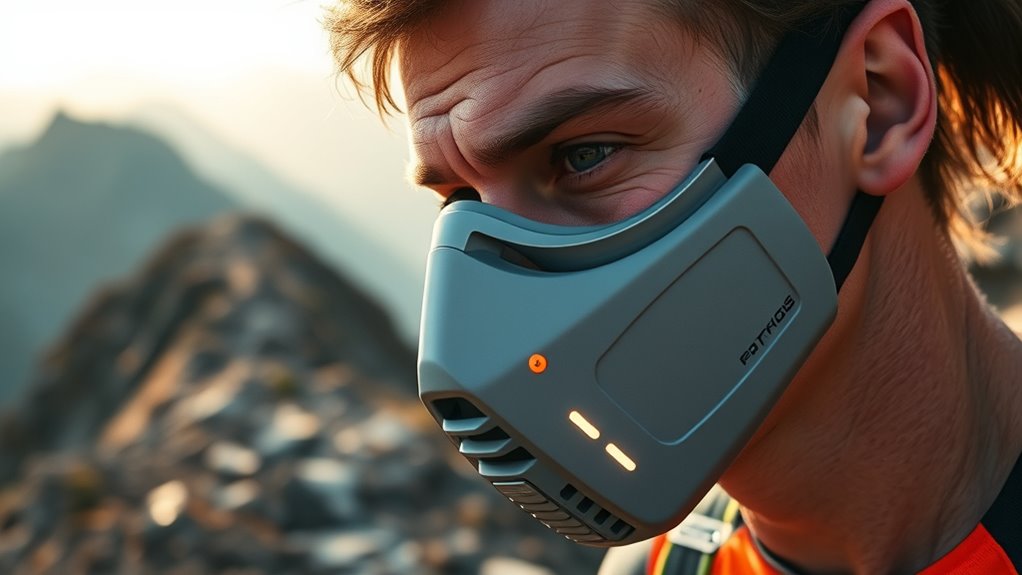
Altitude training involves exercising at high elevations to enhance your body’s ability to utilize oxygen more efficiently. When you train at altitude, your body responds by adapting to the lower oxygen levels, which can lead to significant physiological changes. One key factor you should monitor is your oxygen saturation, which measures how much oxygen your blood is carrying compared to its maximum capacity. As you ascend to higher altitudes, your oxygen saturation typically decreases because there’s less oxygen available in the air. Your body compensates by increasing your red blood cell production, which raises hematocrit levels—the percentage of red blood cells in your blood—allowing more oxygen to be transported to your muscles. This process can improve your endurance and overall aerobic capacity once you return to sea level.
Understanding how oxygen saturation fluctuates during altitude training helps you optimize your sessions. If your oxygen saturation drops too low, it signals that your body is under stress, and you might need to adjust your training intensity or duration. Conversely, maintaining a moderate drop allows your body to adapt without overexertion. This balance is essential because excessive drops can impair performance and recovery. As your hematocrit levels increase, your blood becomes thicker, which enhances oxygen delivery but also risks increasing blood viscosity. That’s why gradual acclimatization is important—your body needs time to produce more red blood cells without becoming overly thick or prone to complications like blood clots.
Recent advances in AI, such as AI-powered nanobots, are exploring ways to further optimize altitude training by precisely monitoring and adjusting physiological parameters in real-time. During altitude training, your body’s response involves more than just changes in blood parameters. Your lungs become more efficient at extracting oxygen, and your cardiovascular system adapts by increasing cardiac output. These adaptations are what make altitude training effective when done correctly, as they help you carry more oxygen to your muscles during your runs. When you descend back to sea level, these adaptations translate into improved performance, especially in terms of endurance and recovery. However, it’s essential to monitor how your hematocrit levels and oxygen saturation respond throughout your training cycle to avoid potential risks like dehydration or excessive blood thickening.
![Training Mask 2.0 [Original Black Medium] Elevation Training Mask, Fitness Mask, Workout Mask, Running Mask, Breathing Mask, Resistance Mask, Elevation Mask, Cardio Mask, Endurance Mask For Fitness](https://m.media-amazon.com/images/I/3189EVz5TlL._SL500_.jpg)
Training Mask 2.0 [Original Black Medium] Elevation Training Mask, Fitness Mask, Workout Mask, Running Mask, Breathing Mask, Resistance Mask, Elevation Mask, Cardio Mask, Endurance Mask For Fitness
TAKE YOUR TRAINING TO NEW HEIGHTS – Elevate your fitness game with simulated high elevation training, proven to…
As an affiliate, we earn on qualifying purchases.
As an affiliate, we earn on qualifying purchases.
Frequently Asked Questions
How Long Should Altitude Training Sessions Last?
You should aim for altitude training sessions lasting about 1 to 2 hours, as this is the ideal length for maximizing benefits without overtraining. Keep your session duration consistent and listen to your body. If you’re new to altitude training, start with shorter sessions, around 30 to 45 minutes, and gradually increase the duration. Remember, quality over quantity enhances your adaptation process effectively.
Can Altitude Training Improve Performance at Sea Level?
Think of altitude training as sharpening your sword; it boosts your performance at sea level. By training at high altitude, your body increases oxygen saturation and hematocrit levels, making your blood carry more oxygen. This adaptation enhances endurance and recovery, translating to better performance on race day. So, yes, altitude training can give you that extra edge, helping you perform at your peak when it counts most.
What Are the Risks of Altitude Training?
Altitude training can pose risks like altitude sickness, which causes headaches, nausea, and fatigue, potentially impairing your performance. You also face dehydration risks since the dry air at high altitudes increases fluid loss. To stay safe, you should pace yourself, stay well-hydrated, and monitor your body’s responses. Consulting a healthcare professional before starting altitude training is wise to mitigate these dangers and ensure proper adaptation.
How Quickly Can I See Benefits From Altitude Training?
You can start noticing benefits from altitude training within a few weeks, but the full effects usually take about 3 to 4 weeks as your body undergoes the adaptation process. During this benefit timeline, your red blood cell production increases, improving oxygen delivery and endurance. Consistency is key, so stick with your training plan to maximize the positive effects, and be patient as your body adjusts to higher altitudes.
Is Altitude Training Suitable for Beginner Runners?
You might wonder if altitude training suits you as a beginner runner. Initially, your body faces adaptation challenges, making it essential to start with low to moderate training intensities. This gradual approach helps your system adjust without overwhelming you. As you progress, your endurance can soar, but rushing in too fast risks setbacks. Will you harness this powerful tool safely? The key lies in patience and smart, consistent effort.

Zacurate Pro Series 500DL Fingertip Pulse Oximeter Blood Oxygen Saturation Monitor with Silicone Cover, Batteries and Lanyard (Royal Black)
ACCURATE AND RELIABLE – Accurately determines your SpO2 (blood oxygen saturation levels), pulse rate and pulse strength in…
As an affiliate, we earn on qualifying purchases.
As an affiliate, we earn on qualifying purchases.
Conclusion
Think of altitude training as fueling your engine with premium oxygen. When you return to sea level, you’re cruising faster and more efficiently, thanks to the extra altitude miles you’ve logged. Remember, it’s a journey of small steps that build your strength over time. Embrace the climb, because the summit of your performance is within reach. Keep pushing upward—your best race is just over the next horizon.

NATURION Mega Blood Booster – Dietary Supplement for White and Red Blood Cell Support with Iron, Selenium, Zinc, Vitamin B12 & Folic Acid – 90 Tablets, 90 Day Supply
Boosts Energy and Red Blood Cell Production: This blood support supplement includes 20 mg of iron per serving,…
As an affiliate, we earn on qualifying purchases.
As an affiliate, we earn on qualifying purchases.
![Sparthos Workout Mask High Altitude Mask - Face Mask for Gym Training, Work Out, Running, Cycling, Elevation, Cardio, Fitness - Resistance o2 2 3 - Lung Breathing Exercise Mask Men Women [Black +Case]](https://m.media-amazon.com/images/I/41xrgJRetmL._SL500_.jpg)
Sparthos Workout Mask High Altitude Mask – Face Mask for Gym Training, Work Out, Running, Cycling, Elevation, Cardio, Fitness – Resistance o2 2 3 – Lung Breathing Exercise Mask Men Women [Black +Case]
✅ CUT YOUR WORKOUT TIME IN HALF! – Training Mask by SPARTHOS makes workouts more effective by simulating…
As an affiliate, we earn on qualifying purchases.
As an affiliate, we earn on qualifying purchases.