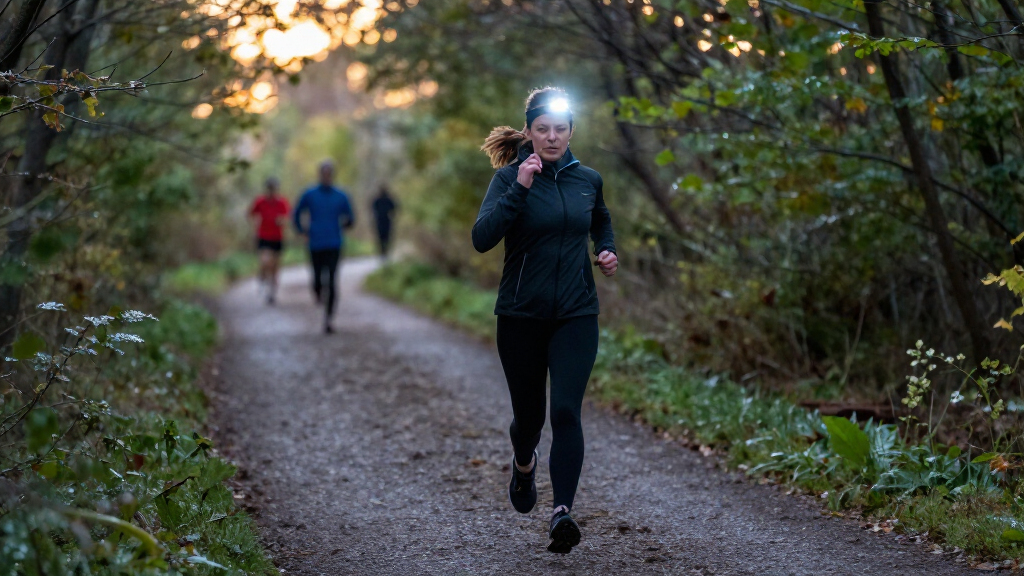
For most runners, I’d start with the BioLite Range 300 for its running-focused design and waterproof build; the Fenix HM65R-T V2.0 is the high-output choice, while the Foxelli USB-C 180-lumen is a simpler pick for familiar, well-lit routes. The best women’s running headlamps are not necessarily made specifically for women: secure fit, bounce control, beam coverage, and comfortable adjustment matter more than color or labeling. A brighter lamp can help on dark trails, but often brings more weight or battery demands, while sweatband styles may feel less like a conventional headlamp but can limit adjustment options. I compare all 11 options by how their design fits different routes and runner preferences. Read on for the full breakdown and help matching a headlamp to your runs.

Get workout gear delivered free with Prime
- Fast, free delivery on millions of items
- Prime Video, Amazon Music and more included
- Member-only deals all year
Complete the kit



Key Takeaways
- Running fit separates the more specialized options. The BioLite Range 300 and Fenix HM65R-T V2.0 are more compelling for regular night running than basic headlamps when secure wear and usable illumination matter.
- Maximum brightness is not the same as the best running light. The Fenix’s 1,600-lumen output suits demanding, dark routes, but many road runners may prefer a lighter, simpler lamp.
- USB-C charging appears across several picks, including the Foxelli, Lepro, and CRAFTZONE models, making charging compatibility less of a differentiator than fit, beam, and weather protection.
- Lighted sweatbands serve a different comfort preference. The ATNKE and IVYWNT options integrate lighting with a band, but shoppers should weigh that format against the adjustment and replaceability of a conventional headlamp.
- Multipacks and compact lights suit specific use cases. The LHKNL and NEBO two-packs can work for households or backups, while the NEBO Mycro 250 prioritizes a compact form over the power of larger models.
| Foxelli USB-C Rechargeable LED Headlamp, 180 Lumens |  | Best for Long, Low-Intensity Runs | Brightness: 180 lumens | Light modes: 5 | Light colors: White and red | VIEW LATEST PRICE | See Our Full Breakdown |
| Lepro Rechargeable LED Headlamp, 300 Lumens, IPX4 Waterproof, Black |  | Best Value for Everyday Road Runs | Brightness: 300 lumens | Light modes: 3 white-light settings and 2 red-light modes | Beam distance: Up to 500 feet | VIEW LATEST PRICE | See Our Full Breakdown |
| Fenix HM65R-T V2.0 Dual-Beam Running Headlamp, 1600 Lumens, USB-C Rechargeable |  | Best Premium Pick for Technical Trails | Maximum brightness: 1600 lumens | Beam distance: 185 yards | Beams: White and warm white | VIEW LATEST PRICE | See Our Full Breakdown |
| CRAFTZONE USB-C Rechargeable LED Headlamp, 800 Lumens |  | Best for Multi-Color Visibility | Maximum brightness: 800 lumens | Low-mode brightness: 100 lumens | Beam distance: 350 meters | VIEW LATEST PRICE | See Our Full Breakdown |
| Foxelli USB-C Rechargeable LED Headlamp for Kids and Adults |  | Best Compact Pick for Beginners | Brightness: 160 lumens | Light colors: White and red | Light modes: 5 | VIEW LATEST PRICE | See Our Full Breakdown |
| ATNKE Rechargeable LED Lighted Sweatband |  | Best Sweatband-Style Pick | Material: Acrylic | Lighting: 4 built-in LED bulbs | Brightness settings: 3 | VIEW LATEST PRICE | See Our Full Breakdown |
| IVYWNT LED Sports Sweat Headband with Rechargeable Headlamp |  | Best Adjustable Sweatband | Material: Nylon | Maximum brightness: 100 lumens | Light modes: 3, including red-blue strobe | VIEW LATEST PRICE | See Our Full Breakdown |
| Rechargeable 230° Wide-Beam LED Headlamp with Motion Sensor |  | Best for Broad Peripheral Coverage | Brand and model: BIAT LX200 | Brightness: 350 lumens | Beam angle: 230 degrees | VIEW LATEST PRICE | See Our Full Breakdown |
| BioLite Range 300 Waterproof Headlamp, Wild Fig |  | Best for Wet-Weather and Long Runs | Brightness: 300 lumens | Beam distance: 75 m | Water resistance: IP67 waterproof | VIEW LATEST PRICE | See Our Full Breakdown |
| LHKNL Rechargeable LED Headlamps, 2-Pack |  | Best Two-Runner Set | Pack size: 2 headlamps | Brightness: 1200 lumens | Battery capacity: 1500 mAh | VIEW LATEST PRICE | See Our Full Breakdown |
| NEBO Mycro 250 Rechargeable Headlamps, 2-Pack |  | Best Two-Pack for Short, Shared Runs | Pack size: 2 headlamps | Maximum brightness: 250 lumens each | Light modes: High: 250 lumens; medium: 50 lumens; low: 15 lumens | VIEW LATEST PRICE | See Our Full Breakdown |
| women’s running headlamp | Runtime | Water resistance | Weight | Charging |
|---|---|---|---|---|
| Foxelli USB-C Rechargeable LED | Up to 40 hours | IPX5 | 2.5 ounces | USB-C rechargeable |
| Lepro Rechargeable LED Headlam | Up to 30 hours | IPX4 | 2.86 ounces | USB rechargeable; USB-C cable included, adapter not included |
| Fenix HM65R-T V2.0 Dual-Beam R | — | IP68 | 4.96 ounces | USB-C |
| CRAFTZONE USB-C Rechargeable L | Up to 30 hours on lower settings | — | 60 g (2.12 ounces) | USB-C; full charge time is 3 hours |
| Foxelli USB-C Rechargeable LED | Up to 30 hours | IPX5 | 2.4 ounces | — |
| ATNKE Rechargeable LED Lighted | — | IP44 for the LED lights | — | USB; approximately 2 hours |
| IVYWNT LED Sports Sweat Headba | 6–8 hours | — | — | — |
| Rechargeable 230° Wide-Beam LE | 6 hours | IPX4 | 2.47 oz | — |
| BioLite Range 300 Waterproof H | Up to 100 hours on low; 4 hours on high | IP67 waterproof | — | USB-C; reaches 80% in 30 minutes |
| LHKNL Rechargeable LED Headlam | 4–10 hours | IPX4 | 1.87 oz | — |
| NEBO Mycro 250 Rechargeable He | Up to 5 hours on low | Water resistant; rating not specified | — | USB-C rechargeable |
More Details on Our Top Picks
Foxelli USB-C Rechargeable LED Headlamp, 180 Lumens
The Foxelli 180 is a sensible pick for runners who value a light load and long stretches between charges over a powerful beam. At 2.5 ounces, it is close in weight to the Foxelli MX10P, while its up-to-40-hour runtime exceeds that model’s stated 30 hours. Its 180 lumens suit familiar paths and easy-paced outings, but leave less reach for fast running on dark, uneven trails than the Lepro’s 300 lumens or the Fenix’s much brighter dual-beam setup. Red light and SOS add useful options for stops and visibility, and the 45-degree tilt helps aim the beam without shifting the strap. IPX5 protection handles wet-weather use, though this is not a high-output choice for technical terrain. The product information does not specify a charge time, so planning charging around a tight schedule may be less convenient.
Pros:- Lightweight 2.5-ounce design for less bulk during a run
- Up to 40 hours of runtime, longer than the listed runtime for the other Foxelli model
- USB-C charging and an included lithium-ion polymer battery
- White and red light, five modes, and a 45-degree adjustable tilt
Cons:- 180 lumens offers less illumination than the Lepro 300 and Fenix 1600 for dark trails
- No charging time is listed, making charge planning less predictable
- The stated 300-foot beam distance does not replace the greater brightness of higher-output options
Best for: Runners who stick to familiar routes, want a lightweight rechargeable lamp, and value long runtime over maximum brightness
Not ideal for: Trail runners moving quickly over technical or very dark terrain who need more illumination and beam reach
- Brightness:180 lumens
- Light modes:5
- Light colors:White and red
- Beam distance:Up to 300 feet
- Runtime:Up to 40 hours
- Weight:2.5 ounces
- Charging:USB-C rechargeable
- Water resistance:IPX5
Our verdict“Choose the Foxelli 180 for lightweight, lower-intensity runs where long runtime matters more than trail-bright illumination.”
Lepro Rechargeable LED Headlamp, 300 Lumens, IPX4 Waterproof, Black
The Lepro is the straightforward middle ground for runners who want more output than an entry-level lamp without carrying the Fenix HM65R-T V2.0’s heavier, trail-focused setup. Its 300-lumen output and listed reach of up to 500 feet give it more headroom than either Foxelli model for unlit paths, while the 2.86-ounce weight remains manageable for routine runs. Three white settings let runners match brightness to the route, and two red modes add an option for stops or preserving night vision. The tradeoff is IPX4 protection: it is rated for splashes and rain, not submersion, and falls short of the Foxelli 180’s IPX5 rating. USB-C cable is included, but the adapter is not, so buyers need a compatible power source already. Its mix of useful brightness and simple controls makes the most sense for regular road and park routes, not severe weather or demanding trails.
Pros:- 300 lumens and a listed beam distance of up to 500 feet
- Three white-light settings plus two red-light modes
- Up to 30 hours of runtime and a 45-degree adjustable angle
- Lightweight 2.86-ounce design with a one-year warranty
Cons:- IPX4 covers splashes and rain, not submersion, and is a lower rating than the Foxelli models’ IPX5
- USB-C cable is included but a power adapter is not
- Its output is far below the Fenix HM65R-T V2.0 for demanding trail use
Best for: Road and park runners who want a brighter everyday lamp than the Foxelli models and already have a USB power adapter
Not ideal for: Runners who need stronger water protection for frequent heavy rain or want a high-output lamp for technical trails
- Brightness:300 lumens
- Light modes:3 white-light settings and 2 red-light modes
- Beam distance:Up to 500 feet
- Runtime:Up to 30 hours
- Weight:2.86 ounces
- Charging:USB rechargeable; USB-C cable included, adapter not included
- Water resistance:IPX4
- Adjustability:45-degree adjustable angle
Our verdict“Pick the Lepro for everyday road and park running when you want a useful brightness step up from the Foxelli lamps.”
Fenix HM65R-T V2.0 Dual-Beam Running Headlamp, 1600 Lumens, USB-C Rechargeable
The Fenix HM65R-T V2.0 is the specialist choice in this group: it prioritizes trail visibility and rugged construction over the minimal weight and simple output of the Foxelli 180 or Lepro. Its 1600-lumen maximum, 185-yard beam distance, and white plus warm-white beams offer substantially more capability for dark, uneven routes. The IP68 rating and impact resistance up to 2 meters also suit conditions that exceed the splash protection of the CRAFTZONE and Lepro. A reflective adjustable headband is designed to help keep the lamp steady while running, and USB-C charging simplifies battery upkeep. At 4.96 ounces, it is nearly twice the weight of the lightweight Foxelli options, so casual road runners may find its added protection and output unnecessary. The listed maximum battery life of over 600 hours is mode-dependent, so it should not be read as runtime at full brightness.
Pros:- Maximum brightness of 1600 lumens with white and warm-white beams
- IP68 waterproof rating and impact resistance up to 2 meters
- USB-C charging and an adjustable reflective headband designed for a steady fit
- Magnesium alloy frame with a five-year warranty
Cons:- At 4.96 ounces, it is substantially heavier than the Foxelli 180 and MX10P
- Maximum battery-life figure of over 600 hours depends on the light mode
- Its high output and rugged build may be more than routine road runners need
Best for: Trail runners who regularly tackle dark, uneven routes and want high output, dual beams, and strong weather protection
Not ideal for: Road runners seeking the lightest possible headlamp or anyone who does not need premium trail durability and high output
- Maximum brightness:1600 lumens
- Beam distance:185 yards
- Beams:White and warm white
- Charging:USB-C
- Maximum battery life:Over 600 hours; mode-dependent
- Water resistance:IP68
- Impact resistance:Up to 2 meters
- Frame material:Magnesium alloy
- Weight:4.96 ounces
Our verdict“Choose the Fenix for demanding trail runs where illumination and durability matter more than keeping weight to a minimum.”
CRAFTZONE USB-C Rechargeable LED Headlamp, 800 Lumens
CRAFTZONE stands apart from the Lepro and Foxelli options with a broader set of light colors: white, red, and blue, plus strobe. That variety can appeal to runners who want more signaling options alongside a standard forward beam. It weighs just 2.12 ounces, lighter than the Lepro and both Foxelli models, and its reflective headband adds a visibility detail that matters on roads shared with traffic. The stated 800 lumens are available in High mode, while the listed up-to-30-hour runtime applies to lower settings; runners should not expect both figures at once. Its 350-meter beam distance is a listed specification, but the supplied information does not describe how that varies by mode. IP54 handles splashes and rain, not submersion, so the Fenix is the stronger fit for harsh wet trail conditions. This is a light, versatile option with clear limits around weather protection and high-mode runtime.
Pros:- Light 2.12-ounce design, the lightest listed among these five products
- Five modes include white, red, blue, and strobe
- USB-C charging with a stated three-hour full charge time
- Adjustable headband has 360-degree reflective piping
Cons:- The 800-lumen maximum is available only in High mode
- Up to 30 hours of runtime is stated for lower settings, not maximum brightness
- IP54 covers splashes and rain, not submersion, unlike the Fenix’s IP68 rating
Best for: Road runners who want a very light headlamp with multiple color modes and reflective headband detailing
Not ideal for: Runners who need submersion-level protection or expect long runtime while using maximum brightness
- Maximum brightness:800 lumens
- Low-mode brightness:100 lumens
- Beam distance:350 meters
- Lighting modes:5: High, Low, Red, Blue, Strobe
- Weight:60 g (2.12 ounces)
- Charging:USB-C; full charge time is 3 hours
- Runtime:Up to 30 hours on lower settings
- Water and dust resistance:IP54
Our verdict“Choose CRAFTZONE if low weight, reflective detailing, and extra color modes matter more than all-weather protection or sustained maximum output.”
Foxelli USB-C Rechargeable LED Headlamp for Kids and Adults
The Foxelli MX10P is the simplest fit here for a new runner or someone sharing a headlamp between adults and younger family members. At 2.4 ounces, it stays light, and its 60-degree tilt gives more angle adjustment than the Foxelli 180’s 45 degrees—useful for directing light toward the ground without changing strap placement. Five modes, white and red light, USB-C charging, and IPX5 water resistance cover the basics for routine outings. Compared with the Lepro, the MX10P has lower output at 160 lumens and a shorter listed beam distance of 200 feet, so it is better suited to familiar, modestly lit routes than fast trail running. Its 30-hour maximum runtime is also shorter than the Foxelli 180’s 40 hours. A four-hour charge time may require planning before an evening run, but its accessible feature set and adjustable fit make it a reasonable starter option.
Pros:- Lightweight 2.4-ounce design with a 60-degree adjustable tilt
- White and red light across five modes
- USB-C rechargeable with up to 30 hours of runtime
- IPX5 water resistance and an adjustable strap
Cons:- 160 lumens and a 200-foot beam distance offer less reach than the Lepro 300
- Four-hour charge time requires advance planning
- Its stated runtime is 10 hours shorter than the Foxelli 180’s maximum
Best for: Beginner runners and families wanting a lightweight, adjustable headlamp for familiar routes and shared use
Not ideal for: Runners covering dark trails who need more than 160 lumens or want a longer beam reach and runtime
- Brightness:160 lumens
- Light colors:White and red
- Light modes:5
- Beam distance:Up to 200 feet
- Beam angle:60 degrees
- Runtime:Up to 30 hours
- Charge time:4 hours
- Weight:2.4 ounces
- Water resistance:IPX5
Our verdict“Pick the MX10P as a lightweight starter lamp for familiar routes, but choose the Lepro or Fenix for darker, faster, or more technical running.”
ATNKE Rechargeable LED Lighted Sweatband
The ATNKE is the lineup’s most apparel-like option: its stretchy knit sweatband holds four removable LEDs, so runners who dislike a conventional headlamp strap may find it less obtrusive. Three brightness settings let you favor longer runtime on low or more light when visibility matters, though high lasts only about two hours. Compared with the adjustable IVYWNT LED Sports Sweat Headband, ATNKE gives less flexibility in fit and lacks the listed reflective details and strobe mode. Its washable band is a practical advantage for regular sweaty workouts, since the light can be removed first. The listed IP44 rating applies to the lights, not necessarily the whole band, so I would treat it as a low-light running option rather than a rain-ready headlamp.
Pros:- Four built-in LEDs with three brightness settings
- Light detaches for USB charging and separate band washing
- Stretchy acrylic band suits low-light outdoor workouts
- Listed low-setting runtime reaches 6–8 hours
Cons:- High setting lasts only about two hours
- One-size range may not fit every head comfortably
- IP44 rating is specified for the lights, not clearly for the full band
Best for: Runners who prefer a soft, stretchy sweatband over a traditional adjustable headlamp strap and can recharge between shorter outings
Not ideal for: Runners who need a reliably adjustable fit, documented rain protection, or several hours of high-output light
- Material:Acrylic
- Lighting:4 built-in LED bulbs
- Brightness settings:3
- Battery life:Up to 6–8 hours on low, 4 hours on medium, 2 hours on high
- Charging:USB; approximately 2 hours
- Water resistance:IP44 for the LED lights
- Size:One size fits most; 21.2–24.4 in (54–62 cm)
- Care:Removable light; sweatband is washable
Our verdict“Choose the ATNKE if a washable, sweatband-style fit matters more than adjustable sizing or extended high-brightness runtime.”
IVYWNT LED Sports Sweat Headband with Rechargeable Headlamp
For runners who want a fabric headband but need more fit control than the ATNKE offers, the IVYWNT’s adjustable, non-slip strap is the stronger match. Its detachable light reaches 100 lumens and has three modes, including a red-blue strobe; reflective details add another visibility cue beyond the beam. The nylon is described as moisture-wicking, which suits sweaty workouts better than treating this as a standard headlamp with a strap. Its listed 6–8-hour runtime is useful for routine runs, but the product gives no waterproofing rating, a meaningful gap beside the IPX4-rated BIAT LX200 or IP67 BioLite Range 300. I’d pick IVYWNT for fit and wearable comfort, not for wet-weather confidence or maximum illumination.
Pros:- Adjustable, non-slip fit is more adaptable than a fixed-size sweatband
- Moisture-wicking nylon suits active workouts
- Detachable 100-lumen light has three modes, including a strobe
- Reflective details provide visibility beyond the lamp
Cons:- No waterproofing information is provided
- Listed runtime is about 6–8 hours
- 100-lumen maximum is modest beside brighter headlamps in the roundup
Best for: Runners who want a moisture-wicking, adjustable fabric band and a modest light for regular low-light training
Not ideal for: Runners who train in heavy rain or need a stated water-resistance rating, a long-distance beam, or high output
- Material:Nylon
- Maximum brightness:100 lumens
- Light modes:3, including red-blue strobe
- Runtime:6–8 hours
- Battery:Rechargeable lithium metal
- Fit:Adjustable strap
- Special features:Detachable light; reflective details
- Color:Yellow
Our verdict“Choose IVYWNT for an adjustable, sweat-wicking headband and extra visibility details, but skip it if rain protection is a priority.”
Rechargeable 230° Wide-Beam LED Headlamp with Motion Sensor
The BIAT LX200 prioritizes seeing a wide area over keeping a narrow beam trained straight ahead: its 230-degree beam is paired with a focused spotlight, a useful combination for spotting nearby path edges while retaining a more directed option. At 350 lumens, it offers more stated output than the IVYWNT sweatband, and its motion sensor can make switching modes easier when hands are occupied. That broad coverage may suit runners on dark, uneven routes, but the product’s listed six-hour runtime is less reassuring for longer outings than the BioLite Range 300’s low-mode endurance. The IPX4 rating covers splashes rather than immersion, and the listing does not establish how comfortably the silicone headband sits over long runs. It is a versatile beam design, not the safest pick for prolonged wet-weather use.
Pros:- 230-degree beam covers a broad viewing area
- Focused spotlight complements the wide beam
- Motion-sensor operation enables hands-free switching
- Lightweight 2.47-ounce design with an adjustable headband
Cons:- Listed runtime is six hours
- IPX4 protection is for splashes, not immersion
- A broad beam may be less useful than a longer, focused beam on open routes
Best for: Runners on dark paths who value broad peripheral illumination and want a motion sensor for hands-free switching
Not ideal for: Ultra-distance runners needing extended runtime or runners seeking protection beyond splash-level water resistance
- Brand and model:BIAT LX200
- Brightness:350 lumens
- Beam angle:230 degrees
- Lighting modes:6
- Runtime:6 hours
- Weight:2.47 oz
- Water resistance:IPX4
- Material:Silicone
Our verdict“Choose the BIAT LX200 for broad near-field visibility and hands-free controls, not for long outings or immersion-level water protection.”
BioLite Range 300 Waterproof Headlamp, Wild Fig
The BioLite Range 300 stands apart from the sweatband-style ATNKE and IVYWNT by pairing a conventional head mount with IP67 waterproof protection and a stated 75-meter beam distance. Its 300-lumen output is not the highest listed in this group, but the longer beam and stronger water protection make it a more convincing choice for exposed routes and changeable weather than the IPX4 BIAT LX200. Runtime depends sharply on brightness: up to 100 hours on low supports long stretches between charges, while high is listed at only four hours. USB-C charging reaches 80% in 30 minutes, a helpful feature when a run plan changes, though the product data does not specify fit adjustments or weight. I’d favor it for weather protection and endurance on lower settings, not for all-night high-output use.
Pros:- IP67 waterproof protection is stronger than the IPX4-rated options
- 75-meter beam distance supports visibility farther ahead
- USB-C charging reaches 80% in 30 minutes
- Up to 100 hours of runtime on low
Cons:- High-mode runtime is listed at four hours
- 300-lumen output is lower than the BIAT LX200’s stated 350 lumens
- Product data does not specify headband adjustability or weight
Best for: Runners who need a waterproof headlamp for wet-weather training and value long low-mode runtime
Not ideal for: Runners who need high brightness for more than four hours or want a clearly specified lightweight, adjustable fit
- Brightness:300 lumens
- Beam distance:75 m
- Water resistance:IP67 waterproof
- Charging:USB-C; reaches 80% in 30 minutes
- Runtime:Up to 100 hours on low; 4 hours on high
- Battery:Included lithium-ion
- Material:ABS and polycarbonate
- Warranty:3-year limited warranty
Our verdict“Choose the BioLite Range 300 for wet-weather protection and long low-mode use, but not for extended running at full brightness.”
LHKNL Rechargeable LED Headlamps, 2-Pack
The LHKNL’s main advantage is practical: two rechargeable headlamps make it easy to equip a running partner or keep a spare ready, while each lamp combines white and red light with eight modes. The 60-degree adjustable beam can be aimed toward the route, and motion-sensor control helps when gloves or cold hands make button use awkward. At 1.87 ounces per headlamp, the listed weight is lower than the BIAT LX200’s 2.47 ounces; however, the BIAT’s 230-degree beam covers a much wider area. LHKNL instead offers more flexibility through red light and mode selection. Its IPX4 protection suits rain or snow but not submersion, and the 4–10-hour runtime range means output and conditions affect how long a charge lasts.
Pros:- Two headlamps provide a spare or equip a running partner
- Eight modes include both white and red light
- Motion sensor allows hands-free operation
- Lightweight 1.87-ounce design with a 60-degree adjustable beam
Cons:- IPX4 protection is intended for rain or snow, not submersion
- Runtime varies from 4 to 10 hours
- 60-degree beam is narrower than the BIAT LX200’s 230-degree coverage
Best for: Running partners, households, or solo runners who want a spare lamp and value red light plus hands-free controls
Not ideal for: Runners who need immersion-level waterproofing, a broad 230-degree beam, or a guaranteed 10-hour runtime at every setting
- Pack size:2 headlamps
- Brightness:1200 lumens
- Battery capacity:1500 mAh
- Battery type:Rechargeable lithium-ion polymer
- Runtime:4–10 hours
- Lighting modes:8
- Beam angle:60 degrees
- Water resistance:IPX4
- Weight:1.87 oz
Our verdict“Choose the LHKNL two-pack for shared use, a backup lamp, and red-light options, but not for wide-area coverage or immersion protection.”
NEBO Mycro 250 Rechargeable Headlamps, 2-Pack
The two-headlamp set makes this a practical pick for running partners or households that want a spare ready to go. Each light offers up to 250 lumens, with lower 50- and 15-lumen settings for easier, shorter outings where maximum output is unnecessary. Compared with the Foxelli 180 Lumens headlamp, the NEBO offers a brighter stated maximum and includes a cap clip, while the Fenix HM65R-T V2.0 is built for runners who need much more output and a more demanding performance profile. The NEBO’s compact body can tilt up to 135 degrees and recharge by USB-C, adding useful flexibility without a bulky lamp. Its main limitation is endurance: low mode is listed for up to five hours, and no water-resistance rating is specified, so I would not choose it for long or wet training routes.
Pros:- Two headlamps provide a ready-to-share pair or a spare.
- 250-lumen maximum output is higher than the Foxelli 180 Lumens model’s stated output.
- Cap clip and adjustable strap offer two ways to wear each light.
- USB-C charging and three brightness settings suit everyday short outings.
Cons:- Low-mode runtime is listed as up to five hours, which may not suit longer runs.
- Water resistance is stated without a specific rating.
- The 250-lumen maximum is modest beside higher-output options such as the Fenix HM65R-T V2.0.
Best for: Running partners or households seeking two compact lights for short evening runs, with the option to wear a strap or clip a light to a cap.
Not ideal for: Runners covering long distances after dark or training in frequent rain who need a stated waterproof rating and longer specified runtime.
- Pack size:2 headlamps
- Maximum brightness:250 lumens each
- Light modes:High: 250 lumens; medium: 50 lumens; low: 15 lumens
- Runtime:Up to 5 hours on low
- Charging:USB-C rechargeable
- Water resistance:Water resistant; rating not specified
- Tilt:Up to 135 degrees
- Mounting:Adjustable head strap and cap clip
- Dimensions:1.26 × 1.69 × 2.17 inches
Our verdict“Choose the NEBO pair for short runs shared between two people, but opt for a higher-output, explicitly rated light for long or wet training.”

How We Picked
I compared the 11 products through the needs of women running after dark: secure fit during movement, practical beam output, comfort, charging convenience, and weather resistance. I also considered whether each model’s format makes sense for running rather than occasional household use. A light that is bright on paper can still be a poor fit if its weight, controls, or band design make it awkward to wear on a moving runner.
The ranking favors options with a clearer running use case and a useful balance of comfort, illumination, and durability. The BioLite Range 300 leads as the most balanced running-oriented choice; the Fenix ranks as a specialized high-output pick rather than a universal winner. Simpler, lower-output models, sweatband designs, and multipacks remain useful for particular routes or budgets, but their narrower strengths and tradeoffs place them lower overall. I treat lumen claims as one factor, not a substitute for beam usability, fit, or battery practicality.
| women’s running headlamp | Charging | Water resistance |
|---|---|---|
| Foxelli USB-C Rechargeable LED | USB-C rechargeable | IPX5 |
| Lepro Rechargeable LED Headlam | USB rechargeable; USB-C cable included, adapter not included | IPX4 |
| Fenix HM65R-T V2.0 Dual-Beam R | USB-C | IP68 |
| CRAFTZONE USB-C Rechargeable L | USB-C; full charge time is 3 hours | — |
| Foxelli USB-C Rechargeable LED | — | IPX5 |
| ATNKE Rechargeable LED Lighted | USB; approximately 2 hours | IP44 for the LED lights |
| IVYWNT LED Sports Sweat Headba | — | — |
| Rechargeable 230° Wide-Beam LE | — | IPX4 |
| BioLite Range 300 Waterproof H | USB-C; reaches 80% in 30 minutes | IP67 waterproof |
| LHKNL Rechargeable LED Headlam | — | IPX4 |
| NEBO Mycro 250 Rechargeable He | USB-C rechargeable | Water resistant; rating not specified |
Factors to Consider When Choosing Women’s Running Headlamps
Before choosing a headlamp, match it to the conditions you actually run in. A familiar neighborhood loop, an unlit path, and a technical trail place different demands on lighting and fit. These factors help avoid paying for power you will not use—or choosing a compact light that feels inadequate where you run.
Match the beam to your route, not just the lumen number
On a lit street, a modest beam may be enough to see uneven pavement and make your presence clearer. Dark trails call for more reach and useful peripheral coverage, but a high lumen figure alone does not tell you whether the beam is focused, broad, or comfortable for seeing nearby roots. Many runners benefit from a light with multiple brightness settings, since full output can drain a battery quickly and feel excessive on familiar routes. A common mistake is choosing the highest output without checking whether the lamp can run at a lower setting comfortably. Think about the darkest section of your regular route, not the brightest stretch. If you run in mixed conditions, versatile settings may matter more than peak output.
Prioritize bounce control and adjustment
Running creates repeated impact, so a headlamp that feels fine while standing may shift or bounce once you pick up pace. Look for an adjustable band that can sit securely without needing to be painfully tight, and check whether the lamp’s weight is likely to stay comfortable over your usual run length. Hair, hats, and cold-weather layers can change how a band fits, so consider what you normally wear. Sweatband-integrated lights may appeal if you dislike a separate strap, but their fit and lighting position can be less adaptable. A bulky light can be a poor match for shorter road runs even if its output is impressive. Prioritize stability before extra features.
Treat weather resistance as route insurance
Rain, mist, sweat, and wet vegetation can all expose weak points in a headlamp’s design. An IPX rating offers a useful clue about water resistance, but it is not a promise that every model can handle every storm or submersion. If you run year-round, favor a clearly stated protection level and follow the maker’s care guidance, especially around charging ports. Runners who stay close to home in dry conditions may not need the same protection as trail runners facing unpredictable weather. Do not assume that a rechargeable model is weatherproof simply because it is designed for outdoor use. Match protection to your likely exposure and willingness to avoid bad weather.
Choose a battery routine you can maintain
Rechargeable USB-C models can fit easily into a routine if you already have compatible cables, but charging convenience does not remove the need to check battery status before a run. High brightness generally draws more power, so a powerful headlamp may need more frequent charging when used at full output. For longer outings, look for clear runtime information at the brightness settings you expect to use rather than relying on a single maximum-runtime figure. A compact lamp may be easier to carry, yet its smaller format can mean less capacity or fewer features. Decide whether you prefer scheduled charging or carrying spare batteries, then select a design that supports that habit. Forgetting to recharge is a practical risk whichever system you choose.
Consider whether a headlamp is your only visibility light
A headlamp helps you see the ground and can make you more visible, but it does not replace reflective clothing or a rear-facing light on roads shared with traffic. A forward beam can also point away from drivers or other runners if the angle is set poorly. For urban runs, combine your lamp with reflective details and position the beam so it illuminates the route without shining directly into other people’s eyes. Trail runners may place more emphasis on seeing obstacles and keeping a steady beam through turns. If you need both hands free for carrying gear or managing a dog, check how securely the lamp stays in place while you move. Think of lighting as part of a visibility setup, not a single-product fix.
Pay for useful comfort, not unused complexity
A premium headlamp makes the most sense when its fit, weather protection, beam control, or durability solves a problem you face often. If your runs are short and well-lit, a simpler rechargeable model may meet your needs without the weight or extra controls of a high-output unit. Multipacks can be practical for keeping a spare or sharing with a running partner, but confirm that the included lights suit your own route and fit preferences. Motion sensors and wide-beam designs add convenience for some runners, yet can introduce controls you may not want while moving. Before choosing extras, identify the one frustration you want the headlamp to fix. That keeps the decision focused on real running use rather than a longer feature list.
Frequently Asked Questions
Do I need a headlamp made specifically for women?
Usually, the fit matters more than a women-specific label. Check whether the band adjusts comfortably, stays stable while running, and works with your hair and any hat or headband you wear. A smaller or lighter lamp may suit some runners, but preferences vary, so neither gender labeling nor color is a reliable substitute for fit details. The sweatband-style ATNKE and IVYWNT designs offer a different wearing format, while conventional models provide a separate adjustable strap. If possible, check the return policy before buying, since comfort is personal.
Is a 300-lumen headlamp enough for running?
It can be enough for many familiar routes, especially where streetlights provide some ambient illumination. On a fully dark trail, the useful beam pattern, distance, and coverage matter as much as the lumen figure. The BioLite Range 300 is a running-oriented option in that output class, while the Fenix HM65R-T V2.0 offers much higher maximum output for more demanding conditions. Higher output can bring greater battery use or bulk, so it is not automatically better for everyday road running. Choose based on the darkest route you regularly run.
Should I choose a rechargeable headlamp or one with replaceable batteries?
Rechargeable models are convenient if you can build charging into your routine and want to use familiar USB-C cables where supported. Their main drawback is that a forgotten charge can leave you without a ready light, and frequent use at high output can mean charging more often. Replaceable batteries can be easier to swap during longer outings, but they require keeping spares on hand. Consider how long your runs last and whether you have a reliable place to recharge. Check runtime at the brightness you plan to use rather than comparing charging types alone.
Are two-pack headlamps a good choice for a solo runner?
A two-pack can still be useful if you want a backup in a car or running bag, or need lights for both a head and another piece of gear. The LHKNL and NEBO Mycro 250 packs offer that spare-light angle, but a second unit does not necessarily make either headlamp a better fit for your own run. Compare the included models’ comfort, controls, and output with a single light that better matches your route. Also consider whether you will charge or maintain both units. If the spare will sit unused, a single well-suited headlamp may be the simpler choice.
Can I use a lighted sweatband instead of a regular running headlamp?
Yes, a lighted sweatband can suit runners who prefer an integrated band rather than a conventional strap and lamp assembly. The ATNKE and IVYWNT options use this format, which may appeal for a streamlined feel. The tradeoff is that lighting position, adjustment, and replacement choices can differ from a standard headlamp, so check how the light is attached and whether the fit accommodates your usual layers. Sweat management and wash instructions also matter for gear worn against the skin. Pick this style for its wearing format, not on the assumption that it will outperform a conventional headlamp.
Conclusion
For the strongest all-around fit for regular night running, I’d choose the BioLite Range 300 as best overall. The Foxelli USB-C 180-lumen is my best value-style pick for simpler, well-lit routes, while the Fenix HM65R-T V2.0 is the best premium choice for runners who need substantially more output and accept a more specialized design. Beginners can start with a straightforward rechargeable model such as the Lepro 300-lumen, especially if they want a simple entry into night running and do not need a trail-focused beam. For a band-integrated option, compare the ATNKE and IVYWNT; for a compact spare or shared setup, look at the NEBO Mycro 250 or LHKNL two-pack. Choose by route and fit first: the right headlamp is the one that stays comfortable and gives you the light you need without more weight or power than your runs call for.