
The best running headlamp for most runners is the BioLite Dash 450, which puts a running-focused fit ahead of the broad utility features found on many general-purpose lights. The Petzl ACTIK CORE stands out for runners who want flexible power options, while the Nitecore NU25 is a compact choice for those who want to keep gear light. The main tradeoffs are beam shape, bounce, battery flexibility, and how much light or weather protection you need for your route. Motion-sensor multipacks can offer useful hands-free controls, but they are not automatically a better fit for running than a stable, purpose-designed headlamp. Read on for the full breakdown of all 13 options and which type of runner each suits best.

Get workout gear delivered free with Prime
- Fast, free delivery on millions of items
- Prime Video, Amazon Music and more included
- Member-only deals all year
Complete the kit



Key Takeaways
- Running fit separates the strongest picks. The BioLite Dash 450 is the lead choice because the lineup includes several general-use headlamps, but runners benefit most from a setup designed around movement.
- Rechargeable does not always mean the same thing. The Petzl ACTIK CORE offers a different power strategy from USB-C-only models, which can matter on longer outings or trips away from a charging point.
- Compact weight and broad utility pull in different directions. The Nitecore NU25 favors a lightweight, streamlined setup, while wider-beam and multi-mode lights add flexibility at the cost of simplicity.
- Multipacks favor backup and shared use over a tailored running fit. The BIAT, Blukar, and LHKNL two-packs add spare-light convenience, though runners should weigh that against fit stability and beam control.
- Headline lumen figures do not settle the choice. Beam pattern, strap security, controls, and water resistance can matter more on a moving runner than a high advertised output alone.
| BIAT Rechargeable 230° Wide-Beam LED Headlamp with Motion Sensor |  | Best for Broad, Close-In Coverage | Brightness: 350 lumens | Beam angle: 230 degrees | Lighting modes: 6 | VIEW LATEST PRICE | See Our Full Breakdown |
| 2 Pack LED Headlamp Rechargeable Motion Sensor Wide Beam Headlight |  | Best Two-Pack for Shared Use | Pack size: 2 headlamps | Brightness: 350 lumens | Beam angle: 230 degrees | VIEW LATEST PRICE | See Our Full Breakdown |
| BioLite Dash 450 Running Headlamp – Rechargeable, Midnight Grey |  | Best for Dedicated Night Runners | Brightness: 450 lumens | Beam distance: 90 meters | Runtime, low mode: Up to 60 hours | VIEW LATEST PRICE | See Our Full Breakdown |
| Petzl ACTIK CORE Headlamp – Blue |  | Best for Long Routes and Backup Power | Maximum brightness: 625 lumens | Battery system: 1250 mAh rechargeable lithium-ion CORE battery or 3 AAA cells | Power source: USB rechargeable or AAA batteries | VIEW LATEST PRICE | See Our Full Breakdown |
| BioLite Range 300 Headlamp – Waterproof USB‑C, 300 lumens & 75 m Beam (Slate Blue) | 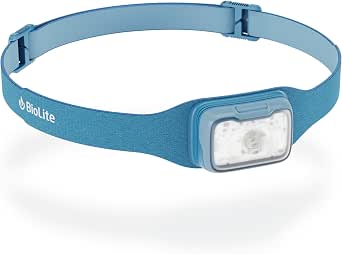 | Best for Wet-Weather Reliability | Brightness: 300 lumens | Beam distance: 75 meters | Runtime: Up to 100 hours on low mode | VIEW LATEST PRICE | See Our Full Breakdown |
| Nitecore NU25 UL 400-Lumen USB-C Rechargeable Headlamp |  | Best Lightweight Long-Run Pick | Maximum brightness: 400 lumens | Maximum beam distance: 144 yards | Weight: 1.6 ounces | VIEW LATEST PRICE | See Our Full Breakdown |
| Black Diamond Spot 400-R Rechargeable Headlamp |  | Best for Wet-Weather Durability | Maximum brightness: 400 lumens | Battery: 1500 mAh integrated lithium-ion | Charging: Micro-USB | VIEW LATEST PRICE | See Our Full Breakdown |
| Black Diamond Cosmo 350 Headlamp, BD Graphite |  | Best Backup-Battery Flexibility | Maximum brightness: 350 lumens | Power source: Three included AAA batteries or compatible BD 1500 Li-ion battery | Lighting modes: Dimming, strobe, red night vision | VIEW LATEST PRICE | See Our Full Breakdown |
| Blukar LED Headlamp Rechargeable (2-Pack), 2000 Lumens, Motion Sensor, IPX5 Waterproof | 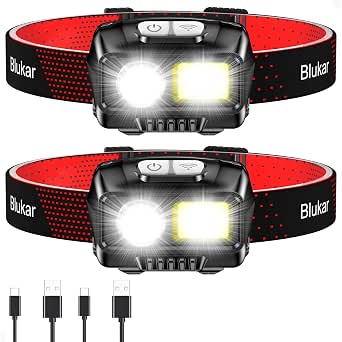 | Best Two-Headlamp Value | Brightness: 2000 lumens | Battery capacity: 1200 mAh | Battery type: Lithium polymer | VIEW LATEST PRICE | See Our Full Breakdown |
| LHKNL Rechargeable LED Headlamp 2-Pack with Motion Sensor |  | Best Lightweight Motion-Sensor Pair | Brightness: 1200 lumens | Battery capacity: 1500 mAh | Weight: 1.87 ounces | VIEW LATEST PRICE | See Our Full Breakdown |
| Petzl Swift LT Rechargeable Headlamp, Desert Green |  | Best Lightweight Pick | Weight: 43 g | Maximum brightness: 380 lumens | Lighting modes: Three white levels and red light | VIEW LATEST PRICE | See Our Full Breakdown |
| Lepro Rechargeable LED Headlamp, IPX4 Water Resistant, 5 Modes, Black |  | Best for Long-Run Runtime | Weight: 2.86 oz | Maximum brightness: 300 lumens; listing also gives 150 lumens for white brightness | Light modes: Three white and two red | VIEW LATEST PRICE | See Our Full Breakdown |
| BIAT Rechargeable LED Headlamps (2-Pack) with 230° Wide Beam and Motion Sensor |  | Best for Peripheral Visibility | Quantity: 2 headlamps | Brightness: 350 lumens | Beam angle: 230 degrees | VIEW LATEST PRICE | See Our Full Breakdown |
| running headlamp | Water resistance | Brightness | Runtime | Weight |
|---|---|---|---|---|
| BIAT Rechargeable 230° Wide-Be | IPX4 | 350 lumens | Up to 6 hours | 2.47 oz |
| 2 Pack LED Headlamp Rechargeab | IPX4 | 350 lumens | 3–8 hours, depending on mode | — |
| BioLite Dash 450 Running Headl | IPX4 | 450 lumens | — | 78 g |
| Petzl ACTIK CORE Headlamp | IPX4 | — | — | — |
| BioLite Range 300 Headlamp | IP67 | 300 lumens | Up to 100 hours on low mode | — |
| Nitecore NU25 UL 400-Lumen USB | IP66 | — | Up to 45 hours; varies by setting | 1.6 ounces |
| Black Diamond Spot 400-R Recha | IP67; submersible for up to 30 minutes | — | — | — |
| Black Diamond Cosmo 350 Headla | IP67; submersible up to 1 meter for 30 minutes | — | — | — |
| Blukar LED Headlamp Rechargeab | IPX5 | 2000 lumens | Up to 30 hours | — |
| LHKNL Rechargeable LED Headlam | IPX4 | 1200 lumens | — | 1.87 ounces |
| Petzl Swift LT Rechargeable He | IPX4 | — | 5 hours | 43 g |
| Lepro Rechargeable LED Headlam | IPX4 | — | Up to 30 hours | 2.86 oz |
| BIAT Rechargeable LED Headlamp | IPX4 | 350 lumens | — | 2.47 oz |
More Details on Our Top Picks
BIAT Rechargeable 230° Wide-Beam LED Headlamp with Motion Sensor
The 230-degree beam spreads light across nearby surroundings, making this BIAT a practical choice for runners who want to see the path edges as well as what is directly ahead. Its focused spotlight adds reach when you need to check a landmark or uneven section, a more flexible setup than the single-level beam described for the BioLite Range 300. The motion sensor can simplify switching modes when your hands are occupied, and the lightweight 2.47-ounce design should be easier to wear than bulkier options.
The tradeoff is stamina: its stated six-hour runtime is less reassuring for long outings than the BioLite Dash 450’s low-mode runtime. IPX4 covers splashes, not immersion, so I’d keep it for ordinary damp-weather runs rather than sustained heavy rain.
Pros:- 230-degree wide beam helps reveal nearby ground and peripheral hazards.
- Separate focused spotlight gives more reach than the wide beam alone.
- Motion-sensor control can be useful when hands are occupied.
- Lightweight 2.47-ounce silicone design with an adjustable band.
Cons:- Six-hour stated runtime may not cover a long run without recharging.
- IPX4 protection does not cover immersion or sustained heavy water exposure.
Best for: Runners on familiar routes who want wide near-field visibility, a separate spotlight, and hands-free controls for shorter outings.
Not ideal for: Ultrarunners and people running in prolonged heavy rain, because the stated runtime is six hours and IPX4 is splash-resistant rather than submersible.
- Brightness:350 lumens
- Beam angle:230 degrees
- Lighting modes:6
- Runtime:Up to 6 hours
- Weight:2.47 oz
- Water resistance:IPX4
- Material:Silicone
- Battery:Rechargeable lithium-ion polymer
Our verdict“Choose this BIAT for short-to-moderate runs where broad close-range coverage matters more than long runtime or heavy-weather protection.”
2 Pack LED Headlamp Rechargeable Motion Sensor Wide Beam Headlight
This set makes the most sense when two runners need matching lights or when you want a spare ready to go. Both units offer a 230-degree, 350-lumen beam and motion-sensor controls, giving them a similar broad-coverage approach to the single BIAT LX200. The extra side spotlight adds some flexibility, while the included pair is the clear differentiator: you can outfit a running partner without buying another separate headlamp.
The listed runtime ranges from three to eight hours depending on mode, so the longer figure shouldn’t be treated as a guarantee at higher output. Compared with the BioLite Dash 450, this pair prioritizes quantity and hands-free convenience over its specified 90-meter beam range and long low-mode runtime. The ABS-and-silicone build is splash-resistant, but IPX4 is not a heavy-rain or immersion rating.
Pros:- Two headlamps support paired runs or provide a ready spare.
- 230-degree beam gives broad peripheral illumination.
- Motion controls can be operated with a hand wave, including while wearing gloves.
- USB-rechargeable 1200 mAh battery with a stated two-hour charging time.
Cons:- Runtime varies from three to eight hours depending on mode.
- IPX4 protection is limited to splash resistance.
- No beam-distance figure is provided for judging visibility farther down the route.
Best for: Running partners, households, or club members who want two rechargeable wide-beam lights with hands-free switching.
Not ideal for: Solo runners seeking a clearly specified long-distance beam or predictable high-output endurance; the runtime varies by mode and no beam distance is provided.
- Pack size:2 headlamps
- Brightness:350 lumens
- Beam angle:230 degrees
- Battery capacity:1200 mAh
- Charging time:2 hours
- Runtime:3–8 hours, depending on mode
- Lighting modes:5
- Water resistance:IPX4
Our verdict“Pick this two-pack when having a matching light for a second runner matters more than a documented long-range beam or consistent runtime.”
BioLite Dash 450 Running Headlamp – Rechargeable, Midnight Grey
The Dash 450 is the most running-specific pick here: its no-bounce, no-slip design targets the movement that can make a general-purpose headlamp distracting at pace. At 78 grams, it pairs a relatively light profile with 450 lumens and a 90-meter beam range, giving it more stated reach than the BIAT models’ broad 230-degree illumination. A rear red safety light and reflective band also add visibility from behind, a useful distinction for road shoulders and shared paths.
Its headline endurance depends heavily on setting: up to 60 hours on low contrasts with about three hours on high. That short high-mode figure makes the Petzl ACTIK CORE, with its higher maximum output and hybrid battery options, a stronger fit for runners who prioritize power flexibility. The Dash’s thin front panel may also need more care around rough storage or handling.
Pros:- No-bounce, no-slip design is tailored to running movement.
- 450-lumen output and 90-meter beam range provide useful forward reach.
- Rear red safety light and reflective band improve visibility from behind.
- USB-C charging and up to 60 hours of low-mode runtime.
Cons:- High-mode runtime is limited to about three hours.
- Thin front panel may be more vulnerable to damage in rough conditions.
- IPX4 protection is not intended for immersion.
Best for: Road and trail runners who prioritize a stable, low-profile fit, a defined beam range, and visibility to traffic from behind.
Not ideal for: Runners who expect to use maximum output for long outings or want replaceable AAA backup power; high-mode runtime is about three hours.
- Brightness:450 lumens
- Beam distance:90 meters
- Runtime, low mode:Up to 60 hours
- Runtime, high mode:About 3 hours
- Weight:78 g
- Charging:USB-C rechargeable
- Water resistance:IPX4
- Warranty:3 years
Our verdict“Choose the Dash 450 for a stable running fit and long-range beam, provided you can manage its shorter runtime at high output.”
Petzl ACTIK CORE Headlamp – Blue
The ACTIK CORE is the most adaptable choice for runners whose routes or plans can outlast a single charge. Its hybrid power system works with the rechargeable 1250 mAh CORE battery or three AAA cells, giving you a fallback that the BioLite Dash 450 does not list. The 625-lumen maximum, mixed-beam design, red light, and strobe also make it better equipped for varied terrain and signaling than the more running-focused Dash.
That versatility comes with a less specialized running setup: the supplied details do not list a weight or a no-bounce fit, so runners sensitive to head movement should compare it carefully with the Dash 450. Its stated 160-hour runtime is not tied to a particular mode, which makes direct endurance comparisons difficult. The single-button interface may also take more attention when changing settings mid-run.
Pros:- 625-lumen maximum output with a multi-beam design.
- Hybrid power accepts the rechargeable CORE battery or three AAA cells.
- Red lighting and strobe add night-vision and signaling options.
- Phosphorescent reflector can help locate the lamp in low light.
Cons:- Single-button control may be awkward for quick adjustments while running.
- No weight or no-bounce fit specification is provided for running-focused comparison.
- The 160-hour runtime is not assigned to a specific lighting mode.
Best for: Trail runners and long-distance runners who want high output and the option to carry AAA batteries as backup.
Not ideal for: Runners who want a proven low-bounce fit or quick, intuitive mode changes; the listing gives no weight or running-specific fit detail and notes single-button control.
- Maximum brightness:625 lumens
- Battery system:1250 mAh rechargeable lithium-ion CORE battery or 3 AAA cells
- Power source:USB rechargeable or AAA batteries
- Stated runtime:Up to 160 hours
- Light modes:White, red, and strobe
- Beam design:Multi-beam, including wide and mixed beams
- Water resistance:IPX4
- Color:Blue
Our verdict“Pick the ACTIK CORE for demanding routes where spare-battery flexibility and high output matter more than a specifically documented running fit.”
BioLite Range 300 Headlamp – Waterproof USB‑C, 300 lumens & 75 m Beam (Slate Blue)
Among these options, the Range 300 has the strongest stated protection against water: its IP67 rating makes it a more appropriate pick for soaking rain or conditions where brief submersion is possible than the IPX4-rated BioLite Dash 450. It also offers a 75-meter beam and up to 100 hours of runtime on low, useful traits for runners who want distance and long intervals between charges. Fast USB-C charging adds practical flexibility before heading out.
The main compromise is control over output: the listing specifies one brightness level, so you cannot choose a lower setting to balance light and battery use. That makes it less adjustable than the Petzl ACTIK CORE, which lists white, red, and strobe modes, and less powerful at maximum output than the Dash 450. The 100-hour figure is for low mode, not evidence of that endurance at full output.
Pros:- IP67 waterproof rating offers substantially more water protection than the IPX4 models.
- 75-meter beam distance supports visibility beyond immediate trail edges.
- Up to 100 hours of runtime on low mode.
- Fast USB-C charging, including a stated 80% charge in 30 minutes.
Cons:- Only one brightness level is listed, limiting control over output and runtime.
- 300-lumen maximum is lower than the BioLite Dash 450 and Petzl ACTIK CORE.
- The 100-hour runtime applies to low mode, not necessarily the available output level.
Best for: Runners who train in heavy rain and want strong water protection, USB-C charging, and a stated long low-mode runtime.
Not ideal for: Runners who need multiple brightness levels, red lighting, or a tailored balance between beam power and battery life.
- Brightness:300 lumens
- Beam distance:75 meters
- Runtime:Up to 100 hours on low mode
- Water resistance:IP67
- Charging port:USB-C
- Fast charging:80% in 30 minutes
- Strap:Adjustable, moisture-wicking fabric
- Special modes:Strobe and lock
Our verdict“Choose the Range 300 if water protection is your priority, but skip it if you want adjustable brightness for changing running conditions.”
Nitecore NU25 UL 400-Lumen USB-C Rechargeable Headlamp
At 1.6 ounces, the NU25 UL is the easiest choice here for runners who want to limit headband weight on longer outings. Its 400-lumen output and stated beam distance of 144 yards give it more reach than the Black Diamond Cosmo 350, while the choice of warm, natural, and cool white light lets runners tune the beam to the setting. Red light and SOS and beacon modes add utility off the road. USB-C charging is also more convenient than the Spot 400-R’s micro-USB connection, and the listed runtime reaches up to 45 hours, depending on mode. The tradeoff is that maximum runtime is not available at every setting, and the supplied information gives conflicting runtime figures. Its IP66 protection is strong against dust and water, but it is not specified as submersible like the IP67 Black Diamond models.
Pros:- Lightweight 1.6-ounce design helps limit weight during longer runs.
- Up to 400 lumens with a stated beam distance of 144 yards.
- Warm, natural, and cool white light plus red, SOS, and beacon modes.
- USB-C charging and IP66 water resistance.
Cons:- The listed runtime varies by setting, and the product information gives conflicting runtime figures.
- IP66 protection is not described as submersion-rated like the IP67 Black Diamond Spot 400-R and Cosmo 350.
- The 400-lumen maximum is not the same as a guarantee of long runtime at full output.
Best for: Runners prioritizing a very light headlamp, USB-C charging, and multiple light colors for varied routes and camp use.
Not ideal for: Runners who need a clearly specified runtime at high output or want a headlamp rated for temporary submersion.
- Maximum brightness:400 lumens
- Maximum beam distance:144 yards
- Weight:1.6 ounces
- Runtime:Up to 45 hours; varies by setting
- Charging:USB-C
- Water resistance:IP66
- Light modes:Warm, natural, and cool white; red light; SOS; beacon
- Impact resistance:Up to 1 meter
Our verdict“Choose the NU25 UL if low weight, USB-C charging, and flexible light color matter more than a submersion rating or an unambiguous full-power runtime.”
Black Diamond Spot 400-R Rechargeable Headlamp
The Spot 400-R is the strongest fit in this group for runners who value a defined water-resistance rating over the lightest possible setup. Its IP67-rated housing is specified for submersion for up to 30 minutes, a clearer wet-weather claim than the Nitecore NU25 UL’s IP66 rating. The 400-lumen maximum, dimming, strobe, and red night vision cover a useful range of running and after-run tasks. Its integrated battery avoids carrying AAA cells, though charging uses micro-USB rather than the NU25 UL’s USB-C. The main limitation is the listed four-hour runtime, which gives less stated endurance than the Nitecore’s up-to-45-hour figure, though those figures may reflect different modes. I’d favor this for damp routes and shorter outings, not for runners seeking long, high-output sessions.
Pros:- IP67-rated housing is specified for submersion for up to 30 minutes.
- Up to 400 lumens with dimming and strobe options.
- Integrated 1500 mAh lithium-ion battery avoids disposable cells.
- Red night-vision mode adds a lower-light option.
Cons:- Micro-USB charging is less convenient than the USB-C port on the Nitecore NU25 UL.
- The listed runtime is four hours, limiting confidence for longer outings.
- Its integrated battery cannot be swapped for fresh AAA batteries like the Black Diamond Cosmo 350 can use.
Best for: Runners who often face heavy rain or wet trails and want an integrated rechargeable battery with a stated IP67 submersion rating.
Not ideal for: Long-distance runners who need a clearly longer stated runtime, or buyers who prefer USB-C charging.
- Maximum brightness:400 lumens
- Battery:1500 mAh integrated lithium-ion
- Charging:Micro-USB
- Listed runtime:4 hours
- Water resistance:IP67; submersible for up to 30 minutes
- Lighting modes:Full power, dimming, strobe, red night vision, lock
- Material:Polycarbonate
- Warranty:3 years
Our verdict“Pick the Spot 400-R for wet-weather protection and rechargeable convenience, but choose a different model if runtime or USB-C charging is your priority.”
Black Diamond Cosmo 350 Headlamp, BD Graphite
The Cosmo 350 makes the most sense for runners who want a choice of power source rather than a built-in rechargeable battery. It runs on three included AAA batteries or a compatible BD 1500 rechargeable battery, so fresh cells can be a practical backup on trips. Its IP67 rating matches the Spot 400-R’s stated submersion protection, while the 350-lumen maximum sits below that model’s 400 lumens and the Nitecore NU25 UL’s 400. Dimming, strobe, and red night vision cover the main lighting needs without an especially complex mode list. The catch is that the rechargeable BD 1500 battery is not listed as included, and standard use means carrying or replacing three AAA cells. I’d choose this over the Spot 400-R for power-source flexibility, not for a brighter beam.
Pros:- Can run on three included AAA batteries or a compatible BD 1500 rechargeable battery.
- IP67-rated protection is specified for submersion up to 1 meter for 30 minutes.
- Dimming, strobe, and red night-vision modes cover varied lighting needs.
- Three-year warranty.
Cons:- The compatible rechargeable BD 1500 battery is not listed as included.
- Standard battery use requires three AAA cells rather than USB charging.
- Its 350-lumen maximum is lower than the 400-lumen Nitecore NU25 UL and Spot 400-R.
Best for: Runners and campers who want to use standard AAA batteries, with the option to add a compatible rechargeable battery later.
Not ideal for: Runners seeking a rechargeable battery included in the package, USB-C charging, or the group’s highest stated brightness.
- Maximum brightness:350 lumens
- Power source:Three included AAA batteries or compatible BD 1500 Li-ion battery
- Lighting modes:Dimming, strobe, red night vision
- Water resistance:IP67; submersible up to 1 meter for 30 minutes
- Mounting type:Head mount
- Material:Polycarbonate
- Dimensions:4 × 3 × 2 inches
- Warranty:3 years
Our verdict“Choose the Cosmo 350 if replaceable AAA power matters more than a higher lumen ceiling or an included rechargeable battery.”
Blukar LED Headlamp Rechargeable (2-Pack), 2000 Lumens, Motion Sensor, IPX5 Waterproof
This Blukar set is the practical pick for runners who want two rechargeable headlamps for a household, a running partner, or a spare in a gear bag. Its stated 2000-lumen output is much higher on paper than the 350-lumen Cosmo 350 and the 400-lumen Black Diamond Spot 400-R, and stepless dimming gives more control than a fixed set of brightness levels. Motion-sensor activation can help when hands are occupied, though it is an extra convenience rather than a substitute for a secure, stable beam while running. USB-C charging and up to 30 hours of stated runtime make it more flexible than the Spot 400-R’s micro-USB setup and listed four-hour runtime. The tradeoff is IPX5 protection, which is less than the IP67-rated Black Diamond options; the supplied description also gives no beam-distance figure to help judge reach.
Pros:- Two headlamps provide a spare or let two runners share the set.
- Stepless dimming offers fine brightness adjustment.
- Motion-sensor activation adds hands-free control.
- USB-C charging and up to 30 hours of stated runtime.
Cons:- IPX5 protection is below the IP67 rating of the Black Diamond Spot 400-R and Cosmo 350.
- No beam-distance figure is provided, making reach harder to compare.
- The 2000-lumen claim alone does not specify runtime at maximum brightness.
Best for: Runners buying for two people or wanting a spare, with adjustable brightness and motion-sensor activation for general outdoor use.
Not ideal for: Runners who need IP67-rated submersion protection or want a published beam-distance figure for route planning.
- Brightness:2000 lumens
- Battery capacity:1200 mAh
- Battery type:Lithium polymer
- Charging interface:USB-C
- Water resistance:IPX5
- Runtime:Up to 30 hours
- Lighting modes:8 modes, including motion sensor
- Pack size:2 headlamps
Our verdict“Choose the Blukar two-pack for shared use and adjustable lighting, but favor an IP67 model for routes where submersion protection matters.”
LHKNL Rechargeable LED Headlamp 2-Pack with Motion Sensor
At a stated 1.87 ounces per headlamp, this LHKNL two-pack suits runners who want a light pair for casual road or trail outings without carrying a heavier unit. The 60-degree pivoting head lets the beam angle adjust, while motion sensing and eight modes add hands-free control and white or red light options. Compared with the Blukar two-pack, this model has a lower stated maximum of 1200 lumens and a shorter listed runtime range of four to 10 hours, but its lightweight build is a clear point of difference. Its IPX4 rating is also a step down from Blukar’s IPX5 and the IP67 Black Diamond models, so I would not choose it for sustained heavy rain or wet routes where submersion protection matters. Runtime varies by mode, which makes it less suited to runners who need predictable long-duration lighting.
Pros:- Light 1.87-ounce design helps keep the headlamp load low.
- Two headlamps are included for a partner or backup.
- Motion sensor and eight lighting modes include white and red beams.
- The head pivots through 60 degrees to change beam direction.
Cons:- IPX4 protection may not withstand heavy rain or submersion.
- Listed battery life ranges from four to 10 hours depending on mode.
- Its 1200-lumen maximum is lower than the Blukar two-pack’s stated 2000 lumens.
Best for: Runners seeking two lightweight headlamps with motion sensing and an adjustable beam angle for shorter outings or shared use.
Not ideal for: Runners who regularly run in heavy rain, need long runtime, or want stronger water protection than IPX4.
- Brightness:1200 lumens
- Battery capacity:1500 mAh
- Weight:1.87 ounces
- Water resistance:IPX4
- Light modes:8
- Battery life:4–10 hours
- Pack size:2 headlamps
- Pivot angle:60 degrees
Our verdict“Choose the LHKNL pair for lightweight, adjustable headlamps for shorter runs, but pick the Blukar set or an IP67 model for longer or wetter outings.”
Petzl Swift LT Rechargeable Headlamp, Desert Green
At 43 g, the Petzl Swift LT is the lightest-feeling choice in this group for runners who want a compact lamp without extra bulk. Its 380-lumen maximum and three white-light levels offer more stated output than the Lepro’s 300 lumens, while a separate red mode gives runners another option when preserving night vision matters. The reflective headband also adds a visibility detail suited to road or path use. USB-C charging keeps the power setup simple, but the listed five-hour runtime is a clear limit beside the Lepro’s claim of up to 30 hours. IPX4 handles splashes and rain, not submersion, so I would choose it for shorter runs rather than long outings in harsh weather.
Pros:- Low 43 g weight helps limit bounce and bulk while running.
- Three white-light levels plus red light provide useful lighting choices.
- USB-C rechargeable battery simplifies charging.
- Reflective headband adds visibility in low-light conditions.
Cons:- Listed runtime is only five hours, shorter than the Lepro’s stated maximum.
- IPX4 protection is for rain and splashes, not full waterproofing.
Best for: Runners prioritizing a compact, 43 g headlamp for short evening runs and who value a reflective band and USB-C charging.
Not ideal for: Ultrarunners or runners who need long intervals between charges, or anyone seeking a lamp rated for immersion rather than rain resistance.
- Weight:43 g
- Maximum brightness:380 lumens
- Lighting modes:Three white levels and red light
- Power source:Lithium-ion battery
- Charging:USB-C rechargeable
- Runtime:5 hours
- Water resistance:IPX4
- Color:Desert Green
Our verdict“Choose the Swift LT for a light, compact headlamp for shorter runs, but pick the Lepro if extended runtime matters more.”
Lepro Rechargeable LED Headlamp, IPX4 Water Resistant, 5 Modes, Black
The Lepro’s main advantage for runners is its stated runtime of up to 30 hours, far beyond the Petzl Swift LT’s listed five hours. That makes it a more practical fit for frequent outings between charges, though its 2.86 oz weight is considerably higher than the Petzl’s 43 g. It offers three white and two red modes, plus a 45-degree tilt that lets runners adjust the beam without changing head position. The claimed 500-foot beam distance is a useful spec for seeing farther ahead, but the listing gives conflicting white-light figures—150 and 300 lumens—so I would not choose it when dependable output documentation is the priority. Its sweat-resistant band and IPX4 rating suit ordinary wet-weather runs, while the power adapter is not included.
Pros:- Up to 30 hours of listed runtime reduces charging frequency.
- Three white modes and two red modes offer flexibility for different conditions.
- 45-degree tilt allows beam adjustment while the headlamp stays mounted.
- Sweat-resistant headband and IPX4 rating suit routine outdoor use.
Cons:- At 2.86 oz, it is heavier than the 43 g Petzl Swift LT.
- Product data lists conflicting white brightness figures of 150 and 300 lumens.
- Power adapter is not included.
Best for: Runners seeking long stated battery life, adjustable beam angle, and multiple white and red modes for regular outings.
Not ideal for: Weight-conscious runners who prefer a very light setup, or buyers who need a clearly stated and consistent brightness figure.
- Weight:2.86 oz
- Maximum brightness:300 lumens; listing also gives 150 lumens for white brightness
- Light modes:Three white and two red
- Beam distance:500 feet
- Runtime:Up to 30 hours
- Charging:USB rechargeable; 5 V input
- Water resistance:IPX4
- Tilt:45 degrees adjustable
- Warranty:1 year
Our verdict“Pick the Lepro if long stated runtime and an adjustable beam matter more than low weight or unambiguous brightness specifications.”
BIAT Rechargeable LED Headlamps (2-Pack) with 230° Wide Beam and Motion Sensor
For runners who want to notice activity beside them without turning their head, the BIAT’s defining feature is its 230-degree wide beam, paired with a spotlight for more focused illumination. That broad spread sets it apart from the Petzl Swift LT, whose listed features emphasize compact weight and conventional white and red modes rather than wide-angle coverage. The motion sensor can make hands-free operation easier, though it is more useful for brief tasks or changing settings than a reason on its own to pick a running light. This set includes two lamps, which may suit a runner who wants a spare or a second unit for another user. The tradeoff is a relatively short stated sensor range of 10 centimeters and silicone construction that may feel less refined than a dedicated running headlamp.
Pros:- 230-degree beam spreads light across peripheral areas.
- Separate spotlight offers a more focused lighting option.
- Motion sensor supports hands-free operation.
- Two headlamps are included in the set.
Cons:- Listed sensor range is short at 10 centimeters.
- Silicone and plastic construction may feel less refined than dedicated running models.
- The wide beam may be less suited to runners who prioritize a long, concentrated forward beam.
Best for: Runners who value broad peripheral illumination, hands-free control, and a second headlamp for a training partner or backup.
Not ideal for: Runners who need a clearly documented long-distance forward beam or want a streamlined, single-purpose running headlamp with a conventional fit.
- Quantity:2 headlamps
- Brightness:350 lumens
- Beam angle:230 degrees
- Modes:6, including strobe and motion sensor
- Water resistance:IPX4
- Battery type:Rechargeable lithium polymer
- Weight:2.47 oz
- Material:Silicone
- Warranty:12 months
Our verdict“Choose the BIAT set for broad peripheral coverage and hands-free features, not for a documented long-range running beam.”

How We Picked
I ranked these running headlamps by how well their stated design and features match movement at night: secure, comfortable wear; useful beam shape; accessible controls; and power arrangements that suit regular runs. I also weighed water resistance, charging approach, and versatility, since a headlamp may need to work in rain, on trails, or as a backup light outside running. A higher lumen claim alone did not move a model up the list; running comfort and practical beam use matter more than a spec that says little about what the light feels like on a route.
The ranking gives priority to options with a more direct running-oriented fit, then distinguishes lightweight choices, flexible-power models, and general-purpose headlamps. The rechargeable multipacks and motion-sensor lights remain relevant for buyers who value spares or hands-free operation, but their extra quantity does not automatically make them stronger running picks. Product details and claims vary, so I avoid treating advertised output figures as directly comparable across brands. The lower-ranked options may still make sense for occasional runs, shared household use, or buyers who want a light for several tasks.
| running headlamp | Water resistance |
|---|---|
| BIAT Rechargeable 230° Wide-Be | IPX4 |
| 2 Pack LED Headlamp Rechargeab | IPX4 |
| BioLite Dash 450 Running Headl | IPX4 |
| Petzl ACTIK CORE Headlamp | IPX4 |
| BioLite Range 300 Headlamp | IP67 |
| Nitecore NU25 UL 400-Lumen USB | IP66 |
| Black Diamond Spot 400-R Recha | IP67; submersible for up to 30 minutes |
| Black Diamond Cosmo 350 Headla | IP67; submersible up to 1 meter for 30 minutes |
| Blukar LED Headlamp Rechargeab | IPX5 |
| LHKNL Rechargeable LED Headlam | IPX4 |
| Petzl Swift LT Rechargeable He | IPX4 |
| Lepro Rechargeable LED Headlam | IPX4 |
| BIAT Rechargeable LED Headlamp | IPX4 |
Factors to Consider When Choosing Running Headlamps
Choosing among running headlamps is less about chasing the biggest number on the package and more about matching the light to your routes and habits. These factors can help narrow the field before you compare individual models.
Choose a beam for your route, not a headline output
On a smooth, familiar path, a broad nearby beam can make obstacles easier to spot without needing maximum reach. Technical trails, uneven ground, and faster descents call for more distance and a beam that keeps the route visible ahead. A wide flood can feel comfortable at low speeds but may provide less useful reach than a focused beam when you move quickly. Avoid comparing lumen claims across brands as if they guarantee the same real-world view. Think about whether you need to see near your feet, far down the path, or both. If you run varied routes, favor useful beam modes over a single high-output setting.
Treat bounce and fit as performance features
A light that shifts with every stride can distract you and make the beam harder to aim, even if its output looks impressive on paper. Head shape, hair, hats, and winter layers all affect how a strap sits, so a fit that works for one runner may not work for another. Adjustable straps and a stable housing can help, but extra parts or a bulky battery can add movement. Do not assume a lightweight label guarantees comfort; balance and strap placement matter too. If possible, check the return policy and test the fit with the clothing you actually run in. For long runs, a small improvement in stability may matter more than another lighting mode.
Match battery setup to run length and routine
USB-rechargeable lights suit runners who can charge between outings and prefer not to keep spare disposable batteries. A model with a different power option can be more useful on trips or when charging access is limited. Battery life changes with brightness, cold weather, and age, so the highest-output mode is rarely a sensible assumption for an entire long run. Check whether charging uses a cable you already carry and whether the remaining charge is easy to judge. A common mistake is selecting a light for its brightest mode without checking how long that mode lasts. For remote routes, carry a backup light or plan a lower-output setting rather than relying on a battery estimate alone.
Read water-resistance claims in light of your conditions
Rain, sweat, mud, and storage all put different demands on a headlamp. Water-resistance ratings can help compare protection, but they do not mean every light is suited to every storm or submersion. If you run in wet climates, prioritize a clearly stated rating and inspect how the charging port is protected. Dry the lamp after a wet outing and follow the maker’s care instructions; residue and moisture can shorten the life of contacts and seals. Runners who mostly use well-lit urban paths may prefer comfort and simple controls over extra weather protection. Trail runners far from shelter may reasonably give durability and dependable controls more weight.
Consider controls you can use while moving
Small buttons can be difficult to find with gloves on, while complicated mode sequences can interrupt a run. Motion sensors offer a hands-free alternative, but accidental activation or a control method you dislike can become an annoyance. Before buying, check how the lamp switches between modes and whether it can be locked for storage. Red or low-output modes may help at a stop, but runners should not assume those modes replace a clear forward beam. A simple interface is often the better choice when you adjust brightness mid-run. If you routinely wear gloves or run in cold weather, prioritize controls that are easy to locate by touch.
Pay for useful design, not extra pieces you will not carry
A two-pack can make sense for a running partner, a household, or a spare kept in a car or pack. It is less compelling if the second lamp will sit unused and the main unit fits less securely than a single running-focused model. Additional modes and charging features are valuable only when they solve a real problem on your routes. Decide whether your priority is a dedicated night-running light, a versatile household headlamp, or a backup for emergencies. Beginners can keep the choice simple by prioritizing fit, an easy interface, and a comfortable everyday brightness. Experienced runners with long or remote routes may benefit more from flexible power and a dependable backup plan.
Frequently Asked Questions
Is a motion-sensor headlamp a good choice for running?
It can be convenient if you often need to switch the light on or off without finding a button. During a run, though, a sensor may respond at moments when you did not intend it to, and the control method may be less predictable with gloves or sweat. A straightforward button interface is often easier to manage while moving. If you choose a sensor model, check whether it can be disabled and whether a manual control remains available. The best choice depends on which control style you can use reliably on your routes.
Should I choose rechargeable power or a model with another battery option?
Rechargeable power works well when you run regularly and can top up the lamp between outings. A model with another power option can offer more flexibility when you travel, camp, or cannot count on access to a charger. Compare the charging connection and battery arrangements before buying, rather than assuming all rechargeable lights are equally convenient. Also account for cold weather and higher brightness settings, which can affect runtime. For a long or remote run, a backup light is sensible regardless of the battery type.
How much advertised brightness do I need for night running?
There is no single lumen figure that fits every route, because beam shape and pace affect what you can see. A familiar, lit path generally asks less of a headlamp than a dark trail with roots, rocks, or fast descents. A wide beam can help with nearby footing, while greater reach can help you read the route sooner. Check the available modes and how the maker describes their use, not just the maximum output. If you run varied terrain, a lamp with useful brightness choices can be more practical than one impressive headline number.
Can I use a general-purpose headlamp for running?
Yes, if it stays secure, feels comfortable, and gives a beam that suits your route. General-purpose models can be a sensible choice when you also need a light for camping, repairs, or emergencies. Their compromises may show up during repeated movement: a strap can shift, controls may be awkward, or the beam may be better suited to stationary tasks. Try to evaluate fit with a running stride rather than judging the lamp only while standing still. Runners covering longer distances or rough trails may prefer a model whose design puts movement and stability first.
Does a two-pack make sense if I only run with one headlamp?
A two-pack can still be useful if you want a backup at home, keep a light in a vehicle, or share one with another runner. If you will carry only one lamp and have no use for the spare, the extra unit should not outweigh fit, controls, or beam suitability. Check whether both lamps have the features you need rather than assuming the pack is a better running value. A dedicated single light may be a better match for frequent night runs. For remote outings, a spare can serve as backup, but it should not replace checking battery status before leaving.
Conclusion
For most runners, I would start with the BioLite Dash 450 as the best overall choice in this lineup because the ranking favors running-oriented fit over broad feature lists. The best value depends on whether you need one reliable running light or want spare units: the two-packs from BIAT, Blukar, and LHKNL suit shared use and backup needs, but they are not automatic upgrades for a solo runner. For a best premium direction, look to the Petzl Swift LT if you prioritize a purpose-oriented rechargeable option, while the ACTIK CORE makes more sense when power flexibility is a priority. Beginners who want a compact, uncomplicated setup can start with the Nitecore NU25. For specific needs, choose the BioLite Range 300 for its stated waterproof USB-C design, or consider a wide-beam motion-sensor model if that control style and spare-light format suit your routine.
Fall Picks
fall essentials
As an affiliate, we earn on qualifying purchases.