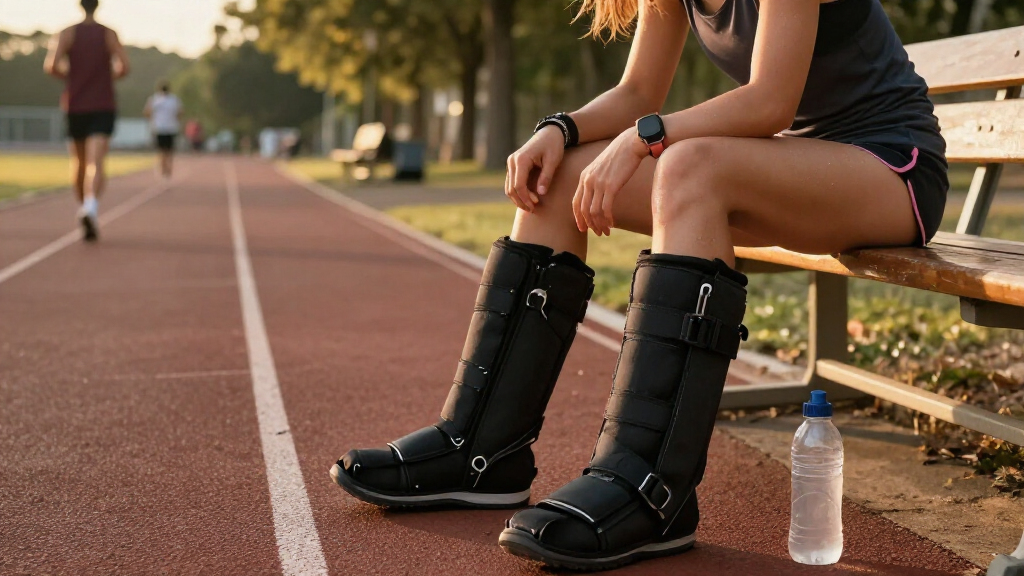

Running recovery compression boots vary most in fit, portability, and how much control they offer. My best overall pick is the Hyperice Normatec 3 for runners seeking a more established, adjustable full-leg system; the Therabody JetBoots Prime stands out for short inseams and cordless use, while the QUINEAR Air Compression Recovery Boots offer a simpler alternative. The main tradeoff is between more tailored controls and a more portable, straightforward setup, with heat and extra zones adding different kinds of convenience. Fit matters as much as features, since boots that do not suit your leg length may be awkward to use after a run. Read on for the full comparison and help choosing the right pair for your recovery routine.

Get workout gear delivered free with Prime
- Fast, free delivery on millions of items
- Prime Video, Amazon Music and more included
- Member-only deals all year
Complete the kit



Key Takeaways
- The Hyperice Normatec 3 leads for adjustable full-leg recovery: it is the strongest match for runners who value a more developed control system over a basic, no-frills setup.
- Short inseams change the shortlist: Therabody JetBoots Prime is specifically positioned for shorter inseams, an advantage over standard-length options when boot fit is a concern.
- Cordless designs suit recovery away from a fixed spot: Anaconda and QUINEAR Cordless emphasize battery-powered use, while wired-style systems may suit runners who recover at home and prefer not to prioritize mobility.
- More settings are not automatically more useful: MUSUGY lists nine pressure levels and six modes, but beginners may prefer a simpler control layout they can use consistently.
- Heat is a separate preference, not a substitute for compression fit: the heated-knee and heat-focused models serve runners seeking warmth, while buyers who mainly want adjustable leg compression may prefer a non-heated design.
| MUSUGY Full-Leg Air Compression Massager, 9 Pressure Levels, 6 Modes, 3 Timers, Medium |  | Best for Targeted Full-Leg Sessions | Air chambers: 5: foot, lower calf, upper calf, knees, and thighs | Pressure levels: 9 levels, 40–120 mmHg | Modes: 6: 3 full-leg sequential and 3 zone modes | VIEW LATEST PRICE | See Our Full Breakdown |
| Anaconda Wireless Leg Compression Boots – Air Recovery System for Athletes, Leg Massager with 4 Zones and 3 Modes, 4-Hour Battery (Medium) |  | Best for High-Pressure Cordless Use | Compression pressure: 200 mmHg | Targeted zones: 4: foot, calf, knee, and thigh | Massage modes: 3: Full-Leg Relief, Massage, and Targeted Zone | VIEW LATEST PRICE | See Our Full Breakdown |
| CINCOM Cordless Air Compression Recovery System | 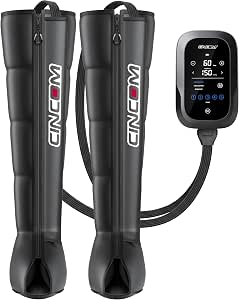 | Best for Session and Pressure Range | Compression zones: 5 independent air chambers | Coverage: Feet and ankles, lower calves, upper calves, knees, and thighs | Pressure levels: 11 | VIEW LATEST PRICE | See Our Full Breakdown |
| SHINE WELL Leg Recovery Compression Boots, Medium |  | Best for a Longer Warranty | Pressure levels: 11 levels, 50–150 mmHg | Massage areas: 4: foot, calf, lower thigh, and upper thigh | Massage modes: 3 | VIEW LATEST PRICE | See Our Full Breakdown |
| Therabody JetBoots Prime Wireless Compression Boots for Short Inseams |  | Best for Short Inseams and Travel | Product type: Wireless compression boots | Inseam fit: Short; under 29 inches | Pressure levels: 4 | VIEW LATEST PRICE | See Our Full Breakdown |
| MUELLER Sports Medicine REVIVE M2 Professional Air Compression Boot |  | Best for Therapist-Style Recovery | Garment type: Medical compression leg sleeves | Included components: Compression sleeves and M2 console | Coverage: Leg, knee, calf, and foot | VIEW LATEST PRICE | See Our Full Breakdown |
| Leg Compression Massager for Circulation and Pain Relief, Full Leg 5-Zone Compression Boots |  | Best for Fine-Tuned Zone Control | Zones: 5 | Air chambers: 10 | Pressure levels: 12 (60–240 mmHg) | VIEW LATEST PRICE | See Our Full Breakdown |
| QUINEAR Air Compression Recovery Boots for Athletes |  | Best for Straightforward Sessions | Air chambers: 4 | Intensity levels: 8 | Pressure range: 50–120 mmHg | VIEW LATEST PRICE | See Our Full Breakdown |
| Hyperice Normatec 3 Full-Leg Compression Boots, Standard |  | Best Premium App-Connected Pick | Product type: Full-leg compression boots | Size: Standard | Inseam fit: 31–35 in | VIEW LATEST PRICE | See Our Full Breakdown |
| Leg Compression Massager with Heated Knee, 6 Modes and 12 Intensity Levels |  | Best for Added Knee Warmth | Air chambers: 4 | Modes: 6 | Intensity levels: 12 | VIEW LATEST PRICE | See Our Full Breakdown |
| Leg Compression Massager Air Compression Boots Medium Black |  | Best for Cordless Full-Leg Coverage | Size: Medium; for heights 5 ft 7 in to 6 ft | Boot length: 37.5 inches | Boot width: 15 inches | VIEW LATEST PRICE | See Our Full Breakdown |
| CINCOM Air Compression Boots for Leg and Foot Massage |  | Best for Easy-On Lower-Leg Sessions | Massage area: Feet and lower legs | Massage technology: Sequential air compression | Modes: 3 | VIEW LATEST PRICE | See Our Full Breakdown |
| FIT KING Air Compression Leg Massager for Recovery, Foot and Calf |  | Best for Adjustable Foot-and-Calf Recovery | Airbag chambers: 3 large chambers | Coverage: 360° wrap around feet and calves | Pump: Large pump for fast inflation and deflation | VIEW LATEST PRICE | See Our Full Breakdown |
| QUINEAR Cordless Leg Compression Recovery Boots |  | Best for Travel-Ready Full-Leg Adjustability | Air chambers: 4 | Pressure: 12 levels, 40–150 mmHg | Massage modes: Sequence, Circulation, Combination | VIEW LATEST PRICE | See Our Full Breakdown |
| Air Compression Boots Leg Massager with Heat for Circulation (Medium) |  | Best for Heated, Quiet Full-Leg Sessions | Compression system: Full-leg, 5-chamber sequential air | Heat therapy: Included | Pump noise: Under 55 dB | VIEW LATEST PRICE | See Our Full Breakdown |
More Details on Our Top Picks
MUSUGY Full-Leg Air Compression Massager, 9 Pressure Levels, 6 Modes, 3 Timers, Medium
The MUSUGY makes sense for runners who want to adjust both the pressure and the area being treated, rather than rely on a few fixed programs. Its five chambers cover the feet through the thighs, while six modes include full-leg sequences and zone-specific options; a pressure sensor adjusts output across chambers. That combination offers more control than the SHINE WELL, which has four massage areas and three modes, though SHINE WELL provides a longer warranty. MUSUGY’s 15-, 20-, and 25-minute timers suit shorter post-run sessions, but don’t match the longer session range of the CINCOM Cordless Air Compression Recovery System. Fit is the main constraint: the listed inseam is 36 inches or longer, with specific thigh and calf limits. I would skip it if those measurements don’t match.
Pros:- Five chambers cover the feet, calves, knees, and thighs.
- Six modes include both full-leg sequences and zone-specific treatment.
- Pressure sensor adjusts air output across chambers.
- Reinforced nylon sleeves use double-stitched seams.
Cons:- The stated fit requires an inseam of at least 36 inches.
- Thigh and calf circumference limits may exclude some runners.
- The longest timer is 25 minutes, shorter than CINCOM’s maximum 60-minute session.
Best for: Runners with an inseam of at least 36 inches who want multiple full-leg and zone-focused settings after training.
Not ideal for: Runners with shorter inseams or thighs over 31 inches or calves over 22 inches, since the stated fit may not accommodate them.
- Air chambers:5: foot, lower calf, upper calf, knees, and thighs
- Pressure levels:9 levels, 40–120 mmHg
- Modes:6: 3 full-leg sequential and 3 zone modes
- Timers:15, 20, or 25 minutes
- Fit:Medium; inseam 36 inches or longer
- Circumference limits:Thigh up to 31 inches; calf up to 22 inches
- Material:Reinforced nylon with double-stitched seams
- Additional features:Pressure sensor with automatic air-output adjustment; memory function
- Warranty:12 months
Our verdict“Choose MUSUGY if its long-inseam fit works for you and you value adjustable, targeted full-leg sessions over longer treatment times.”
Anaconda Wireless Leg Compression Boots – Air Recovery System for Athletes, Leg Massager with 4 Zones and 3 Modes, 4-Hour Battery (Medium)
The Anaconda’s defining choice is 200 mmHg compression paired with a four-hour cordless battery. For runners who want to use boots away from an outlet—at the gym, at home, or while traveling—that freedom is a clearer distinction than the more setting-heavy MUSUGY. Anaconda covers the foot, calf, knee, and thigh and offers three modes, including targeted-zone treatment, but it has fewer zones than the five-chamber CINCOM Cordless Air Compression Recovery System. The included travel bag helps with transport; the tradeoff is a medium-only fit and a basic controller without an app. The stated pressure is also much higher than MUSUGY’s listed range, so this is not the pick for someone seeking a lower-pressure option or a wide choice of intensity levels.
Pros:- Cordless operation with a stated four-hour rechargeable battery.
- Listed compression pressure reaches 200 mmHg.
- Three modes include full-leg, massage, and targeted-zone options.
- Travel bag supports storage and transport.
Cons:- Available in medium only, which may not fit every runner.
- Controller has no dedicated app or app-based customization.
- Four zones provide less segmentation than CINCOM’s five independent chambers.
Best for: Runners who prioritize cordless sessions and want a high listed compression level for use at the gym or while traveling.
Not ideal for: Buyers who need a choice of sizes, app-based controls, or more than three modes and four treatment zones.
- Compression pressure:200 mmHg
- Targeted zones:4: foot, calf, knee, and thigh
- Massage modes:3: Full-Leg Relief, Massage, and Targeted Zone
- Battery:Rechargeable; up to 4 hours
- Size:Medium
- Included accessory:Portable travel bag
- Controls:Basic controller; no dedicated app
Our verdict“Pick Anaconda if cordless convenience and its 200 mmHg specification matter more to you than broader sizing or extensive controls.”
CINCOM Cordless Air Compression Recovery System
Runners who like to fine-tune session length have a strong reason to choose the CINCOM Cordless Air Compression Recovery System: it pairs 11 pressure levels with ten timer settings from 15 to 60 minutes. Its five independent chambers cover the feet and ankles through the thighs, giving it more zone separation than the four-zone Anaconda. A full-touch LCD and rechargeable, cordless design make the controls and portability part of the appeal, and the travel bag is useful for packing the system away. The tradeoff is that its maximum session is 60 minutes, and its stated use is leg compression rather than full-body recovery. Compared with the Therabody JetBoots Prime, CINCOM offers many more pressure and timer choices, while JetBoots Prime is specifically designed for short inseams.
Pros:- Five independent chambers cover the feet and ankles through the thighs.
- Eleven pressure levels allow more adjustment than Anaconda’s listed three modes.
- Ten timer settings span 15 to 60 minutes.
- Cordless rechargeable design, full-touch LCD, and travel bag support portable use.
Cons:- Sessions are limited to a maximum of 60 minutes.
- Designed for leg compression rather than full-body recovery.
- Offers fewer stated pressure levels and timer intervals than its controls may appeal to runners who prefer simple operation.
Best for: Runners who want cordless leg recovery with fine-grained pressure adjustment and timer options up to an hour.
Not ideal for: Runners seeking full-body recovery equipment or those whose top fit requirement is a short inseam.
- Compression zones:5 independent air chambers
- Coverage:Feet and ankles, lower calves, upper calves, knees, and thighs
- Pressure levels:11
- Timer settings:10 settings, 15–60 minutes
- Modes:Sequential, circulation, and combination
- Controls:Full-touch LCD
- Power:Cordless, rechargeable
- Included accessory:Travel bag
Our verdict“Choose CINCOM if adjustable pressure and a wide session-length range matter more than a short-inseam-specific fit.”
SHINE WELL Leg Recovery Compression Boots, Medium
The SHINE WELL keeps the control scheme relatively straightforward: four selectable areas, three modes, and three session lengths from 10 to 30 minutes. Its 11 pressure levels give runners room to adjust intensity, while the 24-month warranty is longer than the 12-month coverage listed for the MUSUGY. MUSUGY counters with five chambers and six modes, so it suits buyers wanting more segmented treatment; SHINE WELL is a simpler alternative for runners who don’t need as many program choices. The touch controller has a display, but the system uses two separate air hoses that must be connected, making setup less convenient than the cordless CINCOM. Its medium size also calls for a fit check before buying.
Pros:- Eleven pressure levels offer a broad range of adjustments.
- Four massage areas allow area selection across the leg.
- Touch controller includes a display.
- 24-month warranty is longer than MUSUGY’s stated 12-month warranty.
Cons:- Two separate air hoses need to be connected to the controller.
- Medium sizing may not fit every runner.
- Three modes and four massage areas offer fewer options than MUSUGY’s six modes and five chambers.
Best for: Runners who want adjustable pressure, a touch display, and a longer stated warranty in a wired boot system.
Not ideal for: Runners who prioritize cordless portability, dislike connecting hoses, or need a size other than medium.
- Pressure levels:11 levels, 50–150 mmHg
- Massage areas:4: foot, calf, lower thigh, and upper thigh
- Massage modes:3
- Timer options:10, 20, or 30 minutes
- Size:Medium
- Controller:Touch controller with display
- Air hoses:2 separate hoses
- Warranty:24 months
Our verdict“Choose SHINE WELL if you want adjustable, display-controlled sessions and value its 24-month warranty more than cordless convenience.”
Therabody JetBoots Prime Wireless Compression Boots for Short Inseams
The Therabody JetBoots Prime stands apart in this group by naming a specific fit: short inseams under 29 inches. That makes it a more relevant starting point for shorter-legged runners than the MUSUGY, whose listed inseam requirement is 36 inches or longer. JetBoots Prime also folds for storage, includes a drawstring backpack, and can run while charging, so a three-hour battery is less restrictive when an outlet is available. Its four pressure levels and four treatment durations are simpler than the 11 pressure levels and ten timer settings on the CINCOM Cordless Air Compression Recovery System. The tradeoff is less adjustment range and a fit profile aimed at shorter inseams, not a general-purpose option for every body size.
Pros:- Designed for short inseams under 29 inches.
- Folds for storage and travel and includes a drawstring backpack.
- Can be used while charging, reducing reliance on battery alone.
- Non-porous material and flat interior lining are easy to clean.
Cons:- The short-inseam fit may not suit runners with longer legs.
- Four pressure levels provide less adjustment than CINCOM’s 11.
- Battery life is up to three hours per charge.
Best for: Runners with inseams under 29 inches who want foldable cordless boots for travel or compact storage.
Not ideal for: Runners with longer inseams or those who want extensive pressure customization beyond four levels.
- Product type:Wireless compression boots
- Inseam fit:Short; under 29 inches
- Pressure levels:4
- Treatment time intervals:4
- Battery life:Up to 3 hours
- Charging use:Can be used while charging
- Technology:TruGrade with 4 overlapping chambers
- Included accessory:Drawstring backpack
- Materials:Medical-grade, non-porous
Our verdict“Pick JetBoots Prime if short-inseam fit and packability take priority over a wide range of pressure settings.”
MUELLER Sports Medicine REVIVE M2 Professional Air Compression Boot
The REVIVE M2 is the strongest fit here for runners who want adjustable, sequential compression with a more clinical orientation. Its multi-chambered sleeves cover the foot, calf, knee, and leg, while programmable patterns and customizable pressure let users tailor sessions to different recovery needs. Compared with the QUINEAR Air Compression Recovery Boots, which offer a simpler four-chamber setup and a carry bag, the M2 emphasizes targeted treatment and professional-use positioning rather than easy portability. That comes with practical tradeoffs: the console is bulky and needs an external power source, so it is better suited to a home recovery corner than a gym bag. The listed large-only sizing also narrows its fit, making it a poor match for runners outside that size range.
Pros:- Multi-chambered sleeves cover the foot, calf, knee, and leg.
- Customizable pressure settings and programmable sequential patterns.
- Designed for athletes as well as professional therapists.
Cons:- Bulky console requires an external power source.
- Only the large size is listed, limiting fit options.
Best for: Runners who want programmable, full-leg compression and have a dedicated space for recovery sessions.
Not ideal for: Runners who need a compact or cordless setup, or whose legs do not fit the listed large size.
- Garment type:Medical compression leg sleeves
- Included components:Compression sleeves and M2 console
- Coverage:Leg, knee, calf, and foot
- Pressure control:Customizable pressure settings
- Programs:Programmable sequential patterns
- Size:Large
- Color:Gray
- Item weight:3.61 kg
Our verdict“Choose the REVIVE M2 for adjustable, therapist-oriented full-leg sessions if its large fit and powered console suit your setup.”
Leg Compression Massager for Circulation and Pain Relief, Full Leg 5-Zone Compression Boots
For runners who want a lot of control over where a session focuses, this model stands out with five zones and ten air chambers, spanning the foot, lower and upper calf, knee, and thigh. Its 12 pressure levels, six modes, three timers, and memory recall offer more stated adjustment options than the QUINEAR Air Compression Recovery Boots, which have four chambers and three modes. Built-in pressure sensors add a fit-safety feature, while the included bag supports trips between home and gym. The tradeoff is that more settings do not make the boots smaller or simpler: the listing notes they may feel bulky on smaller legs, and there is no heat function for runners who want warmth alongside compression. I’d pick this over the heated-knee model when zone coverage and pressure choice matter more than heat.
Pros:- Five zones and ten chambers cover the foot through the thigh.
- Six modes, 12 pressure levels, and three timer settings.
- Pressure sensors help adapt the fit and limit over-tightening.
- Includes a portable bag and handheld LED controller.
Cons:- No heating function.
- Boots may feel bulky on smaller legs.
- The many controls may be more than runners seeking a simple session need.
Best for: Runners who want separate foot-to-thigh zones, many pressure options, and a system they can carry between home and the gym.
Not ideal for: Runners with smaller legs who need a close fit, or anyone seeking heat during recovery sessions.
- Zones:5
- Air chambers:10
- Pressure levels:12 (60–240 mmHg)
- Modes:6
- Timers:3 settings
- Fit feature:Built-in pressure sensors
- Material:Nylon body with polyester edging
- Included accessory:Portable nylon bag
Our verdict“Pick this model for broad zone coverage and extensive pressure control, provided its fit works and heat is not a priority.”
QUINEAR Air Compression Recovery Boots for Athletes
The QUINEAR is a sensible pick for runners who want adjustable compression without the more elaborate control set of the five-zone, ten-chamber model in this lineup. Its four chambers cover the foot, calf, and thigh, with three massage modes, eight intensity levels, and session choices of 20, 25, or 30 minutes. A pressure sensor adjusts to leg size, and the included carry bag makes it easier to store or bring along than the console-heavy MUELLER REVIVE M2. That simpler setup also means less detailed zone targeting: runners who specifically want separate upper- and lower-calf or knee zones may prefer the ten-chamber alternative. The boots still need to be zipped on before use, and their stated function is leg compression massage rather than a broader recovery system. A 24-month warranty is listed.
Pros:- Four chambers cover the foot, calf, and thigh.
- Eight intensity levels and three massage modes.
- Three session lengths from 20 to 30 minutes.
- Pressure sensor adjusts to leg size; carry bag included.
Cons:- Zippered boots take time to put on before each session.
- Four chambers provide less zone detail than the ten-chamber five-zone model.
- Designed for leg compression massage rather than other recovery needs.
Best for: Runners seeking adjustable foot-to-thigh compression, a carry bag, and a relatively simple set of session controls.
Not ideal for: Runners who want detailed five-zone targeting, heat, or recovery features beyond leg compression massage.
- Air chambers:4
- Intensity levels:8
- Pressure range:50–120 mmHg
- Massage modes:3: sequence, circulation, and combination
- Timer settings:20, 25, or 30 minutes
- Coverage:Foot, calf, and thigh
- Controller:Digital
- Warranty:24 months
Our verdict“Choose QUINEAR for manageable, adjustable sessions and portability, but look elsewhere for finer zone control or heat.”
Hyperice Normatec 3 Full-Leg Compression Boots, Standard
The Normatec 3 is the premium-oriented choice for runners who want five overlapping zones, seven compression levels, and app-connected customization in one system. Its Pulse technology and overlapping treatment areas distinguish it from the QUINEAR boots, which have four chambers and a simpler digital controller without listed app connectivity. The Hyperice app can add control options, while the refreshed, lighter system and intuitive interface are aimed at making regular sessions easier to manage. Those features are most useful to runners who will actually use Bluetooth customization; they add little for someone who prefers a basic standalone controller. Fit is the other deciding factor: this Standard size is specified for a 31–35-inch inseam and a thigh circumference up to 30 inches. The fixed sizing guidance makes checking fit more important than choosing by feature list alone.
Pros:- Five overlapping treatment zones with Pulse technology.
- Seven compression levels offer session adjustment.
- Bluetooth connection to the Hyperice app adds customization.
- Lighter refreshed design with an intuitive interface.
Cons:- Standard fit is limited to a 31–35-inch inseam and thigh circumference up to 30 inches.
- App features require a Bluetooth connection.
- App connectivity may be unnecessary for runners who want simple manual controls.
Best for: Runners who want app-connected session customization and whose inseam and thigh measurements fit the Standard model.
Not ideal for: Runners who prefer a controller-only system, do not want Bluetooth-dependent features, or fall outside the stated fit range.
- Product type:Full-leg compression boots
- Size:Standard
- Inseam fit:31–35 in
- Maximum thigh circumference:30 in
- Compression levels:7
- Treatment zones:5 overlapping zones
- Technology:Pulse technology
- Connectivity:Bluetooth; Hyperice app
Our verdict“Choose the Normatec 3 for app-connected control and overlapping-zone compression if the Standard sizing matches your legs.”
Leg Compression Massager with Heated Knee, 6 Modes and 12 Intensity Levels
This model is the lineup’s clearest choice for runners who want heat around the knee alongside air compression through the feet, calves, and thighs. It pairs four chambers with six modes and 12 intensity levels, giving more listed session choices than the QUINEAR boots, though QUINEAR offers a pressure sensor and a 24-month warranty that are not specified here. The knee function is heat only—not compression—so runners seeking pneumatic knee treatment should not mistake warmth for a separate compression zone. Adjustable straps and zippered cuffs help secure the boots across different leg shapes, but the product data gives no exact sizing limits; I’d check the sizing guide before choosing. Its corded power adapter and included storage bag make it a home-friendly rather than cordless recovery option.
Pros:- Four chambers provide sequential compression across feet, calves, and thighs.
- Six modes and 12 intensity levels allow session adjustment.
- Four heat settings offer knee-area warmth.
- Zippered cuffs, adjustable straps, and a storage bag are included.
Cons:- Knee area provides heat only, with no compression.
- Corded use requires the included power adapter.
- Exact sizing and circumference limits are not stated in the supplied specs.
Best for: Runners who want adjustable compression for the feet, calves, and thighs with added knee-area heat.
Not ideal for: Runners who need knee compression, want a cordless setup, or cannot confirm a suitable fit from the sizing guide.
- Air chambers:4
- Modes:6
- Intensity levels:12
- Heating zones:6
- Temperature settings:Off, 113°F, 122°F, or 131°F
- Timer settings:10, 20, or 30 minutes
- Coverage:Feet, calves, and thighs; knee heat only
- Power:Corded with included power adapter
Our verdict“Choose this model if knee warmth matters alongside leg compression, but skip it if you need knee compression or cordless use.”
Leg Compression Massager Air Compression Boots Medium Black
Five overlapping chambers move compression from foot to thigh, making this a more full-leg option than the FIT KING Air Compression Leg Massager, which covers the feet and calves only. Independent removable batteries and controllers let you use one boot or both without staying beside an outlet, a useful distinction for runners who want recovery flexibility around the house or while traveling. Three modes and five pressure levels offer a straightforward range of adjustments, though the QUINEAR Cordless Leg Compression Recovery Boots provide more pressure levels, more target zones, and a wider stated battery-life range. The main compromises are a roughly two-hour battery runtime and a medium fit intended for users from 5 ft 7 in to 6 ft. I’d choose it for cordless thigh-to-foot coverage, not for extended sessions or a less restricted size range.
Pros:- Sequential compression covers the foot, calf, knee, and thigh.
- Separate removable batteries and controllers allow one- or two-leg operation.
- Cordless design supports use away from an outlet.
- Three modes and five pressure levels provide a useful range of adjustments.
Cons:- Around two hours of runtime may not suit frequent or extended sessions without recharging.
- Medium sizing is limited to a stated height range.
- The supplied details do not specify a pressure range in mmHg.
Best for: Runners between 5 ft 7 in and 6 ft who want cordless compression from foot to thigh and the option to treat one leg at a time.
Not ideal for: Runners outside the stated medium height range or anyone who needs longer cordless use between charges.
- Size:Medium; for heights 5 ft 7 in to 6 ft
- Boot length:37.5 inches
- Boot width:15 inches
- Air chambers:5 overlapping chambers from foot to upper thigh
- Massage modes:3
- Pressure levels:5
- Battery:Removable rechargeable 2000 mAh battery per boot
- Battery runtime:Approximately 2 hours per charge
Our verdict“Choose this if you want cordless, full-leg sessions and fit the medium height range; skip it if battery runtime or sizing flexibility matters more.”
CINCOM Air Compression Boots for Leg and Foot Massage
The one-piece zipper design makes these boots a practical choice for runners who want an uncomplicated way to cover their feet and lower legs after a workout. Built-in sensors adapt pressure and inflation volume to leg and foot contours, which may help the fit feel less one-size-fits-all than the fixed coverage suggests. The HD LCD controller provides three modes, three intensity levels, and a timer; by comparison, the FIT KING Air Compression Leg Massager offers nine intensity levels and preset session lengths, giving runners more control over the feel and duration. That simpler control range is a tradeoff, not a drawback for everyone: fewer settings can make routine sessions easier to select. Coverage stops below the knee, though, unlike the full-leg QUINEAR Cordless Leg Compression Recovery Boots. I’d pick CINCOM for accessible foot-and-calf recovery, not thigh compression.
Pros:- Zipper closure simplifies putting the boots on and taking them off.
- Sensors adjust pressure and inflation volume to leg and foot contours.
- Sequential compression targets the feet and lower legs.
- Smooth material is described as easy to clean.
Cons:- Coverage is limited to the feet and lower legs.
- Only three intensity levels are specified, fewer than the FIT KING model’s nine.
- The controller is required to change modes, intensity, and timing.
Best for: Runners who want zip-on compression for feet and lower legs, with sensor-assisted adjustment and simple controller-based session choices.
Not ideal for: Runners seeking thigh or knee coverage, cordless sessions, or a wide selection of pressure levels.
- Massage area:Feet and lower legs
- Massage technology:Sequential air compression
- Modes:3
- Intensity levels:3
- Controller:HD LCD controller with timer
- Fit adjustment:Sensors adjust pressure and inflation volume
- Design:One-piece zipper
- Material:Smooth, easy-to-clean material
Our verdict“Choose CINCOM for straightforward, sensor-adjusted foot-and-calf sessions; look elsewhere if you need full-leg coverage or finer intensity control.”
FIT KING Air Compression Leg Massager for Recovery, Foot and Calf
For runners whose post-run fatigue is concentrated below the knee, the FIT KING’s 360° foot-and-calf coverage and nine pressure intensities offer more fine-tuning than the three-level CINCOM boots. A built-in sensor adjusts inflation, while the large pump is described as speeding inflation and deflation; that can make set-up less of a wait before a timed session. Choose among 20-, 25-, or 30-minute treatments, although those fixed choices offer less timing flexibility than the CINCOM timer. The boundary is coverage: unlike the full-leg QUINEAR Cordless Leg Compression Recovery Boots, FIT KING does not reach the thigh, and its power adapter and hose keep it tethered to an outlet. I’d rank it for focused, adjustable lower-leg recovery, but not for runners who want cordless convenience or compression above the calf.
Pros:- 360° wrap covers the feet and calves.
- Nine pressure intensities offer finer adjustment than CINCOM’s three levels.
- Built-in pressure sensor adjusts inflation automatically.
- Three preset session lengths and a two-year warranty are specified.
Cons:- Power adapter and hose limit use to places with an outlet.
- Coverage does not extend to the knees or thighs.
- Treatment time is limited to 20, 25, or 30 minutes.
Best for: Runners who want several intensity choices and sensor-adjusted compression focused on the feet and calves at home.
Not ideal for: Runners who need thigh coverage, cordless use, or session lengths beyond the three preset options.
- Airbag chambers:3 large chambers
- Coverage:360° wrap around feet and calves
- Pump:Large pump for fast inflation and deflation
- Sensor system:Built-in pressure sensor adjusts inflation automatically
- Massage modes:3
- Pressure intensities:9 levels
- Treatment times:20, 25, or 30 minutes
- Warranty:2 years
Our verdict“Choose FIT KING for adjustable, sensor-guided foot-and-calf sessions at home; choose a full-leg or cordless model if your needs extend beyond that.”
QUINEAR Cordless Leg Compression Recovery Boots
The QUINEAR cordless boots bring foot-to-thigh coverage, a travel bag, and three available sizes together, making them a strong fit for runners who want to move between home, gym, and travel use. Their 12 pressure levels and four target zones offer more control than the five-level Leg Compression Massager Air Compression Boots, while the battery-powered controller avoids the external hose and adapter used by FIT KING. Three modes and a timer adjustable in five-minute increments add useful session choices. The tradeoff is limited cordless runtime: the stated two to four hours per charge can vary, so frequent use may mean regular charging. Fit also depends on selecting one of the three sizes. Compared with the heated, wired Air Compression Boots Leg Massager, QUINEAR gives up heat therapy for portability and broader use away from an outlet.
Pros:- Cordless use supports recovery sessions away from an outlet.
- Four zones and 12 pressure levels allow targeted adjustment.
- Three sizes offer more fit choices than a single-size boot.
- Travel bag is included.
Cons:- Battery life is approximately 2–4 hours per charge.
- Fit depends on choosing from the three available sizes.
- Unlike the wired Air Compression Boots Leg Massager, it does not include heat therapy.
Best for: Runners who want adjustable, full-leg compression for home, gym, or travel and can select a suitable fit from three sizes.
Not ideal for: Runners who prioritize heat therapy, need longer use without charging, or cannot find a suitable fit among the available sizes.
- Air chambers:4
- Pressure:12 levels, 40–150 mmHg
- Massage modes:Sequence, Circulation, Combination
- Target zones:Foot, lower calf, upper calf, thigh
- Timer:15–60 minutes in 5-minute increments
- Battery capacity:2500 mAh
- Battery life:Approximately 2–4 hours per charge
- Sizes and accessory:3 sizes; travel bag included
Our verdict“Choose QUINEAR if portable, adjustable foot-to-thigh compression matters more than heat or extended battery runtime.”
Air Compression Boots Leg Massager with Heat for Circulation (Medium)
For runners who want warmth alongside compression, this model pairs heat therapy with five sequential chambers spanning foot to thigh. Its six programs include foot-, calf-, and thigh-focused options, while 11 pressure levels from 50–150 mmHg provide more adjustment than the five-level Leg Compression Massager Air Compression Boots. A pump rated below 55 dB may suit a quiet home recovery routine, and the carry bag helps with storage or transport. The central compromise is power: unlike the cordless QUINEAR Cordless Leg Compression Recovery Boots, this model needs a wired connection, limiting where sessions can happen. It is also a medium-size boot with stated leg-length and circumference limits, so sensor adjustment does not remove the need to check fit. I’d choose it for heat and tailored programs near an outlet, not for travel-first recovery.
Pros:- Five-chamber sequential compression covers the foot through the thigh.
- Heat therapy adds a feature not listed for the cordless QUINEAR boots.
- Six programs and 11 pressure levels support varied sessions.
- Pump noise is specified as under 55 dB, and a carry bag is included.
Cons:- Wired power limits use away from an outlet.
- Medium fit has stated leg-length and circumference limits.
- Full-leg boots take more storage space than a lower-leg massager.
Best for: Runners who want heated, quiet full-leg sessions with multiple programs and have an outlet and enough space for the boots.
Not ideal for: Runners who need cordless recovery, fall outside the stated leg and circumference measurements, or prefer compact equipment.
- Compression system:Full-leg, 5-chamber sequential air
- Heat therapy:Included
- Pump noise:Under 55 dB
- Pressure range:50–150 mmHg; 11 levels
- Leg length compatibility:29.5–33.5 inches
- Maximum circumference:Thigh: 28 inches; calf: 22 inches
- Massage modes:6 programmable modes: AUTO, CYC, PIN, Foot, Calf, Thigh
- Power and portability:Wired; portable carry bag included
Our verdict“Choose this model if you want heat and multiple full-leg programs at home; choose QUINEAR instead if cordless use is your priority.”
How We Picked
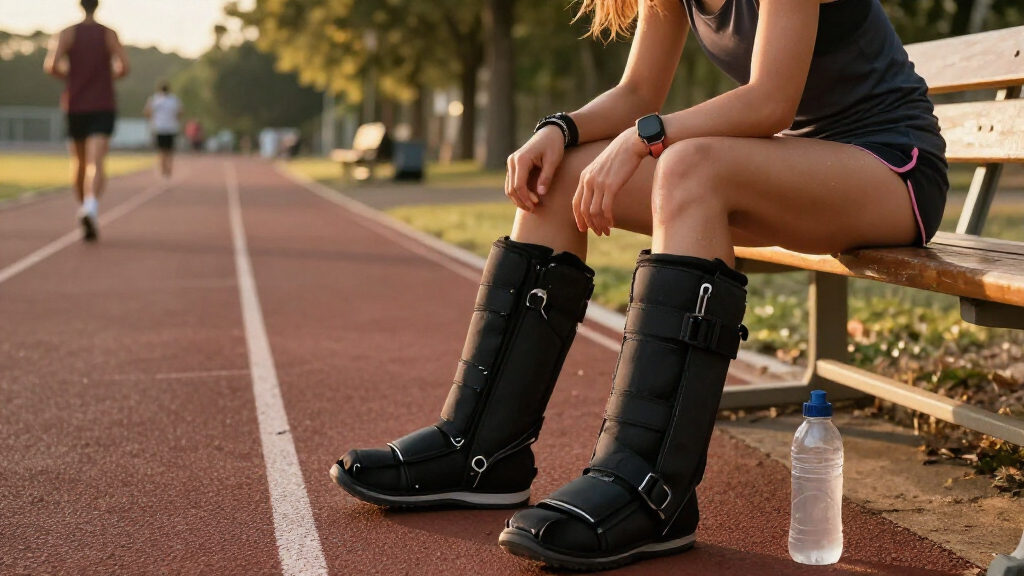
I compared these 15 options as tools for a runner’s post-run routine, focusing on coverage, fit information, pressure and mode controls, portability, and special features. I gave more weight to details that can change everyday use—such as stated short-inseam fit, cordless operation, and the number of compression zones—than to broad recovery claims. I also treated heat as a preference rather than a universal benefit, since it adds a different function from air compression.
The order reflects how clearly each option serves a distinct runner need and how much useful choice its stated features offer. The Hyperice Normatec 3 ranks first for a runner seeking an adjustable full-leg system, while Therabody earns a distinct place for short inseams and cordless use. Other picks sit lower when their listed details point to a narrower use, a simpler feature set, or less clear differentiation; the product names and feature claims alone do not establish clinical outcomes, durability, or fit for every body.
Factors to Consider When Choosing Running Recovery Compression Boots
Before choosing boots, I would match the system to the way you actually recover after a run. A long feature list can look appealing, but the best fit depends on your leg measurements, tolerance for pressure, available space, and whether you want to use the boots away from an outlet.
Fit Your Leg Length and Shape
Start with the size chart and the maker’s measurement instructions, not a broad label such as medium. Check whether the listed measurement refers to inseam, total leg length, or another point, since these are not interchangeable. Boots that end too high may leave parts of the leg uncovered; boots that bunch can make a session uncomfortable or hard to position consistently. If your inseam is short, a model explicitly designed for shorter inseams deserves a closer look than a standard boot with vague sizing details. When between sizes, ask the maker about fit before buying rather than assuming a tighter fit improves compression. A secure, comfortable fit matters more than adding another mode.
Choose Controls You Will Actually Use
Pressure levels, modes, timers, and zones offer different kinds of control, but more choices can also mean more setup. A runner who wants to repeat one familiar routine may be better served by clear presets than by a large menu of adjustments. Look for controls that make it easy to change pressure or stop a session without struggling to reach a unit or remote. Do not treat a higher number of settings as proof of better recovery; it mainly gives you more ways to adjust the experience. If you are new to compression, a simple interface can make it easier to begin gently and learn what feels comfortable. Prioritize control clarity over a specification count.
Decide Whether Cordless Use Is Worth It
Cordless boots can be easier to use in a shared room, while traveling, or anywhere a power outlet is inconvenient. That freedom comes with a need to manage battery charge, and a stated battery duration does not tell you how often you will need to recharge under your chosen settings. For a regular at-home routine beside an outlet, a cordless design may add less value than a comfortable fit or easier controls. Consider the full setup too: boots, hoses, controller, and charging gear all need storage space. If portability matters, check how the system is packed and carried rather than focusing only on the word wireless. Pick battery operation for a real use case, not as a default upgrade.
Treat Heat as an Optional Feature
Heat can appeal to runners who prefer warmth around the knees or legs, but it does not replace the boot’s compression function. Before choosing a heated model, check which area receives heat and whether the feature can be used separately from compression. Heat adds another control and may not suit everyone, particularly if you dislike warmth during recovery. A common mistake is paying attention to the heating label while overlooking boot length, chamber coverage, or pressure adjustment. If warmth is not part of your routine, a non-heated option may keep the setup simpler. Choose heat for a specific comfort preference rather than an assumed performance benefit.
Match Coverage to Your Recovery Priorities
Some models describe full-leg coverage, while others call out specific areas such as the foot, calf, or knee. Decide which parts you want the boots to cover before comparing zone counts, since a chamber number by itself says little about how the garment fits your needs. More zones may offer more segmented compression, but they can also make fit and control choices more involved. Runners who mainly want attention to the lower leg should check whether a full-leg boot feels unnecessarily large for their routine. Those who want a broader treatment area should confirm that the product’s stated coverage matches the body areas they care about. Use the coverage description, not just the product name, to compare options.
Set Expectations for Recovery Claims
Compression boots are a recovery tool, not a replacement for sleep, suitable training loads, or medical care. Product descriptions may refer to circulation or pain relief, but those phrases do not establish an outcome for an individual runner. If you have a medical condition, ongoing pain, or uncertainty about whether compression is appropriate, ask a qualified clinician before use. Also check the instructions for session duration, cleaning, and any restrictions on use. A return policy and accessible support can matter when fit is uncertain, especially for a full-leg garment. Choose based on comfort, usability, and a routine you can follow—not on promises that a device will prevent injury or speed every recovery.
Frequently Asked Questions
Are cordless compression boots worth choosing if I only recover at home?
They are most useful when you want to move around, travel, or use the boots somewhere without a convenient outlet. If you always recover in one spot at home, battery operation may not improve your routine enough to outweigh charging and battery upkeep. Compare the cordless model’s stated battery duration with how long you expect sessions to last, but treat that figure as a guide rather than a guarantee for every setting. You may get more practical value from a better fit or clearer controls instead. Choose cordless when portability solves a real problem in your schedule.
How should I choose boot sizing if I have short legs or a long inseam?
Use the maker’s size chart and measurement method, then check whether the product gives specific guidance for inseam or leg length. A short-inseam design such as the Therabody JetBoots Prime is worth comparing if standard boots tend to bunch or extend beyond your preferred fit. For a long inseam, confirm that the boot reaches the areas you want covered rather than relying on a general size label. If your measurement falls between sizes, contact the maker before ordering. Correct length can make the difference between a boot that sits comfortably and one that shifts during use.
Should I choose boots with heat for post-run recovery?
Choose heat only if warmth is a feature you specifically want; it is separate from the air-compression function. Check whether heat applies to the knee, the whole leg, or another named area, and whether you can control it independently. If your main priorities are pressure adjustment and leg coverage, a non-heated model may fit your needs without adding another setting to manage. Heat should not be treated as proof of better recovery or a substitute for medical advice. If warmth or compression may be unsuitable for your health, ask a clinician first.
Do more pressure levels and modes make a boot better for a beginner?
Not necessarily: more settings provide flexibility, but they can also make the first session harder to set up. Beginners may find a clear preset and an easy way to lower pressure more useful than a long list of modes. MUSUGY, for example, lists many levels and modes, while a simpler system may suit someone who prefers fewer choices. Start with the instructions and a comfortable setting rather than trying to use the highest pressure. If the interface is confusing, a feature-rich model can become less convenient than a straightforward one.
Can compression boots replace rest or help diagnose persistent running pain?
No. These products are consumer recovery devices, not diagnostic tools, and their listed features do not establish that they can prevent injury or resolve persistent pain. Rest, sensible training adjustments, and appropriate medical guidance remain separate parts of managing recovery. If pain is ongoing, worsening, or unusual for you, consult a qualified clinician before using compression. Read the product’s safety instructions as well, since individual health conditions can affect whether compression is suitable. Choose boots for a comfort routine, not as a substitute for care.
Conclusion
For the broadest match among these options, I would start with the Hyperice Normatec 3 as the best overall pick for runners seeking an adjustable full-leg system. The best premium choice is also the Normatec 3 for buyers who put its more developed control approach ahead of a simpler setup. For a distinct fit need, Therabody JetBoots Prime is the pick for short inseams and cordless use. The best value direction is a simpler QUINEAR or CINCOM option if you want compression without making extra controls or heat your priority; compare the exact model’s fit and operation before choosing. For beginners, I would favor the system with the clearest controls and easiest pressure adjustment, rather than the one with the most modes. Choose a heated model only if warmth is a specific preference, and always make fit and safe use the final checks.