
Educational STEM kits for kids can turn science, engineering, and problem-solving into hands-on activities, but the best choice depends on a child’s age and the kind of learning they enjoy. I’d put the National Geographic Amazing Chemistry Set first for its broad experiment range, with Snap Circuits Jr. standing out for reusable electronics projects and Doctor Jupiter My First Science Experiments for younger beginners. Chemistry sets offer variety, while focused kits can provide more practice in one area or a more tangible finished build. Age guidance, adult help, setup, and whether activities can be repeated all shape the experience. Read on for my comparison of all 15 picks and guidance on matching a kit to your child.

Get workout gear delivered free with Prime
- Fast, free delivery on millions of items
- Prime Video, Amazon Music and more included
- Member-only deals all year
Complete the kit



Key Takeaways
- The National Geographic Amazing Chemistry Set leads for school-age kids who want many experiments across a single science theme; its breadth may be less appealing to children who prefer building or open-ended projects.
- Snap Circuits Jr. offers a clear path into electronics through reusable components, while the 420+ project SMILESSKIDDO kit is aimed at families seeking more project prompts and parts.
- Doctor Jupiter’s first experiments kit is the better age fit for many preschool beginners; the National Geographic chemistry sets target older children and can call for more adult guidance.
- Pixel Art Challenge brings pattern-making and creative design into the STEM mix, while the separate pixel art kit and wood craft set offer different hands-on formats.
- Microscope, root viewer, robot, hydraulic, and Earth science kits each focus on a distinct kind of discovery, so a specific interest can matter more than the largest activity count.
| UNGlinga 150 Experiments Science Kits for Kids Chemistry Lab STEM Toys | 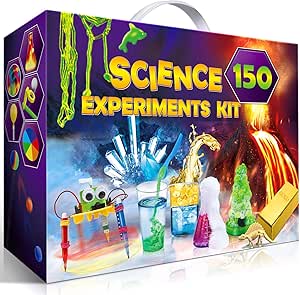 | Best for Broad Science Exploration | Experiments: 150 | Age range: 8 years and up | Topics: Earth science, chemistry, physics, and surface tension | VIEW ON AMAZON | See Our Full Breakdown |
| Snap Circuits Jr. SC-100 STEM Electronics Kit, 100+ Projects, Ages 8+ |  | Best for Hands-On Electronics | Projects: 100+ | Components: 29 Snap Circuits parts | Recommended age: 8 years and up | VIEW ON AMAZON | See Our Full Breakdown |
| Pixel Art STEM Toy Kit for Kids – Creative Arts and Crafts Gift for Ages 5+ |  | Best for Creative STEM Beginners | Brand: CYOEST | Age range: 5 years and up | Number of items: 1 | VIEW ON AMAZON | See Our Full Breakdown |
| National Geographic Junior Chemistry Set with 50 Experiments for Kids |  | Best for First Chemistry Activities | Brand: Blue Marble | Age range: 4 years and up | Experiments: 50 | VIEW ON AMAZON | See Our Full Breakdown |
| 5 Individual STEM Science Kits for Kids, Wood Arts and Craft Kits 8-12 |  | Best for Mechanical Model Building | Number of kits: 5 | Age range: 8–12 years | Material: Non-toxic plywood | VIEW ON AMAZON | See Our Full Breakdown |
| National Geographic Amazing Chemistry Set with 100+ Experiments for Ages 8-12 |  | Best for Chemistry Variety | Brand: Blue Marble | Age range: 8 years and up | Educational objective: STEM | VIEW ON AMAZON | See Our Full Breakdown |
| SMILESSKIDDO Science Kits Electronics STEM Kit 420+ Projects 35 Parts |  | Best for Electronics Project Variety | Projects: 420+ | Parts: 35 | Recommended age: 3 years and up | VIEW ON AMAZON | See Our Full Breakdown |
| Learning Resources Pixel Art Challenge – STEM and Art Activity Set for Kids Ages 5+ |  | Best Compact Screen-Free Challenge | Recommended age: 5+ | Challenge count: 40 | Pixel pieces: 400 foam pieces | VIEW ON AMAZON | See Our Full Breakdown |
| Doctor Jupiter My First Science Experiments Kit for Kids Ages 4+ |  | Best for Preschool Science Beginners | Brand: Doctor Jupiter | Age range: 4 years and up | Experiments: 100+ | VIEW ON AMAZON | See Our Full Breakdown |
| Doctor Jupiter My First Science Experiments Kit for Kids Ages 4+ |  | Best for a Shorter Starter Set | Brand: Doctor Jupiter | Age range: 4+ | Experiments: 50+ | VIEW ON AMAZON | See Our Full Breakdown |
| STEM Kits for Kids Science 8-12, Educational Robot Building Set for Boys and Girls |  | Best for Variety in Building Projects | Number of kits: 5 | Listed age range: 6–14 years | Projects: Solar car, wind car, obstacle-avoidance robot, transmission tank, and glider | VIEW ON AMAZON | See Our Full Breakdown |
| National Geographic Microscope for Kids with Up to 400x Magnification |  | Best for Microscopic Exploration | Maximum magnification: 400x | Light source: LED above and below | Objective lens: Achromatic | VIEW ON AMAZON | See Our Full Breakdown |
| Smartivity 2-in-1 Hydraulic Aeroplane & Dart Launcher STEM Kit for Ages 6-14 |  | Best for Mechanical Cause and Effect | Builds: Hydraulic aeroplane and dart launcher | Number of parts: 58 | Listed age range: 6–14 years | VIEW ON AMAZON | See Our Full Breakdown |
| Root Viewer Kit for Kids – Grow Your Own Plant |  | Best for Plant Growth Observation | Educational focus: Botany and plant growth | Recommended age: 0–8 years | Listed size: 7.5 × 2 × 5.5 inches | VIEW ON AMAZON | See Our Full Breakdown |
| National Geographic Earth Science Kit with 100+ Activities for Kids 8-12 |  | Best for Broad Earth Science Activities | Listed activities: 100+ | Experiments described: Over 15 | Recommended age: 8–12 years | VIEW ON AMAZON | See Our Full Breakdown |
More Details on Our Top Picks
UNGlinga 150 Experiments Science Kits for Kids Chemistry Lab STEM Toys
UNGlinga’s 150 experiments make this the widest-ranging choice here for children who want to sample several areas of science, including chemistry, physics, earth science, and surface tension. Compared with the National Geographic Junior Chemistry Set, which focuses on introductory chemistry for younger children, this kit offers more experiments and a broader set of topics, but its age guidance starts at eight. The illustrated instructions and included tools support hands-on exploration, while some activities still call for household materials. That means families can get plenty of variety, though they may need to gather supplies and help younger users follow steps. I’d choose it for a curious child ready to move between science subjects; those looking for a single, focused chemistry introduction may prefer the simpler National Geographic set.
Pros:- Offers 150 experiments across chemistry, physics, earth science, and surface tension.
- Illustrated instructions help children follow activities independently as they gain confidence.
- Included tools make it easier to begin many of the experiments.
- Variety supports repeat use across different science interests.
Cons:- Some activities require household materials beyond the kit.
- Younger children need adult supervision and help with instructions.
- The broad activity mix may be less focused than a dedicated chemistry set.
Best for: Families with children 8 and older who want a large mix of guided science activities across several subjects.
Not ideal for: Preschoolers or families seeking a chemistry-only kit with minimal need to gather extra household materials.
- Experiments:150
- Age range:8 years and up
- Topics:Earth science, chemistry, physics, and surface tension
- Theme:Educational science
- Material:Plastic
- Dimensions:11.42 x 8.67 x 3.94 inches
Our verdict“Choose UNGlinga for an eight-and-up child who wants to explore several branches of science in one kit.”
Snap Circuits Jr. SC-100 STEM Electronics Kit, 100+ Projects, Ages 8+
Snap Circuits Jr. SC-100 gives children a direct route into circuits: its colorful parts snap together, so builders can focus on how components work without soldering or tools. That makes it a more focused engineering choice than UNGlinga’s 150 Experiments, whose activities span several science subjects. The tradeoff is breadth: this kit stays within electronics and the 29 supplied parts, so children who want chemistry or earth science activities will need another option. More than 100 project ideas provide a sequence of ways to explore the same components, though some builds may challenge younger children. Batteries are required and not included, so families should plan for that before the first project. I’d pick it for an eight-and-up learner who wants to build, observe, and revise simple circuits.
Pros:- Snap-together components let children build circuits without soldering or tools.
- More than 100 project ideas encourage repeated experimentation.
- Colorful parts make the connections easier to follow.
- Introduces practical electronics concepts through physical builds.
Cons:- Batteries are required but not included.
- Activities are limited to the supplied 29 parts and electronics theme.
- Some projects may need adult guidance for younger builders.
Best for: Families with children aged 8 or older who want a tool-free, project-based introduction to electrical circuits.
Not ideal for: Children seeking varied science topics or families who want a kit that can be used without supplying batteries.
- Projects:100+
- Components:29 Snap Circuits parts
- Recommended age:8 years and up
- Batteries:Required; not included
- Tools or soldering:Not required
- Subject:Electronics and circuitry
Our verdict“Pick Snap Circuits Jr. for a child who wants to learn circuitry by building projects with reusable snap-together parts.”
Pixel Art STEM Toy Kit for Kids – Creative Arts and Crafts Gift for Ages 5+
This pixel art kit brings pattern-making and problem-solving into a format that can suit younger children, with a stated age range of 5 to 12 and more than 50 patterns. Its activity is less lab-based than the National Geographic Junior Chemistry Set: children arrange colored blocks on a platform rather than explore materials through experiments. That makes it a gentle entry point for kids drawn to visual challenges, fine motor work, and creative choices, but it offers a narrower science experience than the chemistry kits in this roundup. Four challenge types add variety, while setup can take time and younger users may need supervision. I’d treat it as an art-and-logic activity with STEM elements, not as a substitute for hands-on science experiments or electronics projects.
Pros:- More than 50 patterns provide guided activities and room to practice.
- Four challenge types add variety to the pixel-art format.
- Combines visual creativity with problem-solving and fine motor practice.
- Includes a booklet, colored blocks, and a platform.
Cons:- Activities are centered on pixel art rather than experiments across STEM subjects.
- Setup may take time before children can start a challenge.
- Younger children may need adult supervision.
Best for: Caregivers of children aged 5 to 12 who enjoy visual puzzles, pattern building, and creative activities.
Not ideal for: Families seeking experiments in chemistry, physics, or electronics, or children who dislike careful piece-by-piece setup.
- Brand:CYOEST
- Age range:5 years and up
- Number of items:1
- Included components:Instruction booklet, colored plastic blocks, and plastic platform
- Patterns:More than 50
- Challenge types:4
- Model number:1PX-1
Our verdict“Choose this kit for a younger child who prefers visual building challenges over the lab experiments in the chemistry sets.”
National Geographic Junior Chemistry Set with 50 Experiments for Kids
The National Geographic Junior Chemistry Set is the most accessible chemistry-focused option here for a first introduction, with a stated age range beginning at four, illustrated directions, and 50 activities using household items. Its more than 20 kid-friendly lab tools help make experiments feel hands-on, while the focus stays on basic concepts rather than advanced chemistry. Compared with UNGlinga’s 150 Experiments, this set offers fewer activities and a narrower subject range, but the younger age guidance makes it a better fit for early explorers. That simplicity also limits its appeal for older children ready for longer or more varied challenges. Adult supervision may still be needed during activities. I’d choose it for a young child who wants a guided lab-style start, not for a preteen seeking a broad science program.
Pros:- Age guidance starts at four, making it accessible to younger beginners.
- Includes more than 20 kid-friendly lab tools.
- Fifty activities provide a structured introduction to basic chemistry.
- Illustrated instructions support following the experiment steps.
Cons:- Activities focus on basic chemistry and may feel too simple for older children.
- Experiments use household items, so families may need to gather supplies.
- Adult supervision may be needed during activities.
Best for: Families introducing children aged 4 and up to simple, guided chemistry activities with household materials.
Not ideal for: Older children looking for advanced chemistry, many subject areas, or projects that extend beyond basic experiments.
- Brand:Blue Marble
- Age range:4 years and up
- Experiments:50
- Lab tools:More than 20
- Included equipment:Test tubes, goggles, and other lab tools
- Dimensions:11 x 4.22 x 9.64 inches
- Item weight:0.72 kg
- Model number:NGJRCHEMT
Our verdict“Choose this set for a young beginner who wants simple chemistry activities and lab-style tools.”
5 Individual STEM Science Kits for Kids, Wood Arts and Craft Kits 8-12
This five-kit wooden set makes STEM tangible through assembly: children build amusement-park-themed models including a Ferris wheel, merry-go-round, and windmill, along with two light projects. Compared with Snap Circuits Jr. SC-100, which teaches electronics through reusable snap-together parts, this set centers on constructing physical models and offers several distinct builds. That variety suits children who enjoy crafts and seeing a mechanism take shape, though assembly asks for basic tools such as a screwdriver and lights require batteries that are not included. Its stated 8–12 age range also makes it less suited to younger beginners than the National Geographic junior chemistry kit. I’d choose it for a child who likes building projects at a table and wants a set of separate models, while families seeking open-ended circuit experimentation should look elsewhere.
Pros:- Includes five separate themed STEM builds.
- Model variety includes a Ferris wheel, merry-go-round, and windmill.
- Plywood construction gives children physical models to assemble.
- The set includes both mechanical builds and light projects.
Cons:- Batteries for the light projects are not included.
- Assembly requires basic tools such as a screwdriver.
- The 8–12 age range excludes younger beginners.
Best for: Families with children aged 8 to 12 who enjoy assembling wooden models and want several distinct build projects.
Not ideal for: Younger children, builders without basic hand tools, or kids mainly interested in reusable electronics experiments.
- Number of kits:5
- Age range:8–12 years
- Material:Non-toxic plywood
- Models:Ferris wheel, merry-go-round, windmill, fiber optic lamp, and star nightlight
- Manufacturer:YUTIN
- Assembly tools:Basic tools, including a screwdriver, required
- Batteries:Not included for light projects
Our verdict“Choose this set for an 8-to-12-year-old who prefers assembling a series of physical models to building electronic circuits.”
National Geographic Amazing Chemistry Set with 100+ Experiments for Ages 8-12
For school-age kids ready to explore chemistry, this kit pairs familiar reactions with crystal growing and color-changing experiments. Its test tubes, beakers, and pipettes make activities feel more like lab work than the simpler, preschool-friendly Doctor Jupiter My First Science Experiments Kit. A separate guide adds 85 experiments using household items, giving curious kids ways to keep exploring after the included materials run out. The tradeoff is that a high experiment count does not mean every activity is self-contained: some need adult supervision, and the age guidance starts at 8. Compared with the National Geographic Junior Chemistry Set, this one offers a broader activity list, which suits children who want more variety but may be a bigger commitment for families seeking a short introduction.
Pros:- More than 100 experiments span crystal growing, color changes, and reactions
- Includes test tubes, beakers, and pipettes for hands-on lab-style activities
- Bonus guide adds 85 experiments using household items
- Broad chemistry focus offers more variety than a basic introductory set
Cons:- Some experiments require adult supervision
- Age guidance begins at 8, limiting suitability for younger children
- The large activity count may feel like too much for families seeking a short starter kit
Best for: Families with children 8 and up who want varied, hands-on chemistry activities and are available to supervise some experiments
Not ideal for: Families shopping for preschoolers or a mostly independent kit for young children
- Brand:Blue Marble
- Age range:8 years and up
- Educational objective:STEM
- Set name:Amazing Chemistry Set
- Experiments:100+
- Included components:Chemistry kit with 100+ science experiments
- Dimensions:8.78 x 3.19 x 11.93 inches
- Weight:1.8 pounds
Our verdict“Choose this for an 8-and-up budding chemist who wants a broad set of activities and adult help is available when needed.”
SMILESSKIDDO Science Kits Electronics STEM Kit 420+ Projects 35 Parts
This electronics kit emphasizes repetition and range: it lists more than 420 projects built around 35 circuit parts, with a manual and indicator cards to guide each setup. That makes it a more focused choice for kids drawn to circuits than the National Geographic Amazing Chemistry Set, which explores reactions and crystals instead. No soldering or extra tools are needed, lowering the barrier to trying electrical concepts at home. The broad recommended age range of 3 to 12 is less useful as a skill guide, though; the product notes that some projects may challenge very young children, so an adult may need to choose activities and help. Families should also account for AA batteries, which are not included. Its plastic parts and circuit focus make it a narrower fit than a mixed science kit.
Pros:- More than 420 listed projects offer a long sequence of circuit activities
- Manual and indicator cards provide guidance for building
- No soldering or extra tools are required
- 35 parts give children components to use across projects
Cons:- AA batteries are required and not included
- Some projects may be too complex for very young children without adult help
- Plastic circuit components may not suit children who prefer chemistry or physical construction
Best for: Families with a child interested in circuits who want many guided, no-solder projects and can supply AA batteries
Not ideal for: Buyers seeking chemistry, building materials beyond plastic circuit parts, or projects a preschooler can reliably complete alone
- Projects:420+
- Parts:35
- Recommended age:3 years and up
- Included components:Circuit board
- Guidance:Colorful manual and indicator cards
- Tools:No soldering or extra tools required
- Battery requirement:AA batteries required; not included
- Dimensions:14.5 x 11 x 3.1 inches
- Weight:1.13 kg
Our verdict“Pick this for a circuit-curious child who wants many guided builds and has adult support and batteries available.”
Learning Resources Pixel Art Challenge – STEM and Art Activity Set for Kids Ages 5+
Pixel Art Challenge turns pattern solving into a tactile activity: children arrange 400 foam pieces on a 5.5-inch tray to complete 40 challenges. Its small working surface makes it a more compact tabletop project than the SMILESSKIDDO electronics kit, while the art component gives it a different appeal from chemistry sets such as the National Geographic Amazing Chemistry Set. The challenges can exercise spatial reasoning and fine motor control without a screen, and multiple levels give children puzzles to revisit. The tradeoff is that this is a focused puzzle set, not a broad science kit with experiments across STEM subjects. Its stated age range is 5+, and the small pieces call for care around younger children. Older kids seeking electronics or chemistry may outgrow the format quickly.
Pros:- 40 challenges offer structured pattern-solving activities
- 400 foam pixels allow children to build colorful designs
- Screen-free format combines art activity with problem-solving
- 5.5-inch tray keeps the work area compact
Cons:- Focused on pixel puzzles rather than a range of science experiments
- Small pieces require care around younger children
- May hold limited appeal for older kids looking for deeper engineering projects
Best for: Caregivers of children 5 and up who want a small, screen-free activity combining pattern puzzles and creative play
Not ideal for: Older children seeking experiments in chemistry, electronics, or engineering, or homes where small foam pieces are unsuitable
- Recommended age:5+
- Challenge count:40
- Pixel pieces:400 foam pieces
- Material:Foam
- Tray size:5.5 x 5.5 inches
- Model number:LER9463
- Activity format:Screen-free pixel art puzzles
Our verdict“Choose this for a young child who enjoys visual puzzles and art and needs a compact, screen-free STEM activity.”
Doctor Jupiter My First Science Experiments Kit for Kids Ages 4+
This kit is the clearest entry point for younger children in this group: its age guidance starts at 4, and the set includes beakers, a conical flask, stirring sticks, spray bottles, cups, and a funnel. Those familiar tools support simple, hands-on activities, while the instruction manual and bonus booklet provide a starting structure. Compared with the National Geographic Amazing Chemistry Set, it targets an earlier age and basic experiments rather than a school-age child ready for more varied chemistry. The tradeoff is that older kids may find the activities too introductory, and the listed food ingredients and coloring materials suggest some experiments depend on the kit’s specific supplies. Adult supervision may still be needed, so this is best for shared exploration rather than fully independent play.
Pros:- Age guidance starts at 4, younger than the National Geographic Amazing Chemistry Set
- Includes beakers, a flask, spray bottles, cups, and other activity tools
- Manual and bonus experiment booklet provide guided activities
- Over 100 experiments offer variety for a beginner-oriented set
Cons:- Basic experiments may not hold older children’s interest
- Some activities may require adult supervision
- Several listed activities use specific included food ingredients and coloring materials
Best for: Families introducing children age 4 and up to hands-on science with an adult nearby to guide activities
Not ideal for: Older children who want challenging chemistry concepts or a kit centered on advanced, independent experiments
- Brand:Doctor Jupiter
- Age range:4 years and up
- Experiments:100+
- Model:DJ Junior Science
- Included tools:2 beakers, 1 conical flask, 1 spatula, 2 stirring sticks, 2 spray bottles, 2 cups, 1 funnel, 1 safety goggles, 1 tray
- Included materials:Rose and mango food essence; baking powder, psyllium husk, and corn starch; blue, yellow, and red food colors
- Guides:Instruction manual and bonus experiment booklet
- Manufacturer:Metis Learning Solutions Pvt. Ltd.
Our verdict“Choose this to introduce a preschooler to guided, hands-on science when an adult can help with activities.”
Doctor Jupiter My First Science Experiments Kit for Kids Ages 4+
This version presents a more compact starting point, with 50+ experiments and illustrated, easy-to-follow instructions for children age 4 and up. That smaller stated activity count makes it easier to frame as an introduction than the other Doctor Jupiter kit in this lineup, which lists over 100 experiments and a substantial set of tools. It still offers screen-free activities tied to STEM concepts, but its product data gives fewer details about what materials or equipment are included. Some experiments may need household items, and younger children may need supervision. Compared with the National Geographic Amazing Chemistry Set, this is aimed at a younger audience and a simpler start, but it provides less evidence of a broad, chemistry-focused toolkit. It suits families who want guided variety without committing to a larger activity list.
Pros:- 50+ experiments provide a defined beginner activity range
- Illustrated instructions are described as easy to follow
- Screen-free activities encourage critical thinking and STEM exploration
- Age guidance starts at 4
Cons:- Some experiments may require household items
- Younger children may need adult supervision
- Product details do not specify included materials or tool inventory
Best for: Families seeking a guided first science activity set for a child age 4 or older, especially if they prefer a shorter listed activity count
Not ideal for: Buyers who need a detailed inventory of included tools or a chemistry kit with specified lab equipment
- Brand:Doctor Jupiter
- Age range:4+
- Experiments:50+
- Safety standard:ASTM F963-17
- Instructions:Illustrated, easy-to-follow instructions
- Activity format:Screen-free hands-on activities
Our verdict“Pick this as a guided first science set for a young child if a shorter activity list and unspecified materials fit your needs.”
STEM Kits for Kids Science 8-12, Educational Robot Building Set for Boys and Girls
Five different builds give this set its place: children can move from solar and wind-powered cars to an obstacle-avoidance robot, a transmission tank, and a glider. That range makes it a broader engineering sampler than the Smartivity Hydraulic Aeroplane & Dart Launcher, which focuses on two related builds. The projects offer approachable ways to explore motion and basic mechanisms, though the robot projects are described as basic rather than a path into advanced robotics. Assembly gives kids hands-on problem-solving, but younger builders may need adult help, and the set requires AA batteries that are not included. I’d choose it for families who want several different construction activities in one kit; buyers seeking detailed experiments across many science fields may prefer the National Geographic Earth Science Kit.
Pros:- Five projects offer variety across cars, a robot, a tank, and a glider.
- Hands-on construction introduces basic physics and engineering concepts.
- Step-by-step instructions support guided building.
- The listed age range spans 6 to 14 years.
Cons:- AA batteries are required and not included.
- Assembly may be challenging for younger children without adult help.
- The robotics projects are limited to basic functions.
Best for: Families with children who enjoy building and want several introductory vehicle and robotics projects in one set.
Not ideal for: Buyers looking for advanced programmable robotics or a kit that avoids battery purchases and assembly help.
- Number of kits:5
- Listed age range:6–14 years
- Projects:Solar car, wind car, obstacle-avoidance robot, transmission tank, and glider
- Materials:Plastic
- Manufacturer:BeAndge
- Model number:BA1011
Our verdict“Choose this set for a young builder who wants to try several kinds of vehicle and robot projects rather than specialize in one area.”
National Geographic Microscope for Kids with Up to 400x Magnification
Microscope-led discovery sets this kit apart from activity collections such as the National Geographic Earth Science Kit: instead of moving between experiments, kids use adjustable focus and upper and lower LED lighting to inspect prepared slides, rocks, and minerals. The included tools and instructions give beginners several starting points for asking what a sample looks like under magnification. Its 400x maximum magnification suits introductory exploration, but older children seeking more advanced microscopy may outgrow it. The plastic construction is described as basic, and batteries are required but not included, so setup has a small extra step. I’d pick this for a child drawn to close observation and specimens; families who want a larger assortment of experiment types may get more variety from the Earth Science Kit.
Pros:- Includes prepared slides, rocks, minerals, tools, and instructions.
- Adjustable focus helps children bring samples into view.
- LED lighting above and below supports viewing different kinds of specimens.
- Offers a focused introduction to microscopy for ages 6 and up.
Cons:- Batteries are required but not included.
- Plastic construction may feel basic.
- The 400x maximum magnification may limit more advanced exploration.
Best for: Children aged 6 and up who are curious about specimens and want a guided first microscope experience.
Not ideal for: Older or advanced users seeking higher magnification or a more substantial microscope build.
- Maximum magnification:400x
- Light source:LED above and below
- Objective lens:Achromatic
- Listed dimensions:11 × 6.7 × 12 inches
- Weight:1.8 pounds
- Enclosure material:Plastic
- Model number:NGMICROST
Our verdict“Pick this microscope kit for a beginner who would rather inspect real specimens closely than cycle through many unrelated experiments.”
Smartivity 2-in-1 Hydraulic Aeroplane & Dart Launcher STEM Kit for Ages 6-14
Hydraulic motion is the learning focus here: the 58-piece wooden kit turns assembly into a look at how fluid-powered mechanisms can move an aeroplane and launch a dart. That gives it a more concentrated mechanical theme than the five varied builds in BeAndge’s STEM Kits for Kids, which span several vehicle styles and basic robotics. The engineered wood and included instruction manual make this a hands-on, screen-free project, while the stated lifetime replacement supply may help if parts go missing. Its scope is deliberately narrow, and the assembly may challenge younger children, so it suits a child ready to work through a build with support more than someone who wants quick, varied experiments. I’d choose it for a focused construction activity; the National Geographic Earth Science Kit covers a wider set of topics.
Pros:- Two linked builds introduce hydraulic movement and mechanical cause and effect.
- 58 parts provide a substantial construction activity.
- Engineered wood offers an alternative to the plastic builds in BeAndge’s kit.
- Parts and instructional manual are included.
Cons:- Assembly may be difficult for younger builders.
- The kit is limited to an aeroplane and dart launcher.
- Its narrow project focus offers less variety than multi-activity science kits.
Best for: Children aged 6–14 who enjoy building mechanisms and can work through a guided assembly with adult support as needed.
Not ideal for: Families seeking many different science topics or a low-assembly activity for younger children.
- Builds:Hydraulic aeroplane and dart launcher
- Number of parts:58
- Listed age range:6–14 years
- Material:Engineered wood
- Included components:Parts and instructional manual
- Model number:SMRT1163
- Manufacturer:Smartivity Labs Pvt Ltd
Our verdict“Choose this kit for a child who wants to build and explore a specific mechanical system rather than sample many science topics.”
Root Viewer Kit for Kids – Grow Your Own Plant
Visible root growth gives this compact kit a distinctive place in a STEM roundup: children can watch what normally happens out of sight while learning about botany and plant growth. Seeds, soil, stickers, and instructions support an indoor growing activity, making it a slower, observation-based option compared with the building projects in BeAndge’s STEM Kits for Kids or the microscope-led specimen exploration in the National Geographic Microscope Kit. The small transparent planter suits a simple indoor project, but it is not designed for larger gardening plans, and germination depends on growing conditions. The instructions may also feel basic for older children. I’d choose it for a young child who likes caring for plants and tracking change over time, not for a buyer seeking an immediate or highly varied experiment set.
Pros:- Transparent planter makes root growth observable.
- Includes seeds, soil, stickers, and instructions for a growing activity.
- Growth tracking gives children a reason to observe changes over time.
- Compact listed dimensions suit a small indoor project.
Cons:- Designed for small indoor plants rather than larger gardening projects.
- Germination success can vary with growing conditions.
- Instructions may not offer enough depth for older children.
Best for: Young children interested in gardening who can check on a small indoor plant over time with an adult.
Not ideal for: Older children seeking detailed botany instruction, larger gardening projects, or activities with immediate results.
- Educational focus:Botany and plant growth
- Recommended age:0–8 years
- Listed size:7.5 × 2 × 5.5 inches
- Weight:0.39 kg
- Number of packs:10
- Number of items:10
- Brand:Dan&Darci
Our verdict“Choose this kit for a young, patient plant enthusiast who wants to observe roots as a seed grows.”
National Geographic Earth Science Kit with 100+ Activities for Kids 8-12
Earth science variety is the reason to choose this kit: listed activities include water tornadoes, a volcano, crystal growing, and geologic digs, with a full-color learning guide to help children follow along. That broad topic mix contrasts with the National Geographic Microscope Kit, which centers on inspecting specimens, and the focused root-growth observations of the Dan&Darci Root Viewer Kit. The listing describes 100+ activities and also mentions over 15 experiments; the named examples make the subject range clearer than the exact activity breakdown. Some experiments may need adult supervision, so this is a better fit for children aged 8–12 who can follow instructions with help nearby. I’d choose it for families looking for a broad, hands-on Earth science set, while a child who wants to build a working mechanism may prefer the Smartivity Hydraulic Aeroplane & Dart Launcher.
Pros:- Covers several Earth science themes, including volcanoes, crystals, and geology.
- Named activities offer varied hands-on ways to explore the subject.
- Includes a detailed, full-color learning guide.
- The listed age range targets school-age learners.
Cons:- Some experiments may require adult supervision.
- The listing does not specify the number of crystal or geologic dig kits.
- The listed activity count and the description of over 15 experiments leave the exact activity breakdown unclear.
Best for: Families with children aged 8–12 who want guided activities across several Earth science topics.
Not ideal for: Younger children who need close adult help throughout, or builders seeking a construction-focused STEM project.
- Listed activities:100+
- Experiments described:Over 15
- Recommended age:8–12 years
- Named activities:Water tornadoes, volcano, crystal growing, and geologic digs
- Learning material:Detailed, full-color learning guide
Our verdict“Choose this kit for an 8–12-year-old who wants a guided sampler of Earth science experiments rather than a single focused build.”

How We Picked
I compared these kits on the learning experience they offer: whether children can actively experiment, build, observe, or solve challenges, and whether the activities match the stated age range. I also considered how clearly each kit focuses on a STEM subject, the variety or repeatability of its activities, and the likely need for adult setup or supervision. A large project count can offer more prompts, but it does not automatically mean deeper learning or easier use.
The ranking favors kits with an accessible entry point, a clear educational focus, and activities that can keep a child engaged beyond a single demonstration. That puts the National Geographic Amazing Chemistry Set at the top for broad school-age science exploration, while reusable circuit work earns Snap Circuits Jr. a distinct place. Beginner, creative, and specialized kits rank for the children they serve best. Two entries share the Doctor Jupiter product name, so I treat them as duplicate listings rather than claiming they offer different experiences.
Factors to Consider When Choosing Educational Stem Kits For Kids
I’d start with the child’s interests and the kind of help available at home, then compare what the kit asks them to do. The points below can help you judge fit across science experiments, electronics, building, crafts, and observation kits.
Match the kit to the child’s age and independence
Age labels offer a starting point, but they do not tell the whole story about reading, patience, or comfort with instructions. A younger child may enjoy an experiment with an adult while finding a multi-step build frustrating alone. Think about whether someone can help measure materials, follow diagrams, or troubleshoot when a project does not work on the first try. For shared activities, choose a kit that gives the adult a useful role without requiring them to run every step. A common mistake is buying for the child a parent hopes to teach, rather than the kind of task the child can enjoy now. More advanced kits can wait until the child is ready to handle longer sequences and more independent work.
Choose a learning format, not just a subject label
“STEM” covers very different activities: mixing and observing, wiring circuits, building mechanisms, growing plants, or making patterns. Ask whether the child likes following a procedure toward a result or inventing variations along the way. A guided experiment can make cause and effect easy to see, while a construction set may reward tinkering and persistence. Art-and-pattern activities can support spatial reasoning and design without resembling a traditional science lab. If a child has lost interest in past kits, the issue may have been the format rather than the topic. Pick the kind of participation they are most likely to return to.
Look for repeat use and room to experiment
Some activities are demonstrations that use up materials; others rely on reusable pieces or invite repeated attempts. Before choosing, check whether the main learning happens once or whether a child can change inputs, rebuild, or test new ideas. Reusable parts can support practice, but only if the child has enough project guidance to get started. A long list of experiments may sound extensive while still including many one-time activities. Consider how the kit might fit into several short sessions rather than one long afternoon. The strongest match is the one whose format gives your child a reason to revisit the subject.
Account for setup, cleanup, and supervision
Hands-on learning also has a practical side: preparing materials, keeping a work area organized, and putting everything away. Chemistry activities may involve measuring and cleanup, while small components call for careful storage. Decide whether you want an activity an adult can lead or something a child can manage with light guidance. A kit that sits unused because setup feels like a project of its own is a poor fit, even if its subject is appealing. Check the included instructions and materials list before assuming the box contains everything needed. Planning around the available space and time can make a kit more likely to become part of a family routine.
Pay for depth that matches the child’s interest
A focused kit can be a stronger choice than a broad one when a child already loves a subject. For example, a microscope-centered activity gives observation a different role from a general collection of experiments. Broader kits can help a beginner sample a subject, but a large activity count does not guarantee that every activity will feel distinct. Look for a balance of clear instructions, useful components, and meaningful chances to explore. If interest is uncertain, a simpler introduction may be a better first step than a complex kit with many parts. If enthusiasm is already strong, more specialized tools or build challenges may sustain it.
Frequently Asked Questions
Which kind of STEM kit is a good first choice for a child who has never used one?
I’d choose a kit whose instructions and tasks match the child’s age and attention span, rather than starting with the largest project count. Doctor Jupiter’s first experiments kit is positioned for younger beginners, while Snap Circuits Jr. gives older children a structured introduction to electronics. Think about whether the child enjoys observing results, assembling parts, or solving visual challenges. Adult participation can make a first kit more welcoming, especially when activities have several steps. A successful first experience should leave the child wanting to try another activity.
Are chemistry experiments or building kits better for learning?
Neither format is automatically better; they teach through different kinds of participation. Experiments can help children notice changes and connect actions with results, while circuit and mechanism kits invite assembly, testing, and troubleshooting. A child who likes seeing a quick reaction may gravitate toward chemistry, while one who enjoys constructing may stick with a build. Consider whether the child prefers guided steps or repeated tinkering. The best learning fit is the one that encourages them to ask questions and keep working.
How can I tell whether a kit will need an adult nearby?
Start with the listed age range, then look at the activity type and instructions. Measuring, handling small pieces, or following several steps can call for an adult even when the child is within the suggested ages. Younger beginners often get more from an activity when an adult helps read directions and discuss what happened. Some children can assemble familiar components independently but still need help organizing materials or troubleshooting. If independent use is a priority, favor a format with clear visual guidance and manageable sessions.
Is a kit with hundreds of projects a better choice than one with fewer activities?
Not necessarily. A high project count can provide many starting points, but the activities may vary in depth, difficulty, and how much they reuse the same components. A smaller set with reusable parts may give a child more practice changing designs or testing ideas. Check whether the project prompts suit the child’s age and whether the subject holds their interest. If they are new to the topic, clear early activities may matter more than a long list. For an experienced young builder, variety and room to experiment may carry more weight.
What should I check before choosing a STEM kit as a gift?
Confirm the child’s age, interests, and whether the household has space for the activities. Check if the kit depends on adult help, extra household materials, or careful cleanup, since those details can affect whether it gets used. It also helps to ask whether the child already owns a similar kit; another chemistry set may feel repetitive, while a microscope or build-focused option could introduce a new format. For a young recipient, consider whether an adult will be available to share the activity. A thoughtful fit usually beats choosing the box with the most activities.
Conclusion
For a broad school-age science introduction, I’d choose the National Geographic Amazing Chemistry Set as my best overall pick. The best value in learning range goes to Snap Circuits Jr. for reusable electronics projects, while the more extensive SMILESSKIDDO electronics kit suits children who want many project prompts and parts. For beginners, I’d look to Doctor Jupiter’s first experiments kit and match it to the child’s age and adult support. The best premium-style choice for focused exploration is the National Geographic microscope, which gives observation a central role; for a specific interest, choose the root viewer for plant growth, the robot set for building, or the hydraulic kit for moving mechanisms. Start with the activity your child is most likely to repeat, and use the age guidance and supervision needs to narrow the options.
Columbus Day / Indigenous Peoples' Day Picks
long weekend sales
As an affiliate, we earn on qualifying purchases.