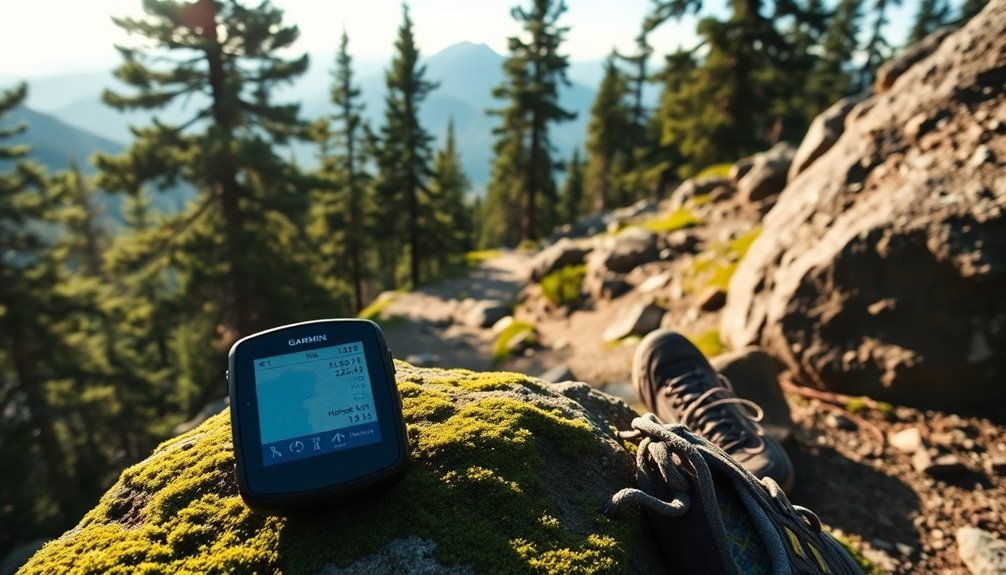

For most runners, I’d choose the Garmin Forerunner 165 as the best overall GPS device for trail running because it combines wrist-based GPS with running and recovery features. The Garmin GPSMAP 65 is a better fit when accurate route navigation in challenging terrain matters more than a lightweight, watch-like setup, while the Garmin Forerunner 55 offers a simpler running-focused alternative. The main tradeoff is between a watch that tracks runs conveniently and a handheld that prioritizes maps, controls, and navigation. I compare all 10 devices by their trail usefulness, usability, and tradeoffs below so you can find the right match for your routes.

Get workout gear delivered free with Prime
- Fast, free delivery on millions of items
- Prime Video, Amazon Music and more included
- Member-only deals all year
Complete the kit


Key Takeaways
- Running watches and handhelds solve different problems: the Forerunner models suit wrist-based run tracking, while the GPSMAP and eTrex devices put more emphasis on navigation.
- The Forerunner 165 is the strongest all-around fit for many trail runners because it pairs running-focused functions with a color AMOLED screen; runners who want a simpler watch can look to the Forerunner 55.
- The GPSMAP 65 stands apart for difficult navigation conditions with multi-band GPS and expanded satellite support, but its handheld format is less convenient for checking data mid-stride.
- eTrex models vary in how much map detail and field convenience they provide: the 22x and 32x offer more mapping capability than the basic eTrex 10, while the eTrex SE and Touch take different approaches to everyday use.
- Non-Garmin handhelds broaden the choices with multi-GNSS support, sunlight-readable screens, or larger displays, but buyers should compare map coverage, controls, and battery setup rather than relying on ruggedness claims alone.
| Garmin GPSMAP 65 Handheld GPS with Multi-Band and Expanded Satellite Support |  | Best for Reliable Navigation in Difficult Terrain | Display: 2.6-inch LCD, 160 x 240 resolution | Satellite support: Expanded GNSS and multi-band frequency support | Battery life: Up to 16 hours | VIEW ON AMAZON | See Our Full Breakdown |
| Garmin Forerunner 165 Running Smartwatch, Colorful AMOLED Display, GPS, Heart Rate, Training Metrics, Recovery Insights, Black |  | Best for Everyday Trail Training | Display: AMOLED touchscreen | Case size: 43 mm | GPS battery life: Up to 19 hours | VIEW ON AMAZON | See Our Full Breakdown |
| Garmin eTrex 22x Rugged Handheld GPS Navigator (Black/Navy) |  | Best for Long Runs with Topographic Maps | Display: 2.2-inch color TFT, 240 x 320 pixels | Battery life: Up to 25 hours in GPS mode | Battery type: Two AA batteries | VIEW ON AMAZON | See Our Full Breakdown |
| Garmin eTrex 10 Worldwide Handheld GPS Navigator |  | Best Simple, No-Frills Handheld | Display: 2.2-inch monochrome LCD, 128 x 160 resolution | Battery life: Up to 20 hours | Battery type: AA batteries | VIEW ON AMAZON | See Our Full Breakdown |
| Garmin eTrex SE GPS Handheld Navigator |  | Best for Extended Trips and Field-Replaceable Power | Display: 2.2-inch sunlight-readable screen, 480 x 272 resolution | Battery life: Up to 168 hours in standard mode | Battery type: Two AA batteries, field-replaceable | VIEW ON AMAZON | See Our Full Breakdown |
| Garmin eTrex Touch Rugged Essential GPS Handheld Navigator |  | Best for Long Trail Days | Screen: 3-inch capacitive color touchscreen | Battery life: Up to 130 hours | Satellite systems: GPS, GLONASS, Galileo | VIEW ON AMAZON | See Our Full Breakdown |
| A6 Handheld GPS for Hiking, Multi GNSS Support, Rugged Navigator |  | Best for Map-Independent Navigation | Screen: 2.4-inch sunlight-readable color LCD | Battery life: Up to 20 hours of continuous use | Charging: USB-C | VIEW ON AMAZON | See Our Full Breakdown |
| Rugged Waterproof Handheld GPS Navigator with 3.2″ Sunlight-Readable Screen, USA Topo Maps, Multi-GNSS Support and Extended Battery Life |  | Best for a Large Screen and Included Topo Maps | Screen: 3.2-inch sunlight-readable LCD | Screen controls: Non-touchscreen, physical buttons | Maps: Preloaded USA topographic maps | VIEW ON AMAZON | See Our Full Breakdown |
| Garmin eTrex 32x Rugged Handheld GPS Navigator |  | Best for Reliable, Button-Based Navigation | Screen: 2.2-inch color TFT, 240 x 320 resolution | Maps: Preloaded Topo Active maps | Battery life: Up to 25 hours | VIEW ON AMAZON | See Our Full Breakdown |
| Garmin Forerunner 55 GPS Running Watch – Black |  | Best for Beginner Trail Runners | GPS battery life: Up to 20 hours | Smartwatch battery life: Up to 2 weeks | Tracking: GPS, heart rate, distance, and pace | VIEW ON AMAZON | See Our Full Breakdown |
| gps devices for trail running | Battery life | Connectivity | Display | Maps |
|---|---|---|---|---|
| Garmin GPSMAP 65 Handheld GPS | Up to 16 hours | Bluetooth and ANT | 2.6-inch LCD, 160 x 240 resolution | Preloaded TopoActive maps; North America map coverage |
| Garmin Forerunner 165 Running | — | Smartphone pairing and smart notifications | AMOLED touchscreen | — |
| Garmin eTrex 22x Rugged Handhe | Up to 25 hours in GPS mode | — | 2.2-inch color TFT, 240 x 320 pixels | Preloaded TopoActive maps |
| Garmin eTrex 10 Worldwide Hand | Up to 20 hours | USB | 2.2-inch monochrome LCD, 128 x 160 resolution | — |
| Garmin eTrex SE GPS Handheld N | Up to 168 hours in standard mode | Bluetooth and USB | 2.2-inch sunlight-readable screen, 480 x 272 resolution | — |
| Garmin eTrex Touch Rugged Esse | Up to 130 hours | Bluetooth, USB-C | — | — |
| A6 Handheld GPS for Hiking | Up to 20 hours of continuous use | — | — | No built-in maps |
| Rugged Waterproof Handheld GPS | Up to 36 hours | — | — | Preloaded USA topographic maps |
| Garmin eTrex 32x Rugged Handhe | Up to 25 hours | — | — | Preloaded Topo Active maps |
| Garmin Forerunner 55 GPS Runni | — | Bluetooth | — | — |
More Details on Our Top Picks
Garmin GPSMAP 65 Handheld GPS with Multi-Band and Expanded Satellite Support
For trail runners who prioritize route-finding over wrist convenience, the GPSMAP 65 offers the strongest positioning toolkit in this group. Its multi-band support and expanded GNSS are suited to routes under dense tree cover or among steep terrain, where a watch such as the Forerunner 165 is easier to check on the move but is less of a dedicated mapping handheld. Preloaded topographic maps and public land boundaries add useful context when planning routes beyond marked trails. The tradeoff is its handheld format: carrying and consulting it while running is less natural than glancing at a watch, and the push-button controls take more deliberate operation than a touchscreen. Its 16-hour battery life is also shorter than the eTrex 22x’s listed 25 hours, so this pick favors demanding navigation over long runtimes.
Pros:- Multi-band and expanded GNSS support help maintain positioning in challenging terrain.
- Preloaded TopoActive maps and public land boundaries provide useful route context.
- 2.6-inch sunlight-readable color display is larger than the eTrex models’ 2.2-inch screens.
- Bluetooth and ANT connectivity support pairing and data sharing.
Cons:- Handheld design is less convenient to check while running than a GPS watch.
- Push-button operation may feel slower than a touchscreen for changing views or settings.
- Listed battery life is 16 hours, shorter than the eTrex 22x’s 25 hours.
Best for: Trail runners who carry a handheld navigator for remote, tree-covered, or mountainous routes and want detailed maps with strong satellite support.
Not ideal for: Runners who want a lightweight, glanceable wrist device or need longer listed GPS runtime; the Forerunner 165 suits run tracking better, while the eTrex 22x lasts longer on its stated battery life.
- Display:2.6-inch LCD, 160 x 240 resolution
- Satellite support:Expanded GNSS and multi-band frequency support
- Battery life:Up to 16 hours
- Maps:Preloaded TopoActive maps; North America map coverage
- Connectivity:Bluetooth and ANT
- Controls:Push buttons
- Memory:microSD
- Compatible device:Smartphone
Our verdict“Choose the GPSMAP 65 if accurate handheld mapping matters more than wrist access and longer battery life.”
Garmin Forerunner 165 Running Smartwatch, Colorful AMOLED Display, GPS, Heart Rate, Training Metrics, Recovery Insights, Black
The Forerunner 165 is the most natural choice here for runners who want GPS on their wrist, plus training and recovery information after the run. Its built-in GPS, wrist-based heart rate, and AMOLED touchscreen make it far easier to glance at during a workout than any of the handheld eTrex devices. Compared with the GPSMAP 65, it gives up dedicated topographic mapping and the listed multi-band positioning features, so it is less suited to complex route-finding in remote terrain. Its 19 hours of GPS-mode battery life is useful for ordinary training, though the eTrex 22x’s listed 25 hours favors longer outings, and the eTrex SE is listed at 168 hours in standard mode. This is a running watch with navigation support, not a substitute for a map-focused handheld on unfamiliar routes.
Pros:- Built-in GPS and wrist-based heart-rate monitoring keep core run data on the wrist.
- AMOLED touchscreen is quick to read during training.
- Training, sleep, recovery, and HRV information add context beyond route tracking.
- Up to 19 hours of GPS-mode battery life suits many routine runs.
Cons:- Does not list the dedicated preloaded topographic maps offered by the GPSMAP 65 and eTrex 22x.
- GPS-mode battery life is shorter than the eTrex 22x’s listed 25 hours.
- Smart notifications and safety features require smartphone pairing.
Best for: Trail runners who want wrist-based GPS, heart-rate tracking, and training or recovery insights for regular runs.
Not ideal for: Runners who need detailed offline topographic navigation or the longest battery life for extended outings; the GPSMAP 65 is the more map-focused handheld.
- Display:AMOLED touchscreen
- Case size:43 mm
- GPS battery life:Up to 19 hours
- Smartwatch battery life:Up to 11 days
- Positioning:Built-in GPS
- Heart-rate monitoring:Wrist-based
- Activity profiles:25+ including running, cycling, HIIT, and strength
- Safety features:Incident detection and Assistance
- Connectivity:Smartphone pairing and smart notifications
Our verdict“Pick the Forerunner 165 for wrist-based run tracking and training insights, not as your main tool for detailed remote navigation.”
Garmin eTrex 22x Rugged Handheld GPS Navigator (Black/Navy)
The eTrex 22x balances mapped navigation and extended battery life better than the simpler eTrex 10. Its preloaded TopoActive maps, color screen, and GPS/GLONASS support make it useful when a trail run calls for checking terrain rather than following a saved line alone. The listed 25-hour GPS runtime also exceeds the GPSMAP 65’s 16 hours, although the GPSMAP 65 offers multi-band support and a larger 2.6-inch display for more demanding reception and easier map viewing. At 4.96 ounces, this handheld can be carried in a pack, but it is still less immediate to consult than the wrist-worn Forerunner 165. Its 2.2-inch screen and button-only operation keep the interface basic; choose it for dependable mapping and AA-powered endurance, not touchscreen speed.
Pros:- Preloaded TopoActive maps give more terrain detail than the eTrex 10’s worldwide basemap.
- Up to 25 hours of GPS-mode battery life supports long outings.
- GPS and GLONASS support provide two satellite systems.
- Sunlight-readable color display and microSD expansion support outdoor mapping.
Cons:- The 2.2-inch screen is smaller than the GPSMAP 65’s 2.6-inch display.
- Button controls are less direct than the Forerunner 165’s touchscreen.
- Runs on two AA batteries rather than a built-in rechargeable battery.
Best for: Trail runners who carry a handheld GPS and want color topographic maps, satellite support, and a long listed GPS runtime.
Not ideal for: Runners who need a wrist-worn device, a large map display, or multi-band positioning; the Forerunner 165 is easier to consult while moving and the GPSMAP 65 has more advanced satellite support.
- Display:2.2-inch color TFT, 240 x 320 pixels
- Battery life:Up to 25 hours in GPS mode
- Battery type:Two AA batteries
- Satellite systems:GPS and GLONASS
- Maps:Preloaded TopoActive maps
- Memory:8 GB internal storage and microSD slot
- Weight:4.96 ounces
- Warranty:1-year limited
Our verdict“Choose the eTrex 22x for long trail outings where handheld topographic maps and replaceable AA power matter more than wrist convenience.”
Garmin eTrex 10 Worldwide Handheld GPS Navigator
The eTrex 10 is the straightforward option for runners who want a rugged GPS position and a basic worldwide basemap without paying for a color mapping interface they may not need. Its GPS with WAAS and GLONASS support and up to 20 hours on AA batteries offer a practical foundation for following routes, while its monochrome display keeps the interface simple. That simplicity is also the main limitation: unlike the eTrex 22x, it does not list preloaded TopoActive maps or a color screen, and its 6 MB of memory leaves little room for added map data. Compared with the Forerunner 165, it is a less convenient running companion because it must be carried and checked by hand. It suits basic navigation, not detailed trail exploration.
Pros:- Rugged, IPX7-rated construction is suited to wet outdoor conditions.
- Up to 20 hours of battery life using replaceable AA cells.
- GPS, WAAS, and GLONASS support provide multiple positioning aids.
- Worldwide basemap and paperless geocaching support basic outdoor use.
Cons:- Monochrome 128 x 160 display cannot show the color terrain detail available on the eTrex 22x.
- Only 6 MB of memory limits map and track storage.
- Handheld button operation is less convenient to check during a run than the Forerunner 165.
Best for: Budget-conscious trail runners who want a rugged, button-operated handheld for basic position tracking and simple routes.
Not ideal for: Runners who rely on detailed terrain maps, color route displays, or glanceable wrist tracking; the eTrex 22x provides color TopoActive mapping and the Forerunner 165 is worn on the wrist.
- Display:2.2-inch monochrome LCD, 128 x 160 resolution
- Battery life:Up to 20 hours
- Battery type:AA batteries
- Satellite support:GPS with WAAS and GLONASS
- Basemap:Worldwide basemap
- Memory:6 MB
- Connectivity:USB
- Weight:5 ounces
- Water resistance:IPX7
Our verdict“Choose the eTrex 10 if you need a rugged handheld for simple navigation and can do without detailed color maps.”
Garmin eTrex SE GPS Handheld Navigator
The eTrex SE stands out for endurance: its listed 168-hour standard-mode battery life makes it a better fit for multi-day outings than the eTrex 22x’s 25-hour GPS-mode figure, though those modes are not directly equivalent. Two replaceable AA batteries let runners carry spares instead of relying on charging access. Its 2.2-inch sunlight-readable display, digital compass, and support for GPS, GLONASS, Galileo, BeiDou, and QZSS give it a broader feature set than the basic eTrex 10. Still, this remains a handheld rather than a running watch, and its 28 MB of memory is limited for map storage. Bluetooth pairing with Garmin Explore adds phone-linked tools, but the GPSMAP 65 is the stronger choice when detailed preloaded topographic mapping and multi-band reception take priority.
Pros:- Listed standard-mode battery life of up to 168 hours supports extended use.
- Two field-replaceable AA batteries allow power changes away from charging sources.
- Supports GPS, GLONASS, Galileo, BeiDou, and QZSS.
- Sunlight-readable display, digital compass, and IPX7 water resistance suit outdoor use.
Cons:- 28 MB of memory limits onboard map storage compared with the eTrex 22x’s 8 GB internal memory.
- Handheld format is less convenient to check while running than the Forerunner 165.
- Batteries are not included.
Best for: Trail runners on extended or remote outings who want long listed battery life, replaceable AA cells, and support for several satellite systems.
Not ideal for: Runners who need substantial onboard map storage, detailed preloaded topographic maps, or a device they can check on their wrist; the GPSMAP 65 is better suited to map-focused navigation.
- Display:2.2-inch sunlight-readable screen, 480 x 272 resolution
- Battery life:Up to 168 hours in standard mode
- Battery type:Two AA batteries, field-replaceable
- Supported GNSS systems:GPS, GLONASS, Galileo, BeiDou, and QZSS
- Digital compass:Yes
- Memory:28 MB
- Connectivity:Bluetooth and USB
- Water resistance:IPX7
- Weight:5.5 ounces
Our verdict“Pick the eTrex SE for extended outings where long listed runtime and replaceable batteries outweigh limited map storage.”
Garmin eTrex Touch Rugged Essential GPS Handheld Navigator
For runners who want a dedicated handheld navigator rather than a wristwatch, the Garmin eTrex Touch pairs a bright, 3-inch touchscreen with preloaded road and trail maps. Its 130-hour battery life is the standout here: compared with the Garmin eTrex 32x, it is better suited to long outings without carrying spare batteries, while multi-band GPS helps maintain precise positioning. The IP67-rated body and sunlight-readable display make it a strong choice for rough, exposed routes, and Garmin Explore supports planning and waypoint management. The tradeoff is its handheld format: it is bulkier to access while running than the Forerunner 55, and it has no built-in cellular connection. Some premium map content also requires a separate subscription.
Pros:- Large, sunlight-readable 3-inch touchscreen makes map details easier to check outdoors.
- Up to 130 hours of battery life supports extended trips with fewer charging concerns.
- Multi-band GPS and support for GPS, GLONASS, and Galileo help with positioning.
- IP67-rated construction adds protection against dust and water exposure.
Cons:- Handheld-only format is less convenient to check while running than a GPS watch.
- Premium Outdoor Maps+ content requires a separate subscription.
- No built-in cellular connectivity for communication or live sharing.
Best for: Trail runners who carry a handheld navigator on long or remote outings and want detailed maps, a large screen, and extended battery life.
Not ideal for: Runners who want glanceable, wrist-based pace and heart-rate tracking, or who prefer not to manage a separate handheld device and optional map subscription.
- Screen:3-inch capacitive color touchscreen
- Battery life:Up to 130 hours
- Satellite systems:GPS, GLONASS, Galileo
- Water resistance:IP67
- Storage:32 GB
- Connectivity:Bluetooth, USB-C
- Weight:5.3 ounces
- Mounting:Handheld; Spine Mount 2 included
Our verdict“Choose the eTrex Touch if long battery life and a readable map screen matter more than having navigation and running metrics on your wrist.”
A6 Handheld GPS for Hiking, Multi GNSS Support, Rugged Navigator
The A6 suits runners who mainly need a position fix, track recording, and basic outdoor sensors rather than a map displayed on the device. Its four-constellation support covers GPS, Galileo, BeiDou, and QZSS, while the compass and barometric altimeter add useful context when following a route. Compared with the Garmin eTrex 32x, the A6 has a larger 2.4-inch screen and USB-C charging, but the eTrex 32x is the more ready-to-navigate option because it includes Topo Active maps. The A6’s 20-hour battery life is reasonable for day outings, though it falls well short of the eTrex Touch’s stated endurance. With no built-in maps, runners need another source for route details before setting out.
Pros:- Four supported satellite constellations offer broad positioning-system coverage.
- Compass and barometric altimeter provide useful directional and elevation context.
- USB-C rechargeable battery supports up to 20 hours of continuous use.
- Sunlight-readable 2.4-inch color screen is larger than the Garmin eTrex 32x display.
Cons:- No built-in maps, so it cannot provide the same on-device route context as the eTrex 32x.
- Up to 20 hours of use is less suited to extended outings than the eTrex Touch.
- The listed Windows operating system may leave software and app compatibility unclear.
Best for: Day-trip trail runners who want a compact handheld for recording tracks and checking position, and who already carry route information elsewhere.
Not ideal for: Runners who need on-device topographic maps or want a long-battery handheld for multi-day routes.
- Screen:2.4-inch sunlight-readable color LCD
- Battery life:Up to 20 hours of continuous use
- Charging:USB-C
- Supported satellites:GPS, Galileo, BeiDou, QZSS
- Navigation sensors:Compass and barometric altimeter
- Input:Buttons
- Mounting:Handheld
- Maps:No built-in maps
Our verdict“Pick the A6 for straightforward track recording and multi-GNSS positioning on day runs, but skip it if you need built-in trail maps.”
Rugged Waterproof Handheld GPS Navigator with 3.2″ Sunlight-Readable Screen, USA Topo Maps, Multi-GNSS Support and Extended Battery Life
This handheld’s case for trail running is simple: it puts USA topographic maps on a comparatively large 3.2-inch sunlight-readable screen and backs them with up to 36 hours of battery life. That makes route checks easier than on the smaller Garmin eTrex 32x, whose 2.2-inch display trades screen space for a more compact body. The Rugged Waterproof Navigator also supports GPS, Galileo, BeiDou, and QZSS, and its physical buttons are practical when touch input is inconvenient. The compromises matter for runners who check maps on the move: this is not a touchscreen, and its IP66 rating is below the eTrex Touch’s IP67. Its listed Windows operating system may also complicate expectations around mapping compatibility.
Pros:- Included USA topographic maps provide route context without relying on a separate map source.
- The 3.2-inch display is larger than the Garmin eTrex 32x screen.
- Up to 36 hours of battery life suits long day outings and some extended trips.
- Four satellite systems and anti-slip physical buttons support outdoor use.
Cons:- Non-touchscreen controls are less suited to quick map gestures than the eTrex Touch interface.
- IP66 water resistance is below the eTrex Touch’s IP67 rating.
- The listed Windows operating system may limit or complicate mapping-app compatibility.
Best for: Trail runners who want an included USA topo map, a large handheld display, and physical controls for route checks.
Not ideal for: Runners who prioritize touch gestures, a watch-sized device, or the higher water-resistance rating of the Garmin eTrex Touch.
- Screen:3.2-inch sunlight-readable LCD
- Screen controls:Non-touchscreen, physical buttons
- Maps:Preloaded USA topographic maps
- Battery life:Up to 36 hours
- Water resistance:IP66
- Satellite systems:GPS, Galileo, BeiDou, QZSS
- Storage:32 GB
- Charging:USB-C
Our verdict“Choose this model if a large screen and included USA topo maps outweigh touchscreen convenience and a higher water-resistance rating.”
Garmin eTrex 32x Rugged Handheld GPS Navigator
The Garmin eTrex 32x is a compact choice for runners who want preloaded Topo Active maps and dependable physical controls rather than a large touchscreen. Its 3-axis compass and barometric altimeter help with orientation and elevation, while GPS and GLONASS provide dual-system tracking. Compared with the touchscreen Garmin eTrex Touch, the 32x has a smaller 2.2-inch display and a much shorter stated battery life, but it avoids a touch interface and can use ordinary AA batteries. That can be useful when charging access is limited, though carrying spares adds weight. The microSD slot gives room for additional map storage beyond its 8 GB internal memory. It is better suited to navigation than pace-focused training, which the Forerunner 55 handles more naturally.
Pros:- Preloaded Topo Active maps include routable roads and trails.
- A 3-axis compass and barometric altimeter add navigation and elevation information.
- microSD expansion allows additional map storage.
- AA batteries can be replaced in the field instead of relying only on a built-in rechargeable battery.
Cons:- The 2.2-inch screen is smaller than the Garmin eTrex Touch and the 3.2-inch Rugged Waterproof Navigator.
- Up to 25 hours of battery life is well below the eTrex Touch’s stated 130 hours.
- AA batteries require spares for longer outings and add carrying considerations.
Best for: Trail runners who prefer a compact, button-operated handheld with included topo maps, a compass, and replaceable AA batteries.
Not ideal for: Runners who need a large, easy-to-read map screen, extensive satellite-system support, or wrist-based pace and heart-rate tracking.
- Screen:2.2-inch color TFT, 240 x 320 resolution
- Maps:Preloaded Topo Active maps
- Battery life:Up to 25 hours
- Battery type:2 AA batteries
- Satellite systems:GPS, GLONASS
- Sensors:3-axis compass and barometric altimeter
- Storage:8 GB internal memory, microSD slot
- Weight:4.96 ounces
Our verdict“The eTrex 32x makes sense for runners who want mapped handheld navigation with physical buttons and easy battery replacement.”
Garmin Forerunner 55 GPS Running Watch – Black
Unlike the handheld navigators in this group, the Garmin Forerunner 55 is built to keep running metrics on your wrist: GPS-based pace and distance, heart-rate monitoring, wellness tracking, and personalized workout guidance. That makes it more convenient than the eTrex 32x or eTrex Touch for checking progress without stopping to handle a separate device. Its GPS-mode battery life reaches up to 20 hours, with up to two weeks in smartwatch mode, so it can cover many training sessions between charges. The tradeoff is navigation depth: the supplied product details do not list preloaded topo maps or a large route-viewing screen, so it is less suitable than the handhelds for map-led exploration. Full customization also depends on a compatible smartphone and Garmin Connect.
Pros:- Wrist-based GPS pace and distance are easier to check while running than on a handheld navigator.
- Heart-rate monitoring and wellness tracking add training context.
- Personalized workouts can help beginners structure running sessions.
- Up to 20 hours of GPS-mode battery life supports extended training outings.
Cons:- Product details do not list preloaded topo maps, unlike the Garmin eTrex 32x.
- Full customization requires a compatible smartphone with the Garmin Connect app.
- It offers less handheld-style navigation context than dedicated GPS navigators.
Best for: New trail runners who want wrist-based GPS pace, distance, heart-rate tracking, and guided workouts for regular training.
Not ideal for: Runners who need detailed topographic maps on the device, handheld navigation features, or a watch that works fully without a compatible smartphone.
- GPS battery life:Up to 20 hours
- Smartwatch battery life:Up to 2 weeks
- Tracking:GPS, heart rate, distance, and pace
- Training features:Personalized workouts
- Wellness features:Wellness tracking
- Connectivity:Bluetooth
- Compatible devices:Smartphones with the Garmin Connect app
- Wearable type:Running watch
Our verdict“Choose the Forerunner 55 if training metrics and wrist convenience matter more than detailed on-device trail maps.”

How We Picked
I ranked these GPS devices for trail running by how well each matches real trail needs: reliable positioning, useful route guidance, glanceable information, practical controls, and a form factor that makes sense while moving. I also weighed map support, screen readability, battery approach, and whether the device offers running-specific functions or primarily serves as a navigation tool. Ruggedness and satellite support matter, but neither makes a device a good running choice if it is awkward to carry or difficult to read on a route.
The ranking favors versatile choices that serve a clear trail-running role, rather than treating watches and handhelds as interchangeable. The Forerunner 165 leads for its balance of running features and everyday wear; the GPSMAP 65 ranks highly for navigation in demanding terrain, despite being less convenient on the wrist. Other Garmin watches and eTrex models follow according to their narrower strengths, while the A6 and larger-screen handhelds are options for buyers who value specific navigation or display features and are prepared to check mapping and usability details.
| gps devices for trail running | Maps | Connectivity |
|---|---|---|
| Garmin GPSMAP 65 Handheld GPS | Preloaded TopoActive maps; North America map coverage | Bluetooth and ANT |
| Garmin Forerunner 165 Running | — | Smartphone pairing and smart notifications |
| Garmin eTrex 22x Rugged Handhe | Preloaded TopoActive maps | — |
| Garmin eTrex 10 Worldwide Hand | — | USB |
| Garmin eTrex SE GPS Handheld N | — | Bluetooth and USB |
| Garmin eTrex Touch Rugged Esse | — | Bluetooth, USB-C |
| A6 Handheld GPS for Hiking | No built-in maps | — |
| Rugged Waterproof Handheld GPS | Preloaded USA topographic maps | — |
| Garmin eTrex 32x Rugged Handhe | Preloaded Topo Active maps | — |
| Garmin Forerunner 55 GPS Runni | — | Bluetooth |
Factors to Consider When Choosing Gps Devices For Trail Running
Before choosing, decide how you’ll use GPS on the trail: to record a run, follow a planned route, or find your way through unfamiliar terrain. Those goals can point to different device types, even when products share satellite-navigation features. I’d use these factors to narrow the field before comparing individual models.
Choose Between a Watch and a Handheld
A watch keeps tracking and run data on your wrist, which makes it easier to check pace or direction without stopping. A handheld navigator gives you a larger control surface for route work, but you need to carry it and may need to stow it between checks. A common mistake is buying a handheld for its navigation features when your actual priority is recording regular runs and checking training data. The reverse can also be frustrating: a running watch may not offer the map detail or buttons you want for exploring unknown trails. Match the format to how often you need to study a route, not just to the word “GPS” in a product name.
Match Navigation Detail to Your Routes
Familiar, well-marked loops may require little more than a recorded track or a route cue, while remote trails can call for maps and dependable position fixes. Before paying extra for advanced satellite support, ask whether your routes pass through steep valleys, dense tree cover, or other places where signal conditions may be difficult. Map availability and map detail are separate questions: a device’s ability to receive satellite signals does not tell you how much useful terrain information its maps contain. Check whether the regions you run are covered and how routes are loaded or updated. For unfamiliar terrain, map readability and usable navigation controls can matter as much as positioning features.
Prioritize Readability and Controls While Moving
A screen that looks vivid indoors may be harder to read in strong sunlight, and a small display can make route checks slower. Touchscreens can feel direct for map browsing, while physical buttons may be easier to operate with sweaty hands, gloves, or rain. Neither control style is automatically better; the key is whether you can check direction without losing focus on the trail. Think about how often you’ll consult the screen, since a runner who follows a known route may not need a large map display. If you often navigate intersections, test how clearly a device separates route information from training data.
Treat Battery Life as a Route-Planning Factor
Battery needs depend on how long you’re out, how often GPS is active, and whether you use navigation or a bright display throughout the run. A stated battery figure can reflect a particular mode, so compare the conditions behind it rather than assuming every feature runs at once for that duration. Decide whether rechargeable convenience or replaceable batteries better suits your trips and charging habits. For long outings, a device that can keep recording while you use maps may matter more than one with a strong headline figure in a basic mode. Leave a reserve for route changes or delays instead of planning around the shortest expected finish time.
Separate Running Metrics From Navigation Features
Heart rate, training information, and recovery guidance can help runners build a training routine, but they do not replace route guidance. A navigation-focused handheld may be the better tool for reaching a trailhead or finding a way back, even if it lacks the everyday training experience of a watch. Conversely, runners who already know their routes may get more value from a wearable that records runs and presents useful workout data. Avoid paying for overlapping devices without deciding which one will handle recording, mapping, and emergency route checks. If you carry a phone as a backup, plan for what happens if its battery or signal is unavailable.
Check Mapping, Setup, and Carrying Needs Before Buying
Trail usefulness depends on setup as much as hardware: confirm how you’ll load a route, obtain maps, and keep them current for the places you run. Look for any added map or software requirements before assuming a device is ready for your local trail network. A rugged case does not tell you whether the unit will sit securely in a vest pocket or whether its buttons are easy to reach while running. Consider the full system you’ll carry, including straps, charging cables, spare batteries, and a phone if you use one for backup. A slightly less feature-heavy device can be the better choice if it is simpler to prepare and use consistently.
Frequently Asked Questions
Is a GPS watch or a handheld navigator better for trail running?
I’d pick a watch if you want to track runs on your wrist, see training information, and check basic route cues without carrying another device. A handheld makes more sense when detailed navigation, physical controls, or map consultation is central to your outings. The products here show why there is no single format for every runner: the Forerunner watches serve a different purpose from the GPSMAP and eTrex navigators. For remote routes, you might also carry a separate navigation device or backup rather than asking a watch to do every job. Let the route and your habits decide the format.
Do I need multi-band or multi-GNSS support for trail running?
Not every runner needs advanced satellite support; it matters most when routes pass through terrain that can make positioning less reliable, such as dense tree cover or narrow valleys. Multi-band support, as found on the GPSMAP 65, is one reason to consider that model for challenging navigation, but it does not replace good maps or sensible route planning. Multi-GNSS support can provide access to multiple satellite systems, though a feature label alone does not guarantee a better experience on every trail. For open, familiar paths, a simpler GPS device may be enough. Match the added capability to the places you actually run.
Are handheld GPS devices comfortable to use while running?
They can be useful on a run, but they do not offer the same glance-and-go convenience as a watch. You’ll need a practical way to carry the unit and retrieve it when checking a map, which can interrupt your stride. A handheld is easiest to justify when route finding is more important than continuous access to wrist-based running data. Before buying, think about whether it will fit your vest, belt, or pack and whether its buttons are workable with your usual kit. If you mainly run familiar routes, a running watch may be the less distracting option.
Will a running watch show detailed trail maps?
Do not assume that every GPS running watch provides the same kind of map detail as a dedicated handheld navigator. Route tracking and basic guidance can be useful without offering the terrain context you’d want for exploring an unfamiliar network. Check what map display and route-following functions are available on the specific model, and whether you need to add or prepare maps separately. The Forerunner models in this lineup are best approached as running watches, while the GPSMAP and eTrex devices are the more navigation-oriented choices. If maps are central to your decision, confirm the coverage for your running area before purchase.
Should I choose the Forerunner 165 or the Forerunner 55 for trail running?
I’d favor the Forerunner 165 if you want a more feature-rich watch with a colorful AMOLED display and running and recovery information. The Forerunner 55 is a simpler running-watch option for someone who wants GPS run tracking without prioritizing the same level of display and training features. Neither choice should be treated as a substitute for a dedicated handheld if detailed navigation is your main need. Consider how often you’ll use the extra watch features beyond the trail, since everyday usefulness can justify choosing the more capable model. If you mainly need a straightforward record of your runs, the simpler watch may be the better fit.
Conclusion
For a single device that balances trail running and everyday training, I recommend the Garmin Forerunner 165 as the best overall. The Garmin Forerunner 55 is my best value-style choice for runners who want a simpler GPS watch, while the Garmin GPSMAP 65 is the best premium navigation pick for challenging terrain and route-focused outings. Beginners who mostly run familiar trails can start with the Forerunner 55 rather than carrying a handheld they may rarely consult. For map-oriented exploration, compare the eTrex 22x and 32x; for alternate handheld formats, review the A6 and larger-screen navigator’s map coverage, controls, and setup. Choose the watch if training and run recording come first, and a handheld if finding your way matters most.
Fall Picks
fall essentials
As an affiliate, we earn on qualifying purchases.