For night running, I’d choose the ISEYOU 800LM Running Lights as my best overall pick for its bright output, adjustable beam, and reflective gear. The 500LM High-Visibility Running Vest Light is a more restrained option for runners who want a vest and a stated 3.5–20-hour runtime, while the Faxins Clip-On LED suits those who prefer a compact light they can attach to clothing. The main tradeoffs are beam brightness versus battery life, a secure vest fit versus the simplicity of a clip, and weather protection versus the conditions you run in. I compare all 11 options by how their features support visibility and practical use after dark. Read on for the full breakdown and a guide to choosing your setup.

Get workout gear delivered free with Prime
- Fast, free delivery on millions of items
- Prime Video, Amazon Music and more included
- Member-only deals all year
Complete the kit



Key Takeaways
- Vest-style lights lead this lineup for night visibility: several pair an adjustable forward beam with reflective gear, giving runners both a way to see ahead and added visibility around the body.
- The ISEYOU 800LM is my lead pick for a bright, adjustable setup. Its listed 800 lumens and 45-degree adjustment make it a stronger fit for runners who want to direct light toward the path.
- A higher lumen figure does not settle the choice. The 500LM vest option lists 3.5–20 hours of runtime, so runners prioritizing longer outings may prefer to weigh that stated range against brighter alternatives.
- Clip-on lights trade coverage for flexibility. The Faxins and two-pack options are easier to place on clothing or gear, while vest styles provide a more integrated setup.
- Reflective apparel and light output serve different jobs. The Zacro light-up vest emphasizes multiple light colors and visibility; runners who need to see uneven ground should also prioritize a forward-facing beam.


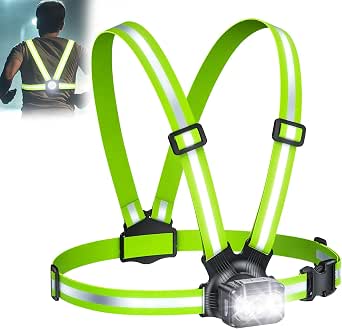


| running light | Modes | Runtime | Brightness | Charging |
|---|---|---|---|---|
| Running Lights for Runners | Full white, half white, red, red strobe | 3 hours 20 minutes | 1000 lumens | USB |
| LHKNL Headlamp Flashlight | 8, including white, red, SOS, and motion-sensor modes | 4–10 hours stated in description; 10 hours also listed in specifications | 1200 lumens listed in product information; description also states 1500 lumens | — |
| Faxins Clip-On LED Flashlight | High spot, medium spot, low spot, flashing red/blue, SOS | 2.5 hours high; 7.5 hours low; 24 hours flashing | 450 lumens | Micro-USB; 2-hour charging time |
| 500LM High-Visibility Running | 7 | 3.5–20 hours stated; 11.75 hours also listed in specifications | 500 lumens | — |
| ISEYOU 800LM Running Lights fo | 6, including SOS and strobe | 4–25 hours | 800 lumens | USB-C; 3.5 hours to full charge |
| Zewdov 800-Lumen Rechargeable | — | 4–15 hours in white modes; 12–25 hours in red mode | Up to 800 lumens | USB-C; 2–3 hours |
| Viccux 800LM Ultra Bright Runn | 7 front modes and 2 rear modes | Front: 4–25 hours; rear: 5–10 hours | — | — |
| Running Light for Runners | 4: spotlight, 50%, 30%, floodlight | — | — | USB rechargeable |
| Running Lights for Runners | 6 | White: 4–9 hours; red: up to 16 hours | 500 lumens | USB-C; 3–4 hours |
| Viccux 500LM & 360° Visibility | 8, including high, medium, low, and strobe | Up to 35 hours; varies by mode | 500 lumens | USB-C fast charging |
| Zacro LED Reflective Vest Runn | — | — | — | USB rechargeable with dual Type-C ports |
More Details on Our Top Picks
Running Lights for Runners, 2 Pack Rechargeable LED, 4 Modes, Night Running
This two-light set makes sense for runners who want to place lights on different parts of their clothing rather than wear a dedicated vest. Its magnetic clips and four settings, including red and red strobe, offer practical ways to add visibility from more than one angle. Compared with the Viccux 500LM High-Visibility Running Light Vest, it is less of a full-body visibility system: there are no reflective shoulder straps or stated long-distance beam range. The tradeoff is a simpler, more adaptable setup that can also work for walking or hiking. The listed 3-hour-20-minute runtime may be limiting for longer outings, and the product data cautions that its brightness may fall short in very dark environments. I’d choose it for short, familiar routes where flexible attachment matters more than a powerful path beam.
Pros:- Two lights allow placement at separate points on clothing or gear.
- Magnetic clips support flexible attachment.
- Four modes include red and red strobe options.
- USB rechargeable and described as waterproof.
Cons:- Listed runtime is only 3 hours and 20 minutes.
- Product data says brightness may not be sufficient for very dark environments.
- Two lights do not provide the reflective vest coverage of the Viccux 500LM model.
Best for: Runners on shorter, familiar routes who want two rechargeable lights they can attach in different positions.
Not ideal for: Runners on long, unlit routes who need extended runtime or strong forward illumination.
- Light source:LED
- Brightness:1000 lumens
- Number of lights:2
- Modes:Full white, half white, red, red strobe
- Runtime:3 hours 20 minutes
- Battery:Lithium-ion polymer
- Charging:USB
- Mounting:Magnetic clip
- Water resistance:Waterproof
Our verdict“Choose this set for flexible, multi-position lighting on shorter runs, but look to a vest light for broader visibility or longer outings.”
LHKNL Headlamp Flashlight, Lumen Bright Head Lamps LED Rechargeable Camping
For runners who want a hands-free beam that follows their gaze, the LHKNL headlamp offers a useful mix of adjustable aim, white and red light, and a stated 4–10-hour runtime. Its motion-sensor mode lets a runner switch the light with a hand wave, while the long-press function avoids cycling through settings to turn it off. Compared with the Faxins Clip-On LED Flashlight, this two-headlamp pack is designed to illuminate the path from the head rather than attach to a belt, collar, or hat; that makes beam direction more intuitive, though some runners may prefer chest-mounted light to reduce headgear. Eight modes offer flexibility, but also add choices a runner may not need. The stated IPX4 rating covers rain and splashes, not immersion, and the product data gives conflicting brightness figures, so I would not rely on a single lumen number when choosing it.
Pros:- Two headlamps are included in the pack.
- Pivoting head lets runners adjust where the beam falls.
- Motion-sensor mode enables hands-free switching.
- White and red light options support different nighttime uses.
Cons:- IPX4 protection is limited to rain and splashes.
- The product information lists both 1200 and 1500 lumens.
- Eight modes may take more setting changes than a simpler clip light such as the Faxins.
Best for: Runners who want a rechargeable, hands-free headlamp for evening routes and also need a light for camping or other outdoor tasks.
Not ideal for: Runners who dislike headbands or want a clearly documented brightness rating and higher water protection.
- Light source:LED
- Brightness:1200 lumens listed in product information; description also states 1500 lumens
- Pack contents:2 headlamps
- Modes:8, including white, red, SOS, and motion-sensor modes
- Runtime:4–10 hours stated in description; 10 hours also listed in specifications
- Battery:Rechargeable lithium-ion polymer, 1500 mAh stated in description
- Mounting:Head mount with adjustable band
- Water resistance:IPX4
- Beam angle:60°
Our verdict“Pick the LHKNL if you want a versatile head-mounted beam and multi-hour runtime for night running and outdoor use.”
Faxins Clip-On LED Flashlight with 450 Lumens, Rechargeable, 5 Modes, IPX6 Waterproof
At 0.6 ounces, the Faxins is the lightest, least gear-intensive choice in this group. Its pocket clip can fasten to a hat, belt, bag, or collar, making it useful for runners who want a small marker light that can move between gear. The IPX6 rating offers stronger stated water protection than the LHKNL headlamp’s IPX4 rating, while five settings add low and flashing options alongside the main beam. That compact format comes with a clear limit: its 450-lumen output and 2.5-hour high-mode runtime are less suited to illuminating a long, dark route than the Viccux 500LM High-Visibility Running Light Vest, which adds reflective coverage and a chest beam. The flashing red/blue and SOS modes are useful for signaling, but this is a small clip light rather than an all-around visibility system.
Pros:- Very light at 0.6 ounces.
- Clip can attach to hats, belts, bags, or collars.
- IPX6 waterproof rating.
- Flashing and SOS modes provide signaling options.
Cons:- High mode runs for 2.5 hours.
- 450-lumen output is less suited to lighting a distant path than the Viccux vest beam.
- Uses Micro-USB charging.
Best for: Runners and dog walkers who want a very light clip-on safety light for short outings or as a secondary light.
Not ideal for: People who need a primary path light for extended runs on unlit routes.
- Light source:LED
- Brightness:450 lumens
- Weight:0.6 ounces
- Modes:High spot, medium spot, low spot, flashing red/blue, SOS
- Runtime:2.5 hours high; 7.5 hours low; 24 hours flashing
- Battery:300 mAh lithium polymer
- Charging:Micro-USB; 2-hour charging time
- Mounting:Pocket clip
- Water resistance:IPX6
Our verdict“Choose the Faxins for a tiny, weather-resistant clip light or backup, not as your only beam for a long night run.”
500LM High-Visibility Running Lights for Runners, Adjustable 45° Beam & 360° Reflective Vest, IPX4 Waterproof Running Vest Light for Night Walking/Cycling/Jogging, 3.5-20Hrs Runtime
This Viccux vest is the most visibility-focused option here: a chest-mounted 500-lumen beam pairs with 360° reflective straps and a reflective board listed as visible from 200 meters. That combination gives drivers more surfaces to see than the LHKNL headlamp or the Faxins clip light, while the 45° adjustment lets the runner aim between nearby ground and farther ahead. It also offers floodlight and spotlight options, unlike the simpler two-light set from B0894DKS43. The tradeoff is a vest-style fit with straps to adjust, and its IPX4 rating is for rain and splashes. Runtime is described as 3.5–20 hours, though a separate specification lists 11.75 hours, so actual time depends on mode and the supplied data is not fully consistent. I’d favor it for road running where being seen from multiple angles matters.
Pros:- Chest-mounted beam can be angled 45°.
- 360° reflective straps and a reflective board add visibility beyond the beam.
- Floodlight and spotlight options serve near and farther coverage.
- Adjustable shoulder and waist straps accommodate a range of fits.
Cons:- Vest straps add setup and bulk compared with the Faxins clip light.
- IPX4 protection is limited to rain and splashes.
- Runtime figures vary between the product description and specifications.
Best for: Road runners who want a chest beam plus reflective coverage visible from multiple directions at night.
Not ideal for: Runners who want minimal gear, stronger water protection, or a single consistent runtime figure.
- Brightness:500 lumens
- Beam range:70 meters
- Beam adjustment:45°
- Reflective coverage:360° straps; reflective board visibility listed at 200 meters
- Modes:7
- Runtime:3.5–20 hours stated; 11.75 hours also listed in specifications
- Battery:1800 mAh lithium-ion
- Fit range:Shoulders 12–23 inches; waist 31–51 inches
- Water resistance:IPX4
Our verdict“Choose this vest for road runs where reflective coverage and an adjustable forward beam matter more than a minimal setup.”
ISEYOU 800LM Running Lights for Runners, 6 Modes, IPX5 Waterproof, Rechargeable, 45° Adjustable, 360° Reflective Gear for Night Walking, Cycling, Jogging
The ISEYOU stands out for runners who want a brighter forward beam and broad reflective coverage in one chest-worn setup. Its 800 lumens and listed 150-meter illumination distance give it more stated reach than the Viccux 500LM vest, while the 45° adjustable angle can help shift light between the path ahead and the ground nearby. Six modes include SOS and strobe, and USB-C charging is a convenient current standard. The stated 4–25-hour runtime varies widely by mode, so I would check whether the selected setting suits the length of a planned run. It also takes 3.5 hours to charge, and the adjustable vest may feel bulky during intense sessions. Compared with the Faxins clip light, this is a more complete night-running setup, but it takes more space and commitment to wear.
Pros:- 800-lumen beam with a listed range of up to 150 meters.
- 360° reflective straps add visibility around the wearer.
- 45° adjustable light angle and six modes, including SOS and strobe.
- USB-C charging and a 2200 mAh battery.
Cons:- Runtime spans 4–25 hours depending on mode.
- Full charge takes 3.5 hours.
- Vest-style form may feel bulky during intense activity.
Best for: Runners on darker routes who want a brighter forward light, reflective straps, and multiple modes in a single vest-style unit.
Not ideal for: Runners seeking a compact clip light or a predictable runtime without changing modes.
- Brightness:800 lumens
- Illumination distance:Up to 150 meters
- Reflective coverage:360° straps
- Beam adjustment:45°
- Modes:6, including SOS and strobe
- Battery capacity:2200 mAh
- Runtime:4–25 hours
- Charging:USB-C; 3.5 hours to full charge
- Fit range:Waist 31–51 inches; shoulders 12–24 inches
Our verdict“Pick the ISEYOU for darker runs where long-range beam reach and reflective coverage outweigh bulk and mode-dependent runtime.”
Zewdov 800-Lumen Rechargeable Running Light with 360° Reflective Gear
The Zewdov 800-lumen light suits night runners who want a bright chest-mounted beam they can angle down by up to 45 degrees. Its four white and three red modes let runners switch between seeing the path and adding a rear-facing visibility cue, while reflective straps and a battery-free rear board add visibility without another light to charge. Compared with the Viccux 800LM Ultra Bright Running Lights, the Zewdov lists longer red-mode runtime and a broader shoulder fit, but the Viccux includes a separate rear safety light with its own modes. The tradeoff here is IPX4 splash protection, which suits rain and sweat but not immersion, and the beam needs careful aiming around other people. This is a flexible pick for runners who value beam adjustment and reflective coverage over a powered rear light.
Pros:- 800-lumen output with a beam adjustable through 45 degrees
- Four white and three red modes for different visibility needs
- Reflective straps and a battery-free rear board add visibility without another battery
- Shoulder and waist straps cover a broad range of fits
Cons:- IPX4 protection is for splashes and rain, not immersion
- Rear visibility comes from reflectors rather than a powered rear lamp
- Aimed beam can bother others if pointed toward their eyes
Best for: Night runners who want a bright adjustable chest beam, reflective rear coverage, and flexible shoulder sizing
Not ideal for: Runners who need a separate powered rear light or plan to use their gear in heavy downpours or submerged conditions
- Brightness:Up to 800 lumens
- Light modes:4 white modes and 3 red modes
- Beam adjustment:0° to 45°
- Battery:2200 mAh lithium-ion
- Charging:USB-C; 2–3 hours
- Runtime:4–15 hours in white modes; 12–25 hours in red mode
- Water resistance:IPX4
- Fit:Shoulders 12–24 inches; waist 31–51 inches
- Visibility features:360° reflective straps and battery-free rear reflective board
Our verdict“Choose the Zewdov for night runs where an adjustable bright beam and passive rear reflectivity matter more than a powered rear light.”
Viccux 800LM Ultra Bright Running Lights with Reflective Vest, 7+2 Modes, Waterproof, Adjustable Fit for Night Running and Jogging
For night runners who want lights at both ends of the vest, the Viccux 800LM pairs its front beam with a separate rear safety light. That gives it an advantage over the Zewdov 800-Lumen Rechargeable Running Light, whose rear visibility relies on reflectors and a board rather than a powered lamp. Seven front modes and two rear modes offer room to adapt visibility, and the 45-degree beam adjustment helps aim the light toward the path. The tradeoff is a second charging task: the front and rear units have separate runtime and charging figures, and the rear light’s listed charge time is only 25 minutes. Its IPX4 protection is suited to rain and splashes, not immersion. Runners who prefer a simpler reflective rear panel may find the Zewdov less involved to maintain.
Pros:- 800-lumen front light with a separate rear safety light
- Seven front modes and two rear modes
- 45-degree beam adjustment helps direct light toward the route
- Adjustable shoulder and waist straps
Cons:- Front and rear lights have separate charging needs
- IPX4 protection does not cover immersion
- Battery life varies by mode
Best for: Night runners and cyclists who want a front beam plus an independently lit rear safety signal
Not ideal for: Runners seeking the simplest single-unit charging routine or protection for immersion and severe wet conditions
- Front brightness:800 lumens
- Modes:7 front modes and 2 rear modes
- Beam adjustment:45°
- Battery capacity:2200 mAh
- Runtime:Front: 4–25 hours; rear: 5–10 hours
- Charging time:Front: 2–3 hours; rear: 25 minutes
- Water resistance:IPX4
- Fit:Shoulders 12–23 inches; waist 31–51 inches
- Strap width:1.2 inches
Our verdict“Pick the Viccux for night routes where a powered rear light is a higher priority than a simpler reflective-only setup.”
Running Light for Runners, 2-Pack Clip-on Rechargeable LED Flashlight
The two-pack of clip-on lights is the compact choice for runners who want to attach a light to a jacket, belt, or bag without wearing a vest. At 1.2 ounces per listed unit and 150 lumens, each light is easier to carry than the 500- and 800-lumen chest systems in this roundup, though it offers less illumination for spotting a dark or uneven path. Its four modes include spotlight and floodlight options, giving it some flexibility for close-range use. Compared with the Viccux 500LM running light with waist pack, this set is lighter and simpler to place on gear, but it lacks a stated adjustable beam angle, reflective vest, and waist storage. Up to 13 hours of battery life supports regular outings, while the unspecified water-resistance rating leaves its limits in heavy rain unclear.
Pros:- Two clip-on lights for attaching to clothing or gear
- Lightweight at 1.2 ounces per unit
- Four modes include spotlight and floodlight
- USB-rechargeable battery with up to 13 hours of listed life
Cons:- 150 lumens provides less path illumination than the vest lights in this roundup
- Water resistance is not specified beyond the general water-resistant description
- Listed battery life varies by mode and may not suit longer outings
Best for: Runners who want lightweight clip-on lights for visibility on familiar, well-lit routes
Not ideal for: Night runners who need a high-output beam to illuminate unlit paths or a clearly specified wet-weather rating
- Pack size:2 lights
- Light output:150 lumens
- Modes:4: spotlight, 50%, 30%, floodlight
- Battery life:Up to 13 hours
- Mounting:Clip-on
- Weight:1.2 oz
- Charging:USB rechargeable
- Material:Plastic
- Water resistance:Water resistant; rating not specified
Our verdict“Choose this two-pack for lightweight clip-on visibility on familiar routes, but use a brighter vest light for dark paths.”
Running Lights for Runners – 500 Lumens, 45° Adjustable Tilt, 360° Reflective Vest, IPX4 Waterproof Rechargeable Light
This 500-lumen reflective vest is a middle ground for night runners who want a hands-free path light without moving up to an 800-lumen system. Its 45-degree tilt and six modes let the wearer adjust the beam and lighting style, while 360-degree reflective strips add passive visibility around the body. Compared with the Viccux 800LM Ultra Bright Running Lights, it gives up peak output and the separate rear lamp, but its 500-lumen beam may be enough for runners who want a less powerful setup. The listed 236-gram weight and built-in 1800 mAh battery are tradeoffs: the battery cannot be swapped during a run, and white-light runtime tops out at nine hours. IPX4 protection covers sweat and rain, not immersion.
Pros:- 500-lumen front light with six modes
- 45-degree adjustable beam helps aim the light at the route
- 360-degree reflective strips improve passive visibility
- USB-C charging and listed 236-gram weight
Cons:- Built-in battery cannot be swapped during an outing
- White-light runtime is limited to 4–9 hours
- IPX4 protection is not suitable for immersion
Best for: Runners who want a 500-lumen chest light, reflective coverage, and a listed vest weight for planning their kit
Not ideal for: Runners needing a swappable battery, a separate powered rear light, or the longest white-light sessions
- Brightness:500 lumens
- Modes:6
- Beam angle:45° adjustable
- Battery:1800 mAh lithium-ion, built-in
- Charging:USB-C; 3–4 hours
- Runtime:White: 4–9 hours; red: up to 16 hours
- Water resistance:IPX4
- Weight:236 g
- Fit:Chest: 31–51 inches; shoulders: 12–24 inches
Our verdict“Pick this vest for night runs that call for a moderate-output adjustable beam and reflective coverage without an 800-lumen front light.”
Viccux 500LM & 360° Visibility Running Lights with Waist Pack
The Viccux 500LM waist-pack light is the most practical fit here for runners who want to carry small essentials along with a chest light. Its included zippered pack adds storage that the other vest options do not list, and the adjustable 45-degree beam and 360-degree visibility keep it oriented toward night use. Compared with the 500-lumen reflective vest with 1800 mAh battery, this model claims a much longer runtime of up to 35 hours, but the product data gives no weight and a narrower 31.5-to-43.3-inch size range. Its 1100 mAh lithium-polymer battery and mode-dependent runtime make the long figure harder to compare directly with the other lights. Eight modes include high, medium, low, and strobe; buyers should check the fit range before choosing it.
Pros:- 500-lumen beam with 45-degree adjustment
- 360-degree visibility features for night activities
- Zippered waist pack carries small essentials
- Eight modes include high, medium, low, and strobe
Cons:- Fit range is narrower than several other vests in this roundup
- Weight is not specified
- Runtime depends on mode, and the listed maximum is not tied to a specific mode
Best for: Night runners and walkers who want a lighted vest with a zippered pack for carrying small essentials
Not ideal for: Runners outside the listed 31.5–43.3-inch size range or those who need a stated weight and directly comparable runtime data
- Brightness:500 lumens
- Beam angle:45° adjustable
- Runtime:Up to 35 hours; varies by mode
- Battery:1100 mAh lithium polymer
- Charging:USB-C fast charging
- Modes:8, including high, medium, low, and strobe
- Fit:31.5–43.3 inches (80–110 cm)
- Pack:Zippered waist pack included
- Weight:Not specified
Our verdict“Choose the Viccux when waist-pack storage is useful and your measurements fall within its listed adjustment range.”
Zacro LED Reflective Vest Running Gear, 5 Lights Colors High Visibility Reflective Gear Rechargeable Light Up Vest for Walking Running Cycling, Adjustable for Men Women Kids
For runners who want drivers to notice them from multiple directions at night, the Zacro pairs LED lighting with reflective strips in a lightweight vest. Its five color choices and three modes let you pick steady light or flashing patterns, while the reflective material adds visibility when headlights reach it. Compared with the 500LM High-Visibility Running Lights vest, this is less focused on a specified forward beam and more on making the wearer conspicuous around the torso. That tradeoff suits urban routes and group runs, but buyers seeking a bright path-lighting beam should look at the ISEYOU 800LM instead. The adjustable shoulders and waist, plus a 0.35-pound stated weight, make layering easier; the claimed 7–20-hour runtime varies with color and mode, so frequent night runners may need to plan charging.
Pros:- Combines LEDs and reflective strips for visibility from several directions
- Five light colors and three modes allow steady or flashing visibility
- Adjustable shoulder and waist measurements accommodate different body sizes and layers
- USB-rechargeable design with a stated 7–20-hour runtime
Cons:- No lumen output or beam adjustment is specified, making path illumination hard to judge
- Runtime depends on the selected color and mode
- The vest format may feel less convenient than a clip-on light for quick outings
Best for: Night runners, walkers, or cyclists who want adjustable all-around visibility and a choice of light colors
Not ideal for: Trail runners who need a clearly specified bright forward beam to illuminate uneven ground
- Light colors:White, green, blue, pink, and red
- Lighting modes:Steady on, single-color flashing, and five-color flashing cycle
- Stated visibility distance:Up to 1,000 feet, per product description
- Charging:USB rechargeable with dual Type-C ports
- Charging time:About 50 minutes, per product description
- Stated runtime:7–20 hours, depending on color and mode
- Shoulder adjustment:16–24 inches
- Waist adjustment:26–49 inches
- Weight:0.35 lb (160 g)
Our verdict“Choose the Zacro for customizable, all-around visibility on night runs; choose a beam-focused vest if lighting the path ahead matters more.”

How We Picked
I compared these running lights on the features that change the experience of running after dark: stated brightness, beam direction, visibility around the body, wearing style, water resistance, modes, and listed runtime. A forward beam can help illuminate the route, while reflective panels or light-up apparel can help other people notice the runner; I treated those as complementary benefits rather than substitutes. Where the product information supplied a specific rating or runtime, I used it as a point of comparison without assuming identical test conditions across products.
My ranking favors options that combine useful forward lighting with wearable visibility and practical adjustability, which makes them more versatile for night runs. I placed compact clip-on lights lower for this use because their small, flexible format does not offer the same integrated body coverage as a vest. The Zacro vest has a distinct visibility-focused role, though its listing centers on colored lights and reflective gear rather than a stated lumen output. I also considered who should skip each style: brighter, more structured gear can be excessive for short, well-lit routes, while a clip or apparel-only option may not suit dark paths where seeing the ground matters.
| running light | Water resistance |
|---|---|
| Running Lights for Runners | Waterproof |
| LHKNL Headlamp Flashlight | IPX4 |
| Faxins Clip-On LED Flashlight | IPX6 |
| 500LM High-Visibility Running | IPX4 |
| ISEYOU 800LM Running Lights fo | — |
| Zewdov 800-Lumen Rechargeable | IPX4 |
| Viccux 800LM Ultra Bright Runn | IPX4 |
| Running Light for Runners | Water resistant; rating not specified |
| Running Lights for Runners | IPX4 |
| Viccux 500LM & 360° Visibility | — |
| Zacro LED Reflective Vest Runn | — |
Factors to Consider When Choosing Running Lights
The right running light depends on your route, pace, clothing, and how much gear you’ll tolerate. I’d start with the job the light must do, then check how it attaches and how its battery and weather rating fit your routine.
Decide Whether You Need to See, Be Seen, or Both
A forward-facing beam helps you spot pavement changes, roots, and turns, while reflective or illuminated clothing helps others see you. Many buyers focus on brightness and overlook visibility from the side or behind. If your route has traffic or crossings, plan for visibility around your body as well as light on the ground. On a well-lit path, reflective gear may matter more than a powerful beam. For dark or uneven routes, a visibility-only vest can leave you without enough light to read the surface. Match the setup to the weakest part of your route rather than buying by lumen figure alone.
Choose a Wear Style You Will Keep On
Vests distribute gear across the torso and often combine a beam with reflective coverage, but they can feel like more equipment than a short run calls for. Clip-on lights are easier to move between a shirt, jacket, bag, or dog lead, though their position can shift as clothing moves. Check whether a vest adjusts over the layers you wear in cold weather, not just over a thin shirt. A clip should attach securely to the fabric you actually run in; a heavy jacket seam and a light running top behave differently. Try to keep the beam centered and stable so it points where you need it. Comfort and secure placement matter because an awkward light is likely to stay at home.
Treat Brightness and Beam Control as a Pair
Lumen claims describe output, but they do not tell you how well the beam is aimed or distributed. An adjustable angle can help point light at the path instead of into another runner’s eyes or toward the horizon. A broad beam can help with peripheral awareness, while a more focused beam may reach farther along a dark route. Multiple modes can help adapt output, but they add little if switching them while running is awkward. Think about the route’s lighting and surface before paying for the largest stated output. If possible, check whether controls are easy to find with gloves on.
Read Runtime as a Range, Not a Promise
Battery life can change with brightness and mode, so a listed maximum may not describe the setting you plan to use. Compare runtime claims only with the mode details the seller provides, and leave room for cold weather or an aging battery. For a short commute run, simple charging may matter more than a long maximum runtime. For long outings, look for a stated operating range and consider whether you can recharge between runs. A rechargeable light also needs a charging routine that fits your schedule. Avoid relying on a nearly depleted light for a route where darkness would leave you without a safe backup.
Match Water Resistance to Your Conditions
Water-resistance ratings can help distinguish gear intended to handle splashes or rain, but they do not make every light suitable for every wet condition. Check the rating stated for the specific product and follow its care instructions, especially around charging ports. If you run in frequent rain, a product with a stated water-resistance rating offers more useful information than an unqualified waterproof claim. Sweat and damp clothing can also affect clips, straps, and reflective materials over time. Dry the light after wet runs and inspect attachment points for wear. Don’t assume a rating for one component applies to every part of a vest or accessory.
Pay for Coverage and Fit That Solve Your Problem
A more elaborate vest makes sense when you need a stable forward beam plus visibility from multiple angles, or when you run in changing conditions. For a brief run on familiar streets, a simple clip-on may be easier to carry and reposition. If you are buying for a beginner, prioritize uncomplicated controls, a secure fit, and an easy charging routine over a long list of modes. Colored lights and reflective panels can improve visibility, but they do not replace a path-facing beam on unlit ground. Think through where the light attaches, what clothing it must fit, and how you will switch or recharge it before spending for added features. The best value is the setup that covers your route without leaving unused gear in a drawer.
Frequently Asked Questions
Is a vest-style running light better than a clip-on for night runs?
A vest can combine a forward-facing beam with reflective or illuminated coverage around the torso, which makes it a more complete setup for dark routes. A clip-on is lighter to move between garments and can suit short runs or routes with existing street lighting. The tradeoff is that clips provide less integrated body coverage and may shift with soft fabric. Choose a vest when stable placement and broad visibility matter most; choose a clip when flexibility and low bulk matter more. For an unlit route, check that either option actually lights the ground ahead.
Do I need an 800-lumen light for running at night?
Not every night run calls for the brightest listed output. Streetlights, familiar pavement, and reflective clothing can make a lower-output setup adequate, while dark trails or uneven paths call for more useful forward illumination. Beam angle and placement affect how much of that output reaches the ground where you need it. A brighter mode may also use battery faster, so compare output with the runtime information supplied for the product. Choose based on the darkest section of your regular route rather than the largest number on a listing.
Can reflective gear replace a running light?
Reflective material helps other people notice you when light falls on it, but it does not illuminate the road for you. A light-up vest can add visible signals, yet it may not show cracks, curbs, or obstacles ahead unless it includes a forward-facing beam. On a lit urban route, reflective coverage may be the main need. On an unlit path, pair body visibility with a beam aimed toward the ground. Consider traffic direction and side visibility too, since a forward light alone may not make you easy to spot from every angle.
What should I check before buying a rechargeable running light for rainy weather?
Look for a stated water-resistance rating on the exact model, then check whether the listing explains which parts the rating covers. A rechargeable design still needs careful handling around its charging port, so follow the manufacturer’s instructions after wet runs. Sweat, rain, and repeated adjustment can also wear straps or clips. If your runs often involve heavy rain, don’t rely on vague claims alone; seek clear product guidance for those conditions. Dry the gear before storing it and keep the battery charged ahead of a night run.
How many running lights should I wear for a dark route?
Start by covering two jobs: seeing the surface ahead and being visible to people approaching from different directions. One well-placed vest light may do both if it has a forward beam and reflective or illuminated coverage. A compact clip-on can add a second point of visibility, but extra lights are only useful if they stay secure and do not distract you. On a route with traffic, consider side and rear visibility as well as the beam in front. Keep controls simple enough that you can manage them without stopping in an unsafe spot.
Conclusion
For a balanced night-running setup, I’d choose the ISEYOU 800LM as best overall for its listed brightness, adjustable beam, and reflective gear. The 500LM High-Visibility Running Vest Light is my value-minded choice for runners who want a vest and a stated runtime range, while the Viccux 800LM Ultra Bright is a premium-style pick for those who want multiple modes and an adjustable fit. Beginners who want to keep gear simple may prefer the Faxins Clip-On for its compact attachment, though it offers less integrated coverage than a vest. For flexible placement, look at the two-pack clip-on lights; for light-up apparel with several color choices, the Zacro vest has a distinct visibility role. Match the pick to your route: choose a directed beam for dark ground, broad body visibility for traffic, or both when your runs include each.
Black Friday Picks

Garmin Forerunner 265 Running Smartwatch, 46 mm, Black/Powder Gray
As an affiliate, we earn on qualifying purchases.