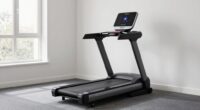
To stop bouncing on the treadmill, focus on landing softly beneath your hips rather than out in front. This cue helps you maintain proper posture, engage your core, and reduce vertical motion. Keep your head up, shoulders relaxed, and aim for a quick cadence of 170-180 steps per minute. By aligning your stride and staying mindful of this key point, you’ll run smoother and conserve energy—discover the other tips that can elevate your form further.
Key Takeaways
- Focus on maintaining an upright posture with your head up and shoulders relaxed to prevent excessive bouncing.
- Visualize landing softly beneath your hips, avoiding overstriding to minimize impact and vertical bounce.
- Increase your cadence to 170–180 steps per minute, promoting quicker, shorter steps that reduce bounce.
- Engage your core muscles to stabilize your torso and support smooth, controlled running motion.
- Use the cue “run tall and light” to remind yourself to keep posture aligned and minimize bouncing during treadmill runs.

Running on a treadmill can be an effective workout, but only if you maintain proper form. One common issue many runners face is bouncing or bouncing-like movement, which can lead to fatigue and even injury. The key to fixing this problem often comes down to your running posture and stride length. When you focus on these aspects, you can improve your efficiency and eliminate that unwanted bounce.
Your running posture is the foundation of smooth, controlled movement. To start, keep your head up and look forward, not down at your feet. This encourages a natural, upright alignment that helps distribute impact evenly across your body. Relax your shoulders and keep them down, avoiding tension that can throw off your balance. Engage your core muscles to support your spine, which stabilizes your entire running motion. When your posture is correct, your body moves with less wasted effort, and you naturally reduce unnecessary bouncing. Proper posture also enhances your overall stability and reduces the risk of injury.
Maintain an upright posture with your head up and shoulders relaxed to ensure smooth, efficient running.
Stride length is another critical element. If your stride is too long, you tend to overextend your legs, which can cause your heel to land heavily and create a jarring bounce. Conversely, if your stride is too short, you might be overcompensating by overusing your calves or thighs, leading to instability. Strive for a comfortable, natural stride length that allows your foot to land directly beneath your hips. This promotes a more efficient gait and decreases impact forces that contribute to bouncing. It’s important to avoid overstriding—landing with your foot too far in front of your body—since it can cause you to land heavily and bounce more.
A simple cue to help you fix your stride length and running posture is to focus on landing softly. Imagine your foot gently rolling from heel to toe with each step, landing beneath your hips rather than out in front. This encourages a quick, light cadence, which can help reduce bounce. Keep your cadence high—around 170 to 180 steps per minute—since a faster, shorter stride reduces the vertical motion that leads to bouncing. Think of your running as a smooth, controlled motion rather than a jarring, bouncing gait. Additionally, understanding proper running biomechanics can further refine your technique for optimal performance.
Incorporating these tips into your treadmill run can make a significant difference. Be mindful of your posture throughout your workout, and consciously adjust your stride length to keep your steps efficient and grounded. By focusing on these cues, you’ll find yourself running more smoothly, conserving energy, and eliminating that annoying bounce that can hinder your progress. Proper form isn’t just about avoiding injury; it’s about making every stride count.

Hydra Fitness Exchange Frame Guide 361253 Works with Pro-Form Treadmill
- Part Number: 361253
- Replacement Parts Guide: How to buy exercise equipment parts
- Compatibility Check: Verify compatibility in description
As an affiliate, we earn on qualifying purchases.
As an affiliate, we earn on qualifying purchases.
Frequently Asked Questions
How Long Does It Take to Correct Treadmill Bouncing?
It usually takes about a few sessions, or 1-2 weeks, to correct treadmill bouncing. You should focus on proper treadmill calibration and gait analysis to identify and fix your form issues. Consistently practicing the correct running posture, combined with professional calibration and gait adjustments, helps speed up the process. Stay patient and dedicated, and you’ll notice improvements in your stride and stability over time.
Can I Fix Bouncing Without Professional Help?
You can fix bouncing without professional help if you treat your treadmill like a delicate dance partner, paying close attention to its needs. Regular treadmill maintenance and understanding running biomechanics help you identify issues early, preventing bounce before it starts. Focus on proper form, tighten loose parts, and keep it clean. With patience and care, you’ll restore smooth running, turning a chaotic rhythm into a steady, harmonious stride.
Are There Specific Shoes That Help Prevent Bouncing?
Yes, specific running shoes, especially stability footwear, can help prevent bouncing while you run. Look for shoes with good arch support, firm midsoles, and a snug fit to minimize excessive vertical movement. Stability shoes are designed to control overpronation and provide extra cushioning, which can improve your form and keep you balanced. Choosing the right running shoes tailored to your gait makes a noticeable difference in reducing bouncing and enhancing comfort.
Does Bouncing Indicate a Serious Injury Risk?
Bouncing during your run can indicate an increased injury risk, especially if it’s severe or persistent. It often signals poor form or fatigue, which can strain your joints and muscles over time. Pay attention to bounce severity—mild bouncing might be manageable, but if it worsens, it’s a sign to adjust your technique or rest. Addressing this early helps prevent injuries and keeps your running safe and efficient.
How Often Should I Check My Treadmill Form?
You should check your treadmill form regularly, ideally every few runs or weekly if you’re consistent. During your gait analysis, focus on your posture, stride, and bounce. Proper footwear selection also plays a key role in maintaining good form. Pay attention to how your body feels and adjust your technique as needed to prevent injury and improve efficiency. Regular checks help you stay aligned and prevent bouncing or other issues.
Conclusion
So, next time you’re bouncing all over that treadmill, remember: it’s not your shoes, it’s your form. Just fix that one cue, and suddenly you’ll look like you’ve got gravity on your side—shocking, right? Who knew that a simple adjustment could transform your workout from a chaos-filled comedy to an elegant glide? Now go on, fix that bounce, and pretend you’re not secretly auditioning for a slapstick marathon.