
TL;DR

Get workout gear delivered free with Prime
- Fast, free delivery on millions of items
- Prime Video, Amazon Music and more included
- Member-only deals all year
Fit&Well published a five-exercise home circuit intended to prepare walkers for uneven surfaces by combining lower-body strength, balance and coordination drills. The routine uses 30-second intervals with short rests and recommends three circuits; the source does not report clinical testing or evidence that it prevents falls or injuries.
Fit&Well has published a five-exercise home workout designed to build lower-body strength and challenge balance and coordination for people who walk on uneven ground. The routine combines lunges, lateral steps, a single-leg deadlift, squats with calf raises and fast footwork, with the report recommending three circuits of timed work and short rests.
The workout grew out of a Fit&Well writer’s account of walking across the pebbles at Chesil Beach in Dorset, England. The writer described the 18-mile (29-kilometre) stretch as physically demanding and said the walk left the calves, thighs and glutes feeling worked. That experience prompted the question of whether some of the physical demands could be practiced at home without recreating the beach surface.
Fit&Well describes the circuit as a combination of strength exercises and balance drills. Its instructions call for each move to be performed for 30 seconds, followed by 15 to 20 seconds of rest before moving to the next exercise. Completing all five moves makes one circuit; the report suggests doing three circuits in total. Some exercises are timed on each side, so the instructions call for switching legs during the 30-second interval or repeating the move for the other side, as applicable.
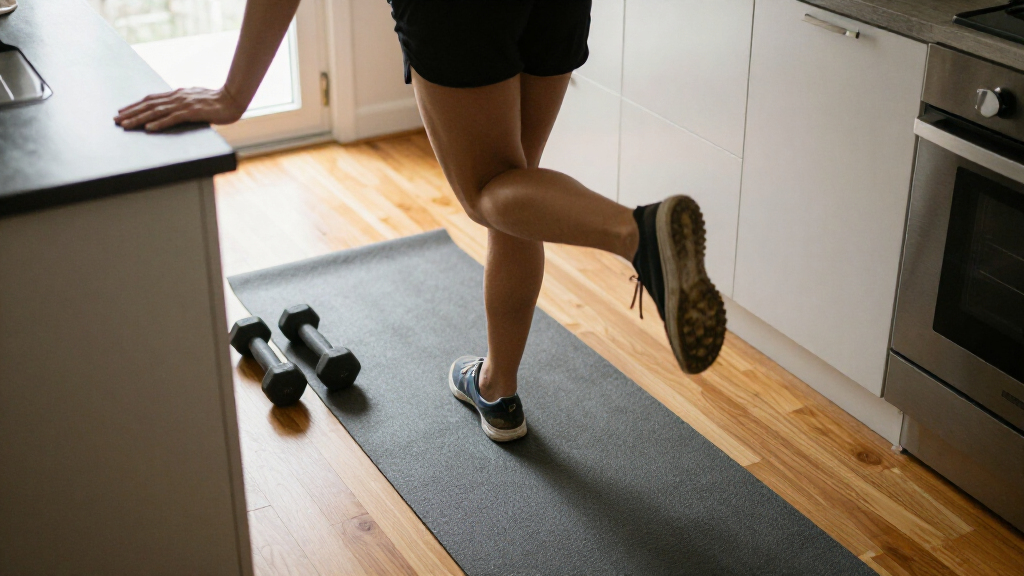
The five moves are a reverse lunge with knee drive, lateral skater steps, a single-leg deadlift, a squat followed by a calf raise, and fast feet. The deadlift can be done with body weight or a dumbbell. For the lateral skater move, people who want a lower-impact version can step from side to side instead of hopping. The report also suggests keeping a chair or wall nearby for support during the single-leg deadlift if needed.
How the Circuit Targets Trail Demands
The routine is aimed at movements that may be useful when a walking surface is uneven: shifting weight between legs, controlling a single-leg stance, moving laterally and adjusting foot placement. The Fit&Well report says uneven ground can make the muscles around the ankles, knees and hips work harder as the body adapts to changes underfoot. It also identifies balance, coordination and the core as part of that adjustment.
For readers, the practical value is a short, equipment-light routine that can be attempted at home, with options to reduce impact or use support. The exercises may help people practice some relevant movement patterns, but the source presents a workout suggestion rather than the results of a study. It does not establish that the routine improves walking performance, prevents falls or reduces injury risk. Those outcomes should not be treated as guaranteed.
The distinction matters because walking on pebbles, trails or other irregular surfaces involves conditions the circuit cannot fully reproduce. Surface movement, footwear, fatigue, weather and individual fitness all affect how a walk feels. The report offers an exercise plan inspired by one writer’s experience, not a tested substitute for walking practice or individualized advice.
Products Worth Considering

BowFlex Results Series SelectTech Dumbbells

BowFlex Results Series SelectTech 552 Adjustable Dumbbell

Garmin Forerunner 70 GPS Running Smartwatch, 43 mm, Black
As an affiliate, we earn on qualifying purchases.
From Chesil Beach to Home
The Fit&Well article begins with its writer’s weekend walk along Chesil Beach, described as an 18-mile (29-kilometre) coastline in Dorset. The writer says the loose pebbles made the outing feel more demanding than walking on a sidewalk or treadmill and were particularly noticeable in the calves, thighs and glutes afterward. This is a personal account, not a measured comparison of energy use or muscle activity.
From that experience, the report proposes exercises intended to work the muscles and movement patterns involved in staying steady. The circuit pairs lower-body movements with balance challenges: the lunge and knee drive and single-leg deadlift require control on one leg; the skater steps add side-to-side movement; the squat to calf raise combines a squat with rising onto the balls of the feet; and fast feet adds quick in-and-out steps.
The instructions allow some flexibility. A dumbbell is optional for the single-leg deadlift, and the lateral skater can be modified by stepping rather than jumping. The source does not give a required weight, a progression schedule, or a separate warm-up and cool-down plan.
“Every step felt like a turn on the Stairmaster.”
— Fit&Well report author
What the Workout Has Not Tested
The supplied report does not state that the circuit has been clinically tested, nor does it cite research showing that these five exercises make walking on uneven ground safer or easier. It also provides no outcomes data, such as changes in balance, strength, walking speed or fall rates. The claimed purpose is to train relevant strength and movement patterns; the degree of benefit for an individual is not established by the article.
It is also unclear how the exercises should be adjusted for people with injuries, balance limitations, joint pain or other health conditions. The source gives a support option and a lower-impact variation but does not offer individualized screening or specify when someone should stop. Anyone unsure whether the routine is suitable for them can seek guidance from a qualified health or fitness professional, particularly if they have a pre-existing condition or current injury.
How Readers Can Try the Routine
The article’s next step for readers is to follow the circuit as described: perform each exercise for 30 seconds, rest for 15 to 20 seconds, move through all five exercises and repeat until completing three circuits. The single-leg deadlift can be done without weight or with a dumbbell, and the skater steps can be performed without hopping. A chair or wall can provide nearby support for balance.
The source does not announce a follow-up study, a formal training program or a schedule for increasing the difficulty. Readers who try the circuit should treat it as a general exercise suggestion rather than a promise of results, and adapt or stop if a movement causes pain, dizziness or unusual discomfort. Any future claims about its effects would need supporting evidence beyond the personal beach-walk account and exercise instructions in the report.
Key Questions
What are the five exercises in the routine?
The circuit includes a reverse lunge with knee drive, lateral skater steps, a single-leg deadlift, a squat to calf raise and fast feet.
How many circuits does Fit&Well recommend?
The report recommends completing all five exercises, then repeating the circuit for a total of three circuits. Each move is timed for 30 seconds, with 15 to 20 seconds of rest between exercises.
Can the exercises be modified?
Yes. The single-leg deadlift can be done with body weight instead of a dumbbell, and the lateral skater can be performed by stepping rather than hopping. Fit&Well also suggests keeping a chair or wall nearby for support during the deadlift.
Does the report show that the routine prevents falls or injuries?
No. The supplied article describes the workout as a way to train strength, balance and coordination, but it does not provide research or outcome data showing that it prevents falls or injuries.
Source: rss