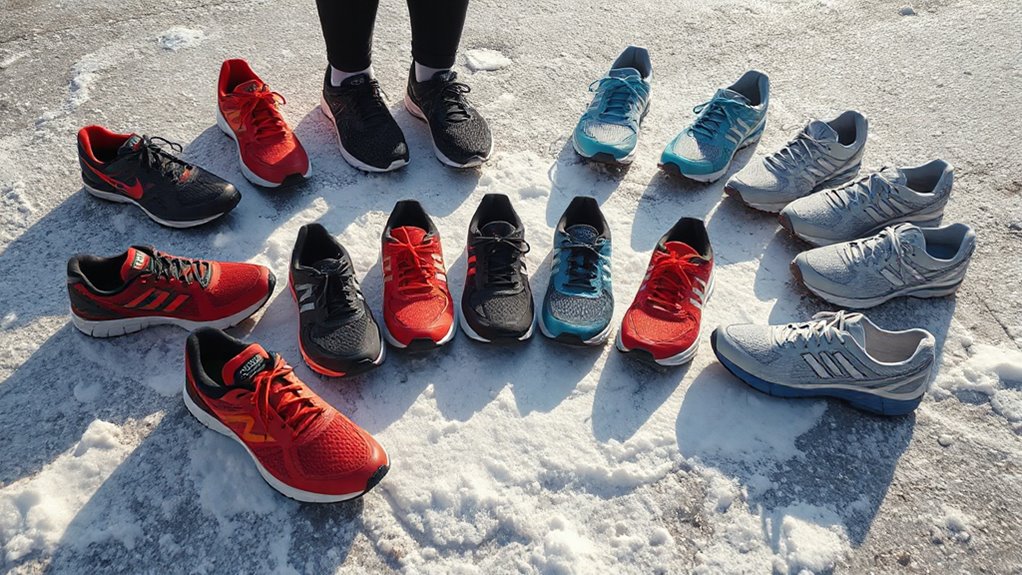
If you are searching for winter running shoes for icy roads, the main choice is whether you want a dedicated running shoe or a traction device to fit over footwear you already own. In this lineup, the current-generation Kahtoola NANOspikes are my leading pick for road runners who want low-profile tungsten-carbide spikes, while the first-generation NANOspikes remain a strong running-focused alternative. The Korkers Ultra Runner offers a broader stud layout and adjustable strap for mixed road and trail use.

Get workout gear delivered free with Prime
- Fast, free delivery on millions of items
- Prime Video, Amazon Music and more included
- Member-only deals all year
The Aliglow and Yaktrax options cost you less complexity in setup: both are slip-on cleats intended for general winter activity, not specifically tuned for running stride. That makes them better suited to walking or occasional short outings than to runners seeking a close, gait-friendly fit. Across all five, the tradeoffs are traction versus comfort on bare pavement, fit over different shoes, and how much confidence you need on packed snow or slick ice. None replaces a shoe with suitable warmth, fit, and weather protection.
Complete the kit

Key Takeaways
- For regular icy-road running, the current Kahtoola NANOspikes pair 10 tungsten-carbide spikes per foot with a low-profile design and a four-year warranty.
- The first-generation Kahtoola NANOspikes also use 10 tungsten-carbide spikes per foot, but the supplied details list a two-year warranty and fewer fit specifics.
- Korkers provides 16 replaceable carbide studs and an adjustable strap, making it the most adaptable pick for roads and trails, though one-size fit can be a gamble.
- Yaktrax Walk is a general-purpose slip-on cleat with steel coils and 360-degree grip; it is easier to frame as a winter-walking option than a dedicated running choice.
- Aliglow combines steel studs with a stretchable silicone harness and a stated temperature tolerance to -45°C, but fit limitations and stud contact on delicate surfaces deserve attention.
| Kahtoola NANOspikes Footwear Traction for Icy Winter Road Running & Walking |  | Best Overall for Regular Icy-Road Runs | Spike count: 10 tungsten-carbide spikes per foot | Temperature range: Down to -22°F (-30°C) | Size range: Women’s 5 to men’s 13+ | VIEW ON AMAZON | See Our Full Breakdown |
| Kahtoola 1st Gen NANOspikes Footwear Traction for Icy Winter Road Running & Walking |  | Best Running-Focused Alternative | Spike count: 10 spikes per foot | Spike material: Tungsten carbide | Temperature range: Down to -22°F (-30°C) | VIEW ON AMAZON | See Our Full Breakdown |
| Korkers Ultra Runner Traction Grips, One Size |  | Best for Roads and Trails | Studs: 16 replaceable push-through carbide studs | Fit: One size fits most; women’s 6 to men’s 14 | Weight: 4.5 oz per pair | VIEW ON AMAZON | See Our Full Breakdown |
| Yaktrax Walk Traction Cleats – 360-Degree Grip on Snow, Ice, & Multi-terrain Surfaces |  | Best for Winter Walking and Occasional Short Outings | Material: Thermoplastic rubber and zinc-coated steel coils | Coil thickness: 1.2 mm | Design: Elastic outer band with heel tab | VIEW ON AMAZON | See Our Full Breakdown |
| Aliglow Ice Cleats Crampons for Shoes and Boots – Snow Steel Traction Grips |  | Best for Deep-Cold General Outdoor Use | Size: L1, 5.8 x 9 in; women’s 10–13 and men’s 8–11 | Harness material: Silicone rubber thermoplastic elastomer | Stud material: Steel | VIEW ON AMAZON | See Our Full Breakdown |
| winter running shoes for icy road | Materials | Warranty | Included footwear |
|---|---|---|---|
| Kahtoola NANOspikes Footwear T | TPE elastomer and tungsten-carbide spikes | 4 years | Shoes not included |
| Kahtoola 1st Gen NANOspikes Fo | Dual-compound TPU and TPE | 2 years | Shoes not included |
| Korkers Ultra Runner Traction | Rubber and tungsten carbide | BOA components guaranteed for life; cleat system backed by Korkers Rock Solid Guarantee | Shoes not included |
| Yaktrax Walk Traction Cleats | — | — | — |
| Aliglow Ice Cleats Crampons fo | — | — | — |
More Details on Our Top Picks
Kahtoola NANOspikes Footwear Traction for Icy Winter Road Running & Walking
This is my first choice for a runner who expects to meet icy pavement often and wants traction without adding a bulky over-shoe system. The 10 tungsten-carbide spikes per foot are intended for icy and snowy surfaces, while the lightweight, low-profile build is meant to limit disruption to a natural gait. Compared with the Korkers Ultra Runner, it has fewer listed spikes but a more explicitly running-focused design and a stated size range from women’s 5 to men’s 13-plus.
The redesigned heel tab is a practical detail: easier on-and-off matters when you move between an icy route and clear pavement or a building entrance. Its stated temperature range reaches -22°F (-30°C), and the four-year warranty is longer than the two years listed for the earlier NANOspikes model. I would still match the harness carefully to the shoe; the listing says it is designed primarily for lightweight footwear, not every bulky winter boot.
That running-specific fit is the reason I rank it above the more adaptable Korkers and the general-purpose Yaktrax and Aliglow cleats. The tradeoff is that the spikes are meant for winter conditions, not dry or hot surfaces, and the shoes are sold separately. If your route alternates between long stretches of bare pavement and patches of ice, you may find repeated removal inconvenient, and traction elements should not be treated as a substitute for controlled pacing.
Pros:- 10 tungsten-carbide spikes per foot are specified for icy and snowy ground.
- Low-profile design aims to minimize gait disruption.
- Listed size range covers women’s 5 through men’s 13-plus.
- Four-year warranty is longer than the one listed for the older NANOspikes.
Cons:- Shoes are not included.
- Designed primarily for lightweight footwear, so bulky shoes may not fit well.
- Not suited to dry or hot surfaces.
Best for: Runners who regularly encounter icy roads and want a low-profile traction accessory with clearly stated sizing and a running-focused design.
Not ideal for: Anyone looking for a complete shoe, a fit over bulky footwear, or one traction setup for both icy routes and extended dry-pavement running.
- Spike count:10 tungsten-carbide spikes per foot
- Temperature range:Down to -22°F (-30°C)
- Size range:Women’s 5 to men’s 13+
- Materials:TPE elastomer and tungsten-carbide spikes
- Design:Lightweight, low-profile traction device
- Fit detail:Redesigned heel tab
- Warranty:4 years
- Included footwear:Shoes not included
Our verdict“I would choose the current NANOspikes first for frequent icy-road running, provided its lightweight-shoe fit matches your footwear.”
Kahtoola 1st Gen NANOspikes Footwear Traction for Icy Winter Road Running & Walking
The first-generation NANOspikes keeps the core feature that makes the newer model my overall pick: 10 tungsten-carbide spikes per foot in a product described for winter road running and walking. Its dual-compound TPU and TPE construction is specified for cold conditions down to -22°F (-30°C), so the listing directly addresses the weather this guide focuses on. For someone comparing the two Kahtoola versions, this model offers the same stated spike count and temperature floor.
Where it falls behind the newer NANOspikes is mainly in the supplied product detail. The current version lists a broader explicit size range, a redesigned heel tab, a low-profile description, and a four-year warranty; this one lists a two-year warranty and does not provide the same fit range. That does not prove a difference in on-foot performance, but it leaves a buyer with less information for checking compatibility. Both are traction devices, not shoes, and both require footwear that suits winter running.
I rank it above Korkers for buyers whose priority is a model expressly aimed at icy road running, rather than a wider road-and-trail role. Korkers brings 16 replaceable studs and an adjustable strap, which may appeal to mixed terrain, but the NANOspikes listing makes the intended use clearer. Its main limitation is the same one faced by every add-on in this roundup: a runner must remove or avoid it on unsuitable surfaces, and the shoe underneath still needs to fit, support, and protect the runner.
Pros:- 10 tungsten-carbide spikes per foot for icy and snowy surfaces.
- Explicitly described for winter road running and walking.
- Specified for temperatures down to -22°F (-30°C).
- Flexible dual-compound construction and reinforced eyelets are listed.
Cons:- Shoes are not included.
- The listed warranty is two years, shorter than the current NANOspikes listing.
- The supplied specifications do not state a size range.
Best for: Runners who want a specifically running-and-walking traction device with tungsten-carbide spikes and can confirm the fit for their shoes.
Not ideal for: Buyers who need a clearly stated broad size range, a longer listed warranty, or an included winter running shoe.
- Spike count:10 spikes per foot
- Spike material:Tungsten carbide
- Temperature range:Down to -22°F (-30°C)
- Materials:Dual-compound TPU and TPE
- Intended use:Icy winter road running and walking
- Fit details:Secure fit with reinforced eyelets and elastomer harness
- Warranty:2 years
- Included footwear:Shoes not included
Our verdict“I would choose this NANOspikes version when its running-focused design is the priority and its fit can be verified before purchase.”
Korkers Ultra Runner Traction Grips, One Size
Korkers takes a different route from the Kahtoola models: it uses 16 replaceable carbide studs rather than 10 spikes per foot and adds an adjustable stretch-fit strap. That combination makes it appealing to runners who move between icy roads and trails and want the option to replace studs instead of treating the traction surface as a fixed unit. At 4.5 ounces per pair, the listed weight is also useful context for anyone trying to keep an add-on light.
Compared with the current NANOspikes, Korkers looks more adaptable but less precise on fit information. Its stated range is one size for most, from women’s 6 to men’s 14, while Kahtoola supplies a more explicit size range and identifies a low-profile running-oriented design. An adjustable strap can help secure the grip over different footwear, but it does not guarantee a comfortable match for every shoe shape. The one-size approach is its central compromise.
I place it third because its replaceable studs and mixed-terrain role are meaningful advantages, but the two Kahtoola products are more directly described for icy road running. The Korkers listing includes a lifetime guarantee for BOA components and a Korkers Rock Solid Guarantee for the cleat system; these terms relate to the specified components, not a promise that the device suits every surface. Like other studded options here, it should not be left on for long stretches where traction elements are inappropriate, and the shoe is not included.
Pros:- 16 replaceable push-through carbide studs per pair are specified.
- Adjustable stretch-fit strap secures the grips over shoes or boots.
- Listed weight is 4.5 ounces per pair.
- Guarantees are specified for BOA components and the cleat system.
Cons:- One-size fit may not suit every footwear shape.
- Shoes are not included.
- The supplied details do not state a cold-temperature range.
Best for: Runners who split time between icy roads and trails and value replaceable studs plus an adjustable strap.
Not ideal for: Anyone who wants a highly tailored size selection or cannot accept the uncertainty of a one-size-fits-most design.
- Studs:16 replaceable push-through carbide studs
- Fit:One size fits most; women’s 6 to men’s 14
- Weight:4.5 oz per pair
- Materials:Rubber and tungsten carbide
- Attachment:Adjustable stretch-fit strap
- Dimensions:11 in long x 5 in wide
- Warranty:BOA components guaranteed for life; cleat system backed by Korkers Rock Solid Guarantee
- Included footwear:Shoes not included
Our verdict“I would pick Korkers over either NANOspikes model when replaceable studs and mixed road-trail use matter more than a more specific fit range.”
Yaktrax Walk Traction Cleats – 360-Degree Grip on Snow, Ice, & Multi-terrain Surfaces
Yaktrax Walk is the most clearly general-purpose option in this group. Its zinc-coated steel coils are described as providing 360-degree grip on snow, ice, and rocky terrain, and an elastic outer band with a heel tab is intended to make the cleats easier to put on and remove. For a household that needs winter traction for walking as well as occasional outdoor errands, that broad use may be more helpful than a running-specific spike layout.
For regular running, however, I would rank it below both Kahtoola models and Korkers. The product description centers on winter walks and multi-terrain stability rather than on maintaining a running stride, while coils are a different traction approach from the tungsten-carbide spikes on the NANOspikes and Korkers. The listing does not give a running-specific profile, spike count, or temperature range. That leaves less evidence for a buyer whose main requirement is repeated running on slick roads.
Its main attraction is easy on-and-off versatility, not specialized running performance. The elastic band may not suit very tight or very loose footwear comfortably, and steel coils can damage delicate surfaces if worn where they should not be. If you already own winter running shoes and only need an occasional walking cleat, Yaktrax is a sensible role-specific pick; if you run on ice frequently, I would spend more attention on fit and running-focused traction such as the Kahtoola options.
Pros:- Steel-coil design is described for 360-degree traction.
- Heel tab and elastic outer band support easier fitting and removal.
- Designed for snow, ice, and rocky terrain.
- Coils are specified as abrasion- and rust-resistant.
Cons:- The description focuses on walking rather than dedicated running.
- May fit very tight or very loose footwear poorly.
- Steel coils may damage delicate surfaces.
Best for: Walkers and occasional outdoor users who want an easy-to-remove cleat for snow, ice, and mixed terrain.
Not ideal for: Runners seeking a product explicitly designed around road-running stride, or buyers whose shoes are especially tight or loose.
- Material:Thermoplastic rubber and zinc-coated steel coils
- Coil thickness:1.2 mm
- Design:Elastic outer band with heel tab
- Traction:360-degree grip on snow, ice, and multi-terrain surfaces
- Resistance:Abrasion- and rust-resistant
- Use:Unisex winter traction
- Footwear included:No shoe included
Our verdict“I would choose Yaktrax for versatile winter walking, not as my first pick for regular icy-road running.”
Aliglow Ice Cleats Crampons for Shoes and Boots – Snow Steel Traction Grips
Aliglow is a broad-use ice cleat built around a stretchable silicone-rubber harness and steel studs. Its stated temperature tolerance reaches -45°C, colder than the temperature floors listed for either Kahtoola model. That makes the cold rating a notable point for buyers in severe winter conditions, although a temperature specification alone does not say how a cleat will feel during a run or how securely it fits a particular shoe.
Compared with Yaktrax, Aliglow uses individual steel studs rather than coils and is described for snow and ice traction across activities such as walking, hiking, and snow shoveling. Its stretchable fit may work across different shoes and boots, but the listed size is specific: L1 measures 5.8 by 9 inches and is given for women’s 10–13 and men’s 8–11. That is narrower than the broad one-size range stated for Korkers and less flexible on paper than an unspecified universal fit suggests.
I rank it fifth for this article because its evidence is strongest for general winter traction, not running. The Kahtoola products are expressly described for icy road running, while Korkers lists running and replaceable carbide studs. Aliglow’s steel studs may be useful on ice, but they can damage delicate surfaces, and stretchable silicone may wear with use. Choose it for walking or other outdoor chores in severe cold if the size matches; skip it if running fit and stride feel are your first concerns.
Pros:- Steel studs are intended to provide traction on snow and ice.
- Stated temperature tolerance reaches -45°C.
- Stretchable silicone material fits a range of shoes and boots.
- Lightweight, portable design suits varied outdoor tasks.
Cons:- The stated L1 size may not fit very small or very large footwear.
- Steel studs may damage delicate surfaces.
- Stretchable silicone may wear over time.
Best for: People who need a portable general-purpose cleat for walking, hiking, or outdoor chores in severe cold, within the listed size range.
Not ideal for: Runners seeking an explicitly running-focused traction device, or buyers outside the listed L1 shoe-size range.
- Size:L1, 5.8 x 9 in; women’s 10–13 and men’s 8–11
- Harness material:Silicone rubber thermoplastic elastomer
- Stud material:Steel
- Temperature tolerance:Up to -45°C
- Fit:Stretchable slip-on fit for shoes and boots
- Intended activities:Walking, hiking, and snow shoveling
- Portability:Lightweight and portable
Our verdict“I would reserve Aliglow for cold-weather walking and chores rather than choose it ahead of the running-specific Kahtoola or Korkers options.”

How We Picked
I ranked these options by how well their stated design fits the specific demands of running on icy roads, not by treating every traction accessory as a running shoe. A runner needs a secure attachment, grip that reaches the ground consistently, and a profile that does not feel needlessly cumbersome through repeated foot strikes. I also looked at whether the product details identify a running purpose, spike or stud material, cold-weather range, and fit information.
That distinction puts the two Kahtoola NANOspikes models ahead of the general-purpose cleats. Both are described for icy winter road running and walking and use tungsten-carbide spikes. The newer listing adds a low-profile design, a redesigned heel tab, a stated size range, and a longer warranty; the older listing remains relevant but gives less fit detail. Korkers ranks next because its 16 replaceable carbide studs and adjustable strap are useful for changing between road and trail conditions, though one-size sizing makes the fit less predictable.
I placed Yaktrax and Aliglow lower for running because the supplied descriptions focus on broad winter traction and general outdoor activity rather than a running-specific setup. Yaktrax emphasizes coils and 360-degree grip; Aliglow uses steel studs and stretchy silicone. Those traits can suit walking, but they do not by themselves establish how either cleat will feel during a running stride. I also weighed practical drawbacks: exposed traction elements may be unsuitable on delicate indoor or dry surfaces, elastic systems may wear or fit awkwardly, and none of these products includes the running shoe itself. I have not treated an accessory as a substitute for suitable footwear or as a guarantee against falls.
| winter running shoes for icy road | Materials |
|---|---|
| Kahtoola NANOspikes Footwear T | TPE elastomer and tungsten-carbide spikes |
| Kahtoola 1st Gen NANOspikes Fo | Dual-compound TPU and TPE |
| Korkers Ultra Runner Traction | Rubber and tungsten carbide |
| Yaktrax Walk Traction Cleats | — |
| Aliglow Ice Cleats Crampons fo | — |
Factors to Consider When Choosing Winter Running Shoes For Icy Roads
I would choose the traction system only after checking how much of the route is genuinely icy, what shoe it must fit, and how often I will move onto clear pavement.Start with the route, not the spike count
For a route with repeated icy patches, a running-specific profile matters at least as much as the number of spikes or studs. Both Kahtoola listings identify road running and walking as intended uses; Korkers also names running and supplies replaceable carbide studs. Yaktrax and Aliglow describe broad winter traction and outdoor activities, which makes them stronger candidates for walking than for frequent running. More traction elements do not automatically mean a better running experience: their placement, attachment, and interaction with the shoe all matter.
If your route is mostly clear with one short icy section, an over-shoe device may be a nuisance to keep taking on and off. If it is consistently icy, a dedicated traction setup may be more practical. I would still slow down on slick surfaces and avoid assuming any cleat can prevent every slip.
Match the harness to your shoe
Check the product’s stated sizing against the actual shoe you plan to wear, including its width and sole shape. The current NANOspikes lists women’s 5 through men’s 13-plus, while Korkers gives a one-size range of women’s 6 to men’s 14. Aliglow’s specified L1 covers women’s 10–13 and men’s 8–11, and Yaktrax warns that very tight or loose footwear may not fit comfortably. These are not interchangeable fit claims.
A harness that slips or sits unevenly can be a bigger problem than a modest difference in traction hardware. If you run in a bulky insulated shoe, check compatibility carefully: the current NANOspikes listing says it is designed primarily for lightweight footwear. The cleats in this roundup do not include shoes, so you remain responsible for warmth, cushioning, weather protection, and a secure underlying fit.
Think about bare pavement and indoor surfaces
Studs, spikes, and coils are meant for winter ground, not every surface you will encounter on a run. The current NANOspikes listing expressly says it is not suitable for dry or hot surfaces. The Aliglow and Yaktrax descriptions warn that their metal traction can damage delicate surfaces. Before crossing a long dry stretch, entering a building, or walking on a vulnerable floor, follow the product’s use guidance and remove the device when appropriate.
For a route that shifts often between ice and bare ground, the ease of removing a heel-tab design or adjustable strap can affect your routine. That convenience does not make every system equally comfortable to run in; try to confirm fit and practice with the attachment on a safe surface before relying on it outdoors.
Choose materials and maintenance for your winter
The NANOspikes and Korkers use tungsten-carbide traction elements, while Yaktrax lists zinc-coated steel coils and Aliglow lists steel studs. Korkers makes its 16 carbide studs replaceable, a practical distinction if serviceability matters to you. The two Kahtoola listings provide cold-temperature ranges down to -22°F (-30°C); Aliglow states a tolerance to -45°C. Yaktrax describes cold-resistant materials but does not give a numeric range in the supplied details.
After use, check that the harness remains secure and the traction elements are intact, then follow the manufacturer’s care directions. Elastic and stretch materials can wear, and metal parts should be checked for damage. Warranty terms differ: the current NANOspikes listing states four years, the first-generation model states two, and Korkers specifies guarantees for particular components. Read the applicable terms rather than assuming they cover every type of wear.
A traction accessory is not a winter shoe
Every option here attaches to footwear you already own. None supplies a complete winter running shoe, and traction hardware does not automatically provide warmth, water resistance, cushioning, or a stable fit. For cold-weather running, choose a shoe that fits well with enough room for winter socks and suits the conditions you face, then confirm the traction device fits that shoe without shifting.
I would also separate the decision to add traction from the decision to run. Fresh snow, refrozen slush, black ice, and exposed pavement behave differently; if a surface is beyond your comfort or control, changing the route or walking may be the safer call.
Frequently Asked Questions
Which option is most specifically suited to running on icy roads?
The two Kahtoola NANOspikes are the clearest running-focused choices because both product descriptions explicitly mention icy winter road running and walking. The current-generation listing adds a low-profile design, a stated size range, a redesigned heel tab, and a four-year warranty. Korkers also lists running as its sport and may suit mixed road-and-trail use, but its one-size fit is less tailored on paper.
Are these complete winter running shoes?
No. All five products are traction devices that fit over shoes or boots, and the Kahtoola listings explicitly state that shoes are not included. You still need footwear that fits properly and offers the warmth and weather protection you want. Check that the cleat or spike harness is compatible with that particular shoe before using it on a run.
Can I leave traction cleats on while running over dry pavement?
These options are designed for winter surfaces, not unrestricted running over dry pavement. The current NANOspikes listing specifically excludes dry or hot surfaces, while metal coils or studs can damage delicate surfaces. If your route alternates between ice and clear pavement, read the maker’s directions and plan for appropriate removal rather than assuming the traction device suits every section.
How should I decide between the two Kahtoola NANOspikes listings?
Both list 10 tungsten-carbide spikes per foot and a temperature range down to -22°F (-30°C). The current-generation listing gives a women’s 5 to men’s 13-plus size range, a low-profile design, a redesigned heel tab, and a four-year warranty. The first-generation listing specifies dual-compound TPU and TPE, reinforced eyelets, and a two-year warranty, but the supplied details do not include a size range. I would compare fit and the warranty terms before choosing.
Which option makes more sense for walking than regular running?
Yaktrax Walk and Aliglow are the more natural choices for general winter walking or outdoor tasks, based on their descriptions. Yaktrax uses steel coils and emphasizes 360-degree grip across snow, ice, and rocky ground; Aliglow uses steel studs, a stretchable silicone harness, and lists a temperature tolerance to -45°C. For regular running, I would give preference to the explicitly running-focused Kahtoola models or the running-oriented Korkers grips.
Conclusion
For regular icy-road running, I would start with the current Kahtoola NANOspikes: its low-profile design, stated size range, and running-specific purpose give it the clearest all-around fit in this comparison. Choose the first-generation NANOspikes if its fit suits your shoe and you want the same listed spike count and cold range in the earlier model. If your winter miles include trails as well as roads, Korkers Ultra Runner is the better match for replaceable carbide studs and an adjustable strap, with one-size fit as the main caveat.
For someone who mostly walks on snow or ice, Yaktrax Walk is the more natural general-purpose option. Pick Aliglow for cold-weather chores or walking when its L1 size fits and the stated -45°C tolerance matters more than a running-focused design. I would not treat either general-use cleat as the default for frequent running. In every case, match the device to your shoe, keep it for suitable winter surfaces, and remember that traction hardware cannot remove the need to judge conditions carefully.